A reassuring guide to understanding your child’s hand skills—from first grasps to confident coordination
The Moment That Caught You Off Guard
Your two-year-old is struggling to stack blocks that the neighbor’s toddler stacks effortlessly. Or maybe your four-year-old still can’t hold a crayon properly while their preschool friends are drawing recognizable shapes. You find yourself Googling at midnight: Is this normal? Should I be worried?
Here’s the thing about fine motor development: It follows a predictable path, but every child travels that path at their own pace. Some race ahead. Some take scenic routes. And most—the vast majority—arrive exactly where they need to be.
This guide will help you understand what’s typical, what’s variation, and what genuinely warrants a conversation with your pediatrician. No judgment, no pressure—just information to help you support your child’s development with confidence.
What Are Fine Motor Skills (And Why Do They Matter)?
Fine motor skills involve the small muscles in your child’s hands, fingers, and wrists—the ones that make precise movements possible. These skills require:
- Hand-eye coordination (eyes and hands working together)
- Hand strength (ability to grasp and manipulate)
- Bilateral coordination (using both hands together)
- Hand dominance (eventually preferring one hand)
Why they’re essential:
- Self-care tasks: feeding, dressing, brushing teeth
- Play and exploration: building, creating, manipulating toys
- School readiness: writing, cutting, using art supplies
- Communication: gestures, sign language, eventually typing
Think of fine motor skills as the foundation for independence. They’re how children learn to interact with and shape their world.
The Fine Motor Timeline: What to Expect
The CDC, in partnership with the American Academy of Pediatrics, updated developmental milestones in 2022 to reflect what 75% or more children can do by specific ages. This means milestones represent when most children achieve a skill—not when all children should.
Important note: These are based on full-term births. If your child was born prematurely, your pediatrician will adjust expectations based on their “adjusted age” (calculated from their due date, not birth date).
Birth to 3 Months: Reflexive Beginnings
What you’ll see:
- Reflexive grasp: Baby’s fingers close around anything touching their palm (this is automatic, not intentional)
- Hand-to-mouth movements: Brings hands to mouth, often during self-soothing
- Visual tracking: Watches their own hands move (hand regard)
- Batting at objects: Swipes at dangling toys, though often misses
What’s developing:
- Hand awareness (discovering they have hands!)
- Basic reach-and-swipe coordination
- Foundation for later intentional grasping
How to support:
- Place colorful objects within arm’s reach during tummy time
- Let baby explore their hands freely (avoid mittens unless medically needed)
- Offer rattles or soft toys that are easy to hold briefly
4 to 6 Months: Intentional Reaching
What you’ll see:
- Reaches for and grasps toys (intentional, not reflexive)
- Holds objects in palm using whole-hand grasp
- Transfers toys hand-to-hand (typically around 6 months)
- Rakes small objects toward themselves using all fingers together
What’s developing:
- Purposeful grasp (they’re now choosing to grab things)
- Beginning of object exploration (everything goes to the mouth for sensory input)
- Early bilateral coordination
How to support:
- Offer toys of different textures and shapes to grasp
- Place toys slightly out of reach during supervised floor play
- Let them explore safe household objects (wooden spoons, soft dish towels)
Red flag at this age:
- Hands persistently fisted after 3-4 months
- Not reaching for objects by 6 months
- Strong hand preference this early (can indicate weakness on one side)
7 to 12 Months: The Pincer Grasp Emerges
What you’ll see:
- Pincer grasp develops (thumb and forefinger) around 9-10 months
- Bangs objects together
- Puts objects into containers (and dumps them out repeatedly!)
- Points with index finger (typically by 12 months)
- Holds and drinks from cup with help
What’s developing:
- Refined grasp patterns (moving from palm to fingertips)
- Hand-eye coordination improving dramatically
- Cause-and-effect understanding
How to support:
- Offer small, safe finger foods to encourage pincer grasp (puffs, soft cooked vegetables)
- Provide shape sorters and simple containers for filling/dumping
- Let them practice self-feeding, even though it’s messy
- Introduce board books with sturdy pages they can turn
Red flag at this age:
- Not reaching, grasping, or exploring toys by 9 months
- Inability to transfer objects hand-to-hand by 12 months
- Not using fingers to pick up small items by 12 months
12 to 18 Months: Exploration and Independence
What you’ll see:
- Stacks 2-3 blocks (though they might fall quickly!)
- Scribbles spontaneously when given a crayon
- Turns pages in books (several at once is normal)
- Uses spoon with increasing skill (still messy)
- Removes simple clothing (pulls off socks, hat)
What’s developing:
- Precision and control increasing
- Problem-solving with hands
- Self-help skills emerging
How to support:
- Provide large crayons and paper for early scribbling
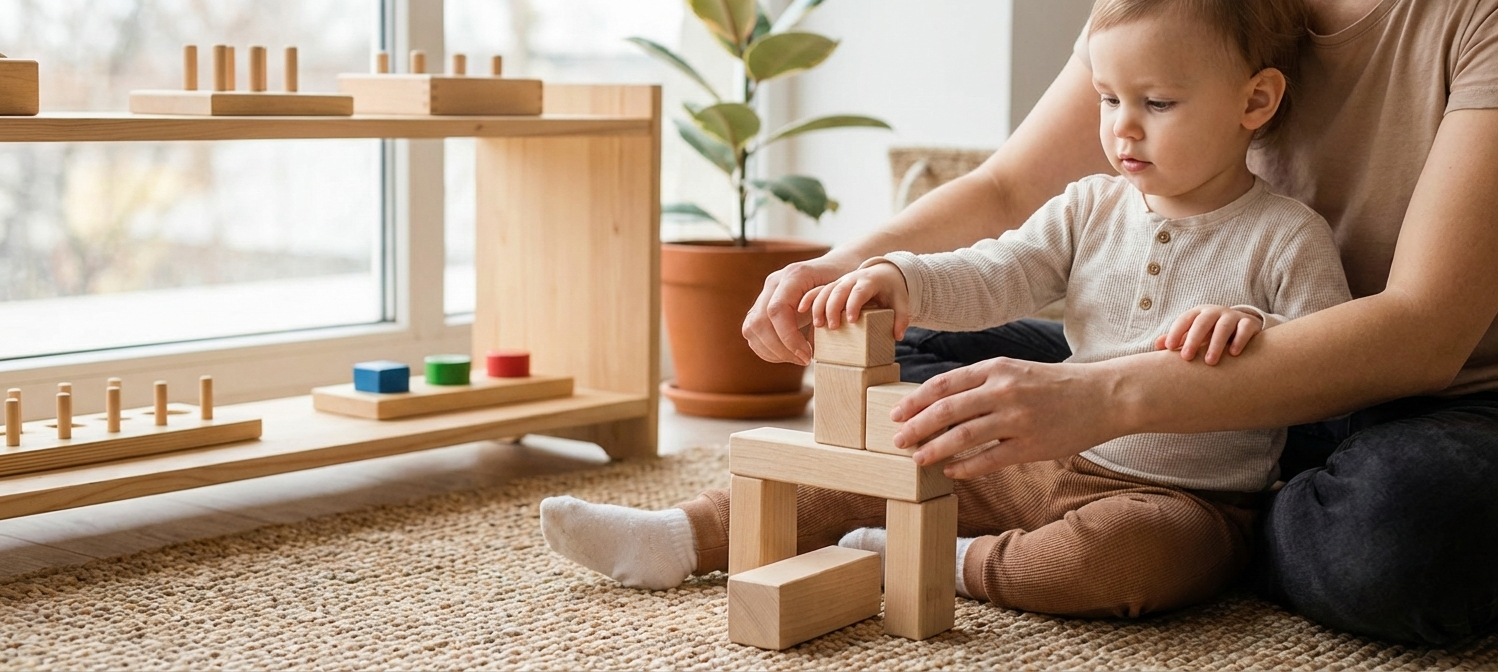
- Offer chunky wooden blocks for stacking
- Let them practice feeding themselves at every meal
- Give time and patience for dressing attempts
Typical variation:
- Some children are more interested in gross motor skills (walking, climbing) and develop fine motor skills a bit later
- Hand dominance might emerge, or might not be clear yet (both are normal)
18 Months to 2 Years: Building Confidence
What you’ll see (by 2 years):
- Stacks 4-6 objects with more precision
- Uses both hands for different tasks (holding container while putting items in)
- Turns book pages one at a time
- Uses hands to twist things like doorknobs or jar lids (simplified version)
- Scoops well with spoon during meals
What’s developing:
- Bilateral coordination (two hands working together in different ways)
- Rotation movements (twisting wrist)
- Tool use improving
How to support:
- Provide playdough or clay for squeezing and shaping
- Offer simple puzzles with knobs (2-4 pieces)
- Let them help with simple tasks: stirring, opening containers (supervision required)
- Introduce large beads for stringing (always supervised)
Red flag at this age:
- Not using hands to feed self by 18 months
- Unable to stack any blocks by 2 years
- Consistent one-handed use without using the other hand to assist
- Extreme difficulty manipulating toys
2 to 3 Years: Precision and Control
What you’ll see:
- Builds tower of 6+ blocks
- Turns pages one at a time in books
- Copies a vertical line when shown how
- Snips with scissors (single cuts, not cutting along a line yet)
- Threads large beads onto string
- Uses fork and spoon with less spilling
What’s developing:
- Hand strength increases significantly
- Visual-motor coordination refining
- Beginning of pre-writing skills
How to support:
- Offer wooden lacing toys or threading activities
- Provide child-safe scissors and paper for cutting practice
- Encourage drawing, scribbling, painting
- Let them help with meal prep: stirring, spreading, sprinkling
Typical variation:
- Some children prefer large muscle activities and engage less with fine motor tasks (both preferences are valid)
- Messiness is still very normal—precision takes time
3 to 4 Years: Emerging Coordination
What you’ll see:
- Draws circles and crosses (when shown)
- Builds towers of 9+ blocks
- Uses scissors to cut along a line (roughly)
- Strings small beads
- Copies simple shapes
- Buttons large buttons, zips large zippers
- Uses fork and spoon correctly most of the time
What’s developing:
- Pre-writing patterns (circles, lines, crosses)
- Self-help skills increasing (dressing with less help)
- Tool use becoming more refined
How to support:
- Offer puzzles with 12-20 pieces (interlocking)
- Provide opportunities for buttoning practice (button boards, dress-up clothes)
- Encourage art projects with varied materials
- Introduce simple board games with pieces to manipulate
Red flag at this age:
- Cannot stack 4+ blocks by 3 years
- Shows no interest in drawing or manipulating small objects
- Extreme difficulty with self-feeding or spills constantly
- Cannot turn individual pages in a book
4 to 5 Years: School Readiness Skills
What you’ll see (by 5 years):
- Draws recognizable pictures (people, houses, simple objects)
- Copies letters (some might be reversed—that’s normal)
- Cuts along a line with reasonable accuracy
- Uses fork, spoon, and sometimes table knife competently
- Dresses and undresses independently (except tricky fasteners)
- Ties simple knots (shoe-tying often comes later)
What’s developing:
- Fine motor skills necessary for kindergarten
- Hand dominance clearly established
- Pre-writing and writing skills
How to support:
- Provide opportunities for writing practice (letters, name, drawing)
- Offer games requiring precision (Operation, Pick-Up Sticks, board games)
- Encourage building with LEGOs or other construction toys
- Let them practice real-life skills: pouring, spreading, buttoning
Red flag at this age:
- Cannot copy a circle or draw simple shapes by 4 years
- Extreme difficulty with scissors
- Unable to dress self (except complex fasteners) by 5 years
- Cannot stack 8-10 blocks
- Avoids all fine motor activities consistently
Red Flags vs. Normal Variation: When to Act
It’s easy to worry, especially when you’re comparing your child to others. Here’s how to tell the difference between typical variation and genuine concern.
Normal Variation Looks Like:
- Child is developing some skills faster, others slower (common pattern)
- Interest level varies (loves building, less interested in drawing—that’s okay)
- Messiness and clumsiness within expected ranges for age
- Gradual but consistent progress over time
- Skills improve with practice and opportunity
Genuine Concerns Look Like:
- Child is significantly behind in multiple fine motor areas for their age
- Loss of previously acquired skills (regression is always concerning)
- Child avoids all fine motor activities due to frustration or inability
- Extreme difficulty with age-appropriate tasks despite practice
- Persistent use of only one hand when two-handed tasks are expected
- Child shows signs of pain or discomfort during hand activities
When to Talk to Your Pediatrician
Trust your instincts. You know your child best. If something feels off, it’s worth discussing—even if others aren’t concerned.
Schedule a conversation if:
- Your child isn’t meeting several milestones for their age
- You notice regression (losing skills they once had)
- Fine motor challenges are affecting daily life (eating, dressing, playing)
- Your child is significantly behind peers in multiple areas
- You’ve tried supporting development at home without progress
- Your child seems frustrated or aware of their difficulties
The American Academy of Pediatrics recommends:
- Developmental screening at 9, 18, and 30 months
- Autism screening at 18 and 24 months
- Ongoing developmental surveillance at every well-child visit
Important: Early intervention services are available for children birth to age 3 even without a formal diagnosis. You don’t have to wait to get help.
Factors That Influence Fine Motor Development
Fine motor skills don’t develop in isolation. Several factors can affect the timeline:
Prematurity
- Premature babies often develop fine motor skills on an adjusted timeline
- Pediatricians calculate “adjusted age” for developmental expectations
- Many premature infants catch up by age 2-3, though some need ongoing support
Muscle Tone
- Low muscle tone (hypotonia) makes grasping and manipulation harder
- High muscle tone (hypertonia) can limit hand flexibility and precision
- Both require evaluation and often benefit from occupational therapy
Sensory Processing
- Children with sensory sensitivities may avoid messy play, which limits practice
- Some children seek intense hand sensory input and need specific activities
- Sensory issues can affect motivation to engage in fine motor tasks
Vision
- Undetected vision problems significantly impact hand-eye coordination
- Children need clear vision to guide their hands accurately
- Vision screening is essential if fine motor delays are present
Opportunity and Practice
- Children need time and materials to practice fine motor skills
- Constant screen time limits hands-on exploration
- Overuse of containers with handles, sippy cups, or assistance can delay development
Underlying Conditions
- Developmental conditions (cerebral palsy, Down syndrome, autism, genetic disorders)
- Neuromuscular conditions (muscular dystrophy, spinal muscular atrophy)
- These require specialized evaluation and intervention
How to Support Fine Motor Development at Home
You don’t need expensive toys or special programs. Everyday activities provide rich opportunities for practice.
For Babies (0-12 months):
- Tummy time with toys just out of reach
- Offer varied textures to grasp (fabric, wood, silicone)
- Let them feed themselves finger foods
- Play games that encourage reaching and grasping
For Toddlers (1-3 years):
- Playdough, clay, or kinetic sand for squeezing and shaping
- Simple puzzles with chunky pieces
- Stacking cups, blocks, nesting toys
- Drawing with large crayons
- Helping with simple tasks (stirring, pouring, opening containers)
For Preschoolers (3-5 years):
- Art projects: cutting, gluing, painting, drawing
- Construction toys (blocks, LEGOs, magnetic tiles)
- Threading activities (beads, lacing cards)
- Dressing practice (buttons, zips, snaps)
- Real-life tasks: setting table, helping cook, gardening
General Principles:
- Offer opportunities, don’t force participation
- Let them be messy—that’s how they learn
- Celebrate effort, not just results
- Follow their interests (build on what they enjoy)
- Give time—rushing creates frustration
What Early Intervention Looks Like
If your pediatrician recommends evaluation, here’s what to expect:
The Process:
- Referral: You or your doctor contacts your state’s early intervention program
- Evaluation: A team assesses your child’s development (usually at home)
- Eligibility determination: Based on established criteria
- Service plan: Individualized based on your child’s needs
Who Might Help:
- Occupational therapists (OTs): Specialize in fine motor, self-care, and sensory skills
- Physical therapists (PTs): Focus on gross motor but often address hand-arm coordination
- Developmental therapists: Work on multiple skill areas
- Speech therapists: May address oral motor skills affecting feeding
What Therapy Includes:
- Play-based activities tailored to your child’s developmental level
- Parent education so you can practice at home
- Adaptive strategies if needed
- Progress monitoring with regular check-ins
The Reality:
- Most children see significant improvement with early intervention
- Therapy is usually 1-2 times per week depending on needs
- Many children “graduate” from services once they catch up
- Early intervention is most effective when started young
The Connection Between Fine Motor Skills and Play
This is where Montessori and Waldorf approaches shine. These philosophies recognize that children develop fine motor skills naturally through meaningful play.
Montessori Toys That Support Fine Motor Development:
For grasping and manipulation (6-18 months):
- Object permanence boxes
- Coin boxes (dropping items through slots)
- Shape sorters
- Simple peg boards
For precision and control (18 months-3 years):
- Wooden puzzles with knobs
- Stacking rings and nesting toys
- Simple lacing boards
- Threading large beads
For refinement and coordination (3-5 years):
- Advanced puzzles (interlocking, more pieces)
- Fine threading activities
- Practical life tools (pouring, spooning, tweezing)
- Buttoning and zipping frames
Why these work:
- Designed for repetition without pressure
- Self-correcting (child can see when it works)
- Natural materials provide rich sensory feedback
- Open-ended enough to match current skill level
Toys to Support Fine Motor Skills at Every Stage
Ready to add intentional fine motor support to your toy collection? Here are research-backed recommendations:
Infants (0-12 months):
- Best First Grasping Toys – Wooden rattles and safe teethers
- Object Permanence Boxes – Supporting cause-and-effect and hand-eye coordination
Toddlers (1-3 years):
- Complete Guide to Toddler Puzzles – Knob puzzles to early jigsaws
- Best Fine Motor Toys for 2-Year-Olds – Stacking, threading, and practical life activities
- Montessori Busy Boards – Multi-skill practice in one toy
Preschoolers (3-5 years):
- Fine Motor Montessori Toys – Threading, lacing, and precision activities
- Best Puzzles for Preschoolers – Building spatial reasoning and coordination
- Practical Life Tools for Kids – Real tasks that develop independence
Frequently Asked Questions
Q: My child is left-handed. Should I be concerned? Left-handedness is completely normal (about 10% of people are left-handed). Don’t try to change your child’s hand preference—this can interfere with development. Hand dominance usually becomes clear between ages 2-4, though some children switch between hands until age 5-6.
Q: My child holds their crayon with a fist. Is that a problem? At age 2-3, a fist grip is typical. By age 4, most children transition to a tripod grasp (thumb and two fingers). If your child is 5+ and still using a fist grip, occupational therapy can help establish more efficient patterns.
Q: Should I be worried if my child refuses messy play? Some sensory sensitivity is normal. However, if your child has extreme reactions to textures, avoids all messy play, or this affects daily life (won’t touch grass, food textures, won’t finger paint), discuss with your pediatrician. Occupational therapists specialize in sensory processing.
Q: My 4-year-old can’t write their name. Is that a delay? By age 5, most children can copy letters, and many can write their name. At age 4, this skill is still emerging. Focus on pre-writing activities (drawing shapes, coloring) and don’t stress about perfect letters yet.
Q: How much screen time affects fine motor development? The AAP recommends minimal screen time before age 2, and less than 1 hour daily for ages 2-5. Screen time replaces hands-on play, which is how children develop fine motor skills. Prioritize active, manipulative play.
Q: Can fine motor delays indicate autism? Fine motor delays can occur alongside autism, but they don’t indicate autism on their own. Autism involves social-communication differences, repetitive behaviors, and sensory sensitivities. If you’re concerned about autism, discuss comprehensive screening with your pediatrician.
The Bottom Line: Trust the Process (And Your Instincts)
Fine motor development unfolds gradually, predictably, but individually. Some children’s hands are quick and precise early on. Others take their time, focusing energy on running, climbing, or talking first.
What matters most:
- Progress over time (not perfection at every milestone)
- Multiple opportunities to practice (through play, daily routines, exploration)
- Your observations (you notice patterns professionals might miss)
- Early action when needed (waiting rarely helps genuine delays)
If you’re reading this because you’re worried, here’s permission to trust yourself. If something feels off, pursue evaluation. Early intervention doesn’t label or limit children—it gives them tools to thrive.
And if you’re reading this just to understand development better? Your child is lucky to have someone paying attention, offering opportunities, and meeting them where they are.
That’s what supports development best: not pressure, but presence.
Your Next Steps
If your child is developing typically:
- Continue offering varied play opportunities
- Introduce age-appropriate challenges gradually
- Enjoy watching their skills unfold
If you have mild concerns:
- Increase fine motor play opportunities at home
- Discuss observations at your next well-child visit
- Give it 4-6 weeks of focused practice, then reassess
If you have significant concerns:
- Schedule an appointment with your pediatrician soon
- Request developmental screening
- Contact your state’s early intervention program (for children under 3)
- Trust that early action is always better than waiting
Find your state’s early intervention program:
- Visit: cdc.gov/FindEI
- Or call your pediatrician for a referral
Download Your Free Fine Motor Milestone Tracker
Want an easy reference to track your child’s fine motor progress? I’ve created a printable Fine Motor Milestone Tracker with:
- Age-by-age milestones from birth to 5 years
- Space to note when your child achieves each skill
- Red flags to watch for
- Activity ideas for each developmental stage
Pinterest Pin Ideas for This Post
Pin 1: Timeline Style
- Title: “Fine Motor Milestones: Birth to 5 Years”
- Text on image: “What to expect at every age • When to worry • How to support development”
- Description: “Complete fine motor development timeline based on CDC milestones. Learn what’s typical, what’s variation, and when to seek help. Reassuring guide for parents. #childdevelopment #finemotorskills #parentingtips”
Pin 2: Reassurance Focused
- Title: “Is My Child’s Development Normal? Fine Motor Red Flags vs. Variation”
- Text on image: “Not all delays are concerning • Here’s how to tell the difference”
- Description: “Worried about your child’s fine motor skills? Learn the difference between normal variation and genuine delays. Plus when to talk to your pediatrician. #developmentalmilestones #parentingadvice”
Pin 3: Support Focused
- Title: “10 Ways to Support Fine Motor Development at Home”
- Text on image: “Simple activities for every age • No expensive toys needed”
- Description: “Support your child’s fine motor development through everyday play. Research-based activities from occupational therapists for ages 0-5. #finemotorskills #playideas #montessori”
This post is for educational purposes only and is not a substitute for professional medical advice. All developmental milestone information is based on current CDC and American Academy of Pediatrics guidelines.