A practical guide to keeping playtime fresh without buying more stuff
The Scene You Might Recognize
Your living room looks like a toy store exploded. There are puzzle pieces under the couch, blocks scattered across three rooms, and that shape sorter you bought last month? Your toddler walked past it fourteen times today without a single glance.
Meanwhile, you’re wondering: Did I buy the wrong toys? Is my child just not interested in learning through play? Should I get something new?
Here’s what’s probably happening: It’s not the toys. It’s the overwhelm.
When children have access to everything at once, they often engage with nothing deeply. This is where Montessori toy rotation changes everything—not by adding more, but by thoughtfully managing what’s already there.
What Toy Rotation Actually Means
Toy rotation is simple: You keep some toys accessible and store others out of sight. Every week or two (or month, depending on your child’s interest), you swap them out.
What it’s NOT:
- Hiding toys to create artificial scarcity
- A rigid schedule you must follow perfectly
- An excuse to buy organizing systems you don’t need
What it IS:
- Respecting your child’s capacity for focus
- Keeping play materials fresh and engaging
- Creating a calmer environment for everyone
The Montessori approach takes this further by emphasizing observation—watching what your child actually gravitates toward, rather than rotating on autopilot.
Why Toy Rotation Works (The Development Angle)
For toddlers and preschoolers:
When a child walks into a room with 40 toys visible, their developing brain faces decision fatigue before play even starts. They might:
- Flit from toy to toy without engaging
- Feel overwhelmed and ask for screen time
- Pull everything out, play with nothing, then melt down during cleanup
With fewer, intentionally chosen options:
- They can actually see and process what’s available
- They’re more likely to engage in sustained, focused play
- They have the mental space to use toys creatively
- Cleanup becomes manageable (for them AND you)
Think of it this way: Adults feel overwhelmed shopping at stores with too many choices. Children feel the same way about play spaces.
The Foundation: What to Keep Out (Always)
Before we talk about rotating, let’s establish what stays constant. These are the anchors in your child’s play environment:
1. Comfort Items
Loveys, special blankets, or that one stuffed animal they sleep with. These aren’t toys to rotate—they’re emotional anchors.
2. Gross Motor Equipment (if you have space)
Balance boards, climbing structures, or ride-on toys typically stay out because:
- They’re used differently than table toys (more physically, less cognitively overwhelming)
- They’re often too large to store easily
- Children use them for brief bursts throughout the day
3. Art Supplies (in accessible but limited quantities)
Crayons, paper, playdough—these support creative expression and are used differently than structured toys. Keep them accessible but contained (more on this in a future post).
4. One “Comfort Play” Option
This might be blocks, a favorite puzzle, or dolls—whatever your child consistently returns to for regulation and comfort. This shouldn’t rotate unless they’ve truly moved past it developmentally.
Everything else? Fair game for rotation.
How Many Toys Should Be Out at Once?
There’s no magic number, but here’s a helpful framework:
For Toddlers (1-3 years):
6-10 toys/activities visible at a time
This might include:
- 2-3 puzzles
- 1 stacking/nesting toy
- 1 matching or sorting activity
- 1 fine motor challenge (threading, lacing, pegboard)
- 1 pretend play item (doll, play kitchen item, vehicle)
- 1-2 books (rotate these too!)
For Preschoolers (3-5 years):
8-12 toys/activities visible at a time
This might include:
- 3-4 puzzles (varying difficulty)
- 1-2 building materials (blocks, magnetic tiles)
- 1-2 fine motor activities
- 1 early math/logic toy (counting rods, pattern blocks)
- 1-2 pretend play items
- 2-3 books
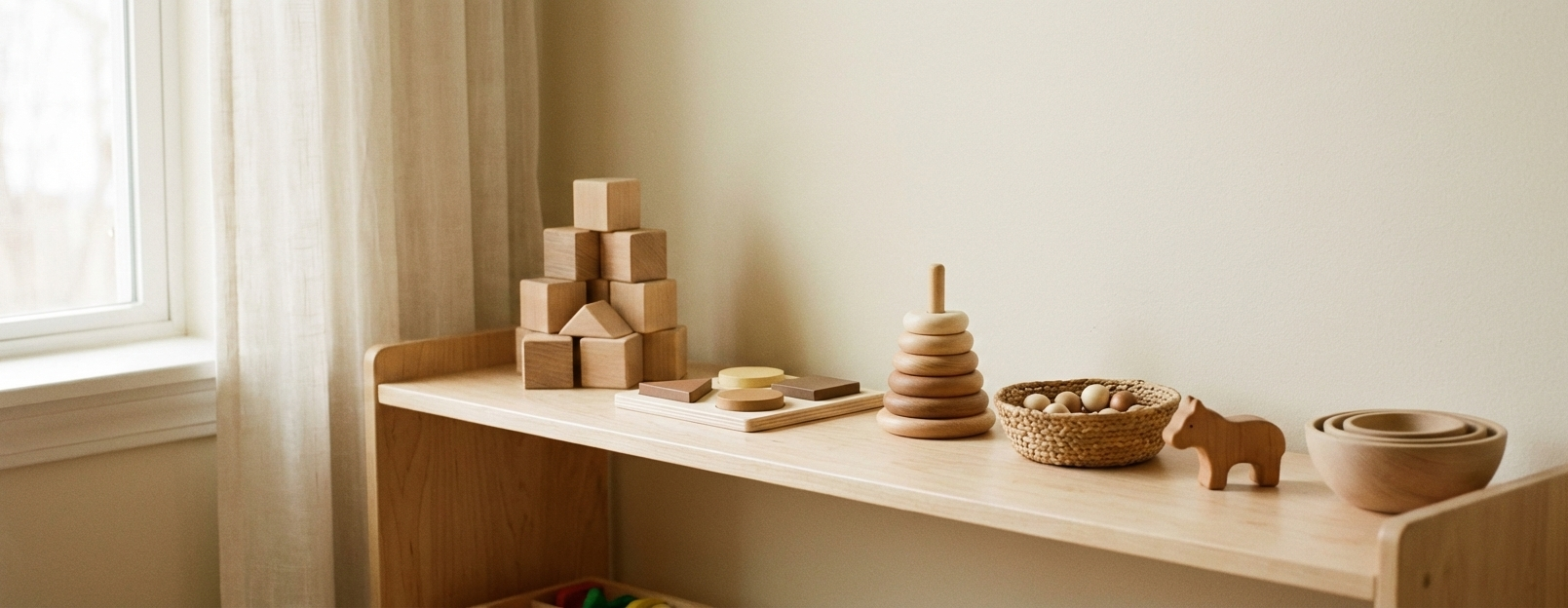
The real test: Can your child see and identify each toy without searching? If the shelf looks cluttered to you, it probably feels overwhelming to them.
The Observation-Based Rotation Method (Not Just Random Swapping)
Here’s where Montessori gets practical. You’re not rotating on a schedule—you’re rotating based on what you notice.
Step 1: Watch for These Signs
Time to rotate OUT:
- ✅ Your child walks past a toy repeatedly without playing
- ✅ A toy hasn’t been touched in 3-5 days
- ✅ The activity seems too easy (they complete it instantly without thought)
- ✅ The toy gets pulled out but discarded within 30 seconds
Time to rotate IN:
- ✅ Your child has mastered a skill and might enjoy a challenge
- ✅ You notice a new interest emerging (suddenly fascinated with pouring, stacking, animals)
- ✅ A seasonal activity becomes relevant (outdoor toys in spring, cozy puzzles in winter)
- ✅ They ask about a toy that’s been stored
Step 2: Swap Thoughtfully, Not Randomly
Don’t just swap:
- Puzzle for puzzle
- Block set for block set
Instead, think about:
- Skills: If fine motor toys are getting lots of use, keep those prominent
- Interests: If they’re obsessed with animals, rotate in animal figurines or puzzles
- Challenge level: Swap an easy puzzle for one that’s slightly harder
- Balance: If everything out is quiet/focused, consider adding something more active
Step 3: Introduce “New” Toys Properly
When you rotate a toy back in after a break:
- Place it on the shelf without fanfare (let them discover it)
- OR sit together and demonstrate it once, then step back
- Avoid: “Look what I got out for you! Isn’t this fun?!”
The Montessori principle: Let the toy do the inviting. Your enthusiasm can sometimes create pressure rather than interest.
Practical Storage Solutions (No Pinterest Perfection Required)
You don’t need an Instagram-worthy setup. You just need functional storage that works for your space.
What Works Well:
Bins/Baskets in a Closet
- Label with pictures (for you AND your child)
- Group by type: puzzles together, building toys together, pretend play together
- Stack bins if needed (just make sure you can actually reach them)
Under-Bed Storage
- Flat bins work great for puzzles and board games
- Out of sight but accessible when you need to swap
Hall Closet or Guest Room
- If you have the space, dedicate one shelf or area to rotated toys
- Keeps them truly out of sight and out of mind
What to Avoid:
- ❌ Storing toys where your child can see but not reach them (creates frustration)
- ❌ Systems so complicated you won’t maintain them
- ❌ Clear bins if they’re visible (defeats the “out of sight” purpose)
The goal: You should be able to complete a toy rotation in 5-10 minutes without moving furniture or creating chaos.
Creating Your Rotation System (Start Small)
Week 1: Baseline Assessment
Don’t change anything yet. Just observe:
- What does your child play with most?
- What gets ignored?
- What time of day do they engage most deeply?
- Where do they play (at table, on floor, in multiple rooms)?
Take notes. Seriously. You think you’ll remember, but you won’t.
Week 2: First Rotation
Choose 3-5 toys that have been ignored and store them. That’s it.
Notice what happens:
- Does your child ask for the removed toys? (If so, bring them back—you misread the interest)
- Does the space feel calmer?
- Do they engage more deeply with what remains?
Week 3: First Swap
Based on your observations, rotate 2-3 toys back in and remove 2-3 others.
Ask yourself:
- What skill are they working on right now?
- What have they mastered that can be stored?
- What might support their emerging interests?
Ongoing: Every 2-4 Weeks
As you get comfortable, you’ll develop a rhythm. Some parents rotate weekly; others rotate monthly. There’s no wrong answer.
The only rule: If your child is deeply engaged, don’t rotate just because it’s “time.” Follow their lead.
Common Rotation Challenges (And Solutions)
“My child asks for a stored toy”
Solution: Get it out. Rotation serves your child’s development, not an abstract system. If they’re asking for something, their brain is telling you they’re ready to engage with it.
“I rotated out a toy and now my child wants ONLY that toy”
Solution: This is normal. The “forbidden fruit” effect. Either:
- Get it back out and learn that this toy isn’t ready to be stored yet
- OR let them experience the feeling of wanting something and not having it immediately available (a valuable experience, as long as you’re not doing this intentionally to manipulate)
“My child dumps out all the stored toys when they find them”
Solution: This means:
- Storage isn’t truly inaccessible, OR
- You have too many toys total (consider donating/consigning), OR
- They’re seeking novelty because what’s out isn’t engaging
“I don’t have anywhere to store toys”
Solution:
- Start with just 3-5 toys rotated out in a closet or under-bed bins
- Consider whether you have more toys than your space can handle (it’s okay to reduce the total collection)
- Use vertical space—high closet shelves work fine since your child won’t access them
“This feels like too much work”
Solution: You’re probably overthinking it.
- Rotation doesn’t have to be weekly
- It doesn’t have to be perfect
- Even rotating out 3 toys once a month is better than overwhelming chaos
If it feels like work, simplify your system.
The Seasonal Rotation Bonus Strategy
Beyond regular rotation, consider these natural refresh points:
Spring: Rotate in outdoor toys, gardening tools, nature exploration items
Summer: Water play, gross motor toys, art supplies for outdoor use
Fall: Cozy puzzles, building sets, early learning activities
Winter/Holidays: Then rotate most back OUT in January (post-gift influx)
Birthdays: Before birthday parties, rotate out 5-10 toys to make space for new gifts. This prevents overwhelm and helps you assess what you actually need vs. what can be donated.
How to Know It’s Working
You’ll notice:
- ✅ Your child plays with toys more deeply, for longer periods
- ✅ They’re able to choose an activity without wandering aimlessly
- ✅ Cleanup is faster (for both of you)
- ✅ The play space feels calmer
- ✅ You’re not constantly feeling pressure to buy new toys
You might also notice:
- Your child plays with “old” toys in new ways after a break
- They combine toys more creatively (because they can actually see their options)
- They ask to help with rotation (a sign they’re understanding the system)
The 80/20 Rule for Toy Rotation
Here’s the truth most organizing guides won’t tell you:
80% of engagement will come from 20% of your toys.
Once you’ve been rotating for a month or two, you’ll identify this core 20%:
- The puzzles they return to again and again
- The blocks that anchor every play session
- The dolls or vehicles that support their imaginative world
Here’s what to do with this information:
- Keep that 20% accessible (or rotate it very slowly)
- Rotate the other 80% more freely
- Consider whether you actually need all of the 80% (probably not)
This is how you end up with a genuinely curated collection rather than just organized clutter.
When to Let Go of Toys Entirely
Rotation helps you identify what’s truly valued. After 3-4 months, if a toy hasn’t been requested or played with despite multiple rotations:
Consider:
- Is this toy developmentally mismatched? (Too easy, too hard, or just not interesting to this particular child)
- Did I buy this because I thought it was educational, but my child isn’t drawn to it?
- Am I keeping this out of guilt? (“It was expensive” / “It was a gift”)
It’s okay to:
- Donate toys your child has outgrown
- Consign toys in good condition
- Pass along to younger siblings or friends
- Keep just a few special items for sentimental reasons
A smaller collection that’s actually used is far more valuable than a large collection that creates stress.
Your Simple Starting Point (This Week)
Don’t try to overhaul everything at once. Just try this:
Today:
- Count how many toys are currently visible/accessible
- Observe what your child plays with between now and bedtime
This Weekend:
- Choose 3 toys that haven’t been touched in days
- Store them in a closet or under-bed bin
- Notice the difference in the space
Next Week:
- Rotate 2 toys back in if your child seems ready
- Keep 2-3 stored for another week
- Notice what happens
That’s it. You’re rotating toys.
The Bigger Picture
Toy rotation isn’t really about toys. It’s about:
- Creating space for focus
- Respecting your child’s capacity to choose
- Building an environment that supports deep play
- Reducing the mental load (for both of you)
When you rotate thoughtfully, you’re not limiting your child—you’re giving them the freedom to actually engage with what’s in front of them.
And here’s the bonus: Once you start rotating toys, you’ll probably realize you don’t need nearly as many as you thought. Which means less to clean up, less to store, and less pressure to constantly buy new things.
That’s the real Montessori magic: Less overwhelm, more engagement.
Questions I Hear Often
“Isn’t this just manipulating my child into thinking old toys are new?”
Not exactly. You’re managing the environment to support focus—the same way you wouldn’t leave every book you own scattered on the floor. The toys aren’t “new,” but the renewed interest is genuine because your child’s brain has had a break and is ready to engage again.
“What if my child has a favorite toy that they want out all the time?”
Keep it out! Rotation serves your child, not an arbitrary system. If something is consistently beloved, it’s telling you it’s developmentally perfect for this moment.
“How is this different from just having fewer toys?”
It’s similar, but rotation gives you flexibility. Some families do well with a permanently minimal collection (10-15 toys total). Others benefit from rotation because children’s interests change rapidly. Do what works for your family.
What’s Next
Now that you understand how rotation works, you might be wondering: Okay, but what toys should I actually have in my collection?
That’s where the rest of Natural Play Finds comes in. I curate Montessori and Waldorf toys that are worth having in your rotation—the ones that actually support development and engage children through multiple stages.