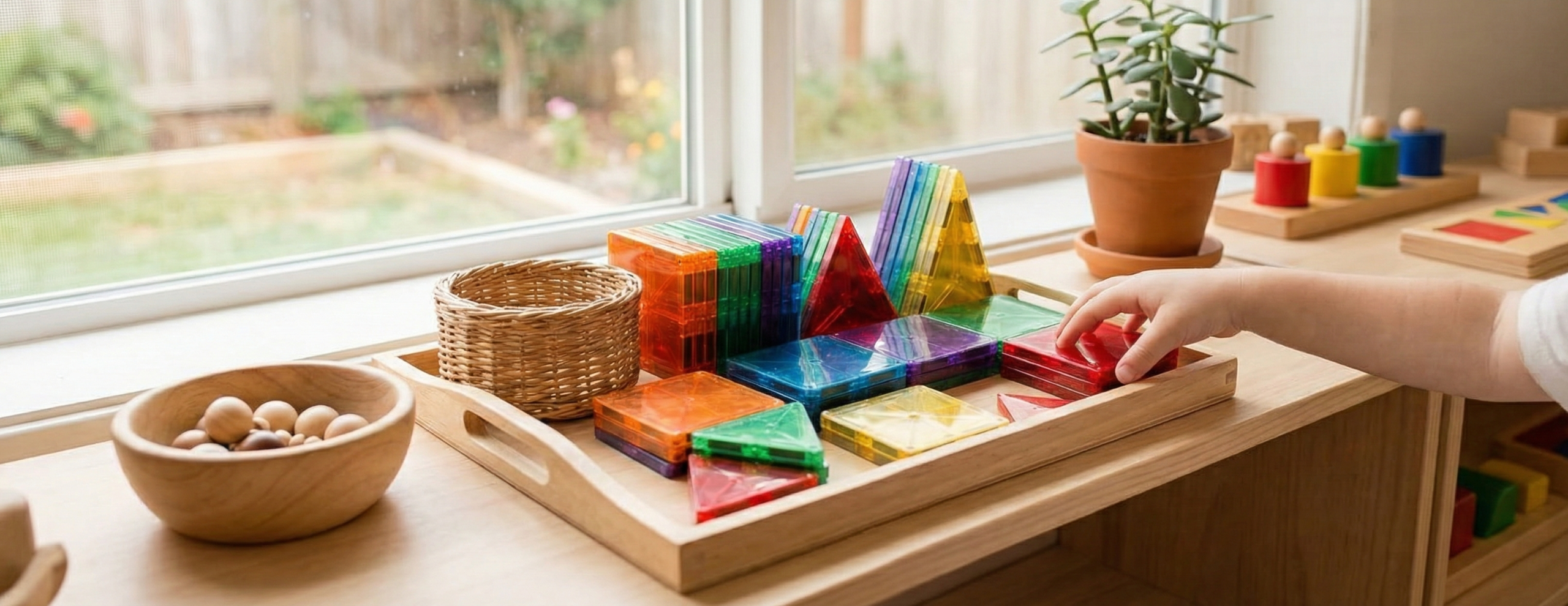
You bought the Magna-Tiles. Your child loved them for the first week. Then it became “build tower, knock down tower, repeat.”
You’re wondering: Is this it? Did I just spend $100+ on something that’s already getting boring?
Here’s what’s actually happening: your child has mastered basic stacking. That’s developmental progress. Now they’re ready for the next challenge—they just don’t know what that looks like yet.
The tiles aren’t the problem. The invitation is.
Magna-Tiles are one of those rare materials that can genuinely grow with a child from toddlerhood through early elementary years. But that only happens when we offer new ways to engage with them—not by directing play, but by preparing invitations that spark curiosity.
Let me show you what that looks like.
Why Magna-Tiles Work (When Used Well)
Before we get into activities, it helps to understand why these tiles are worth the investment.
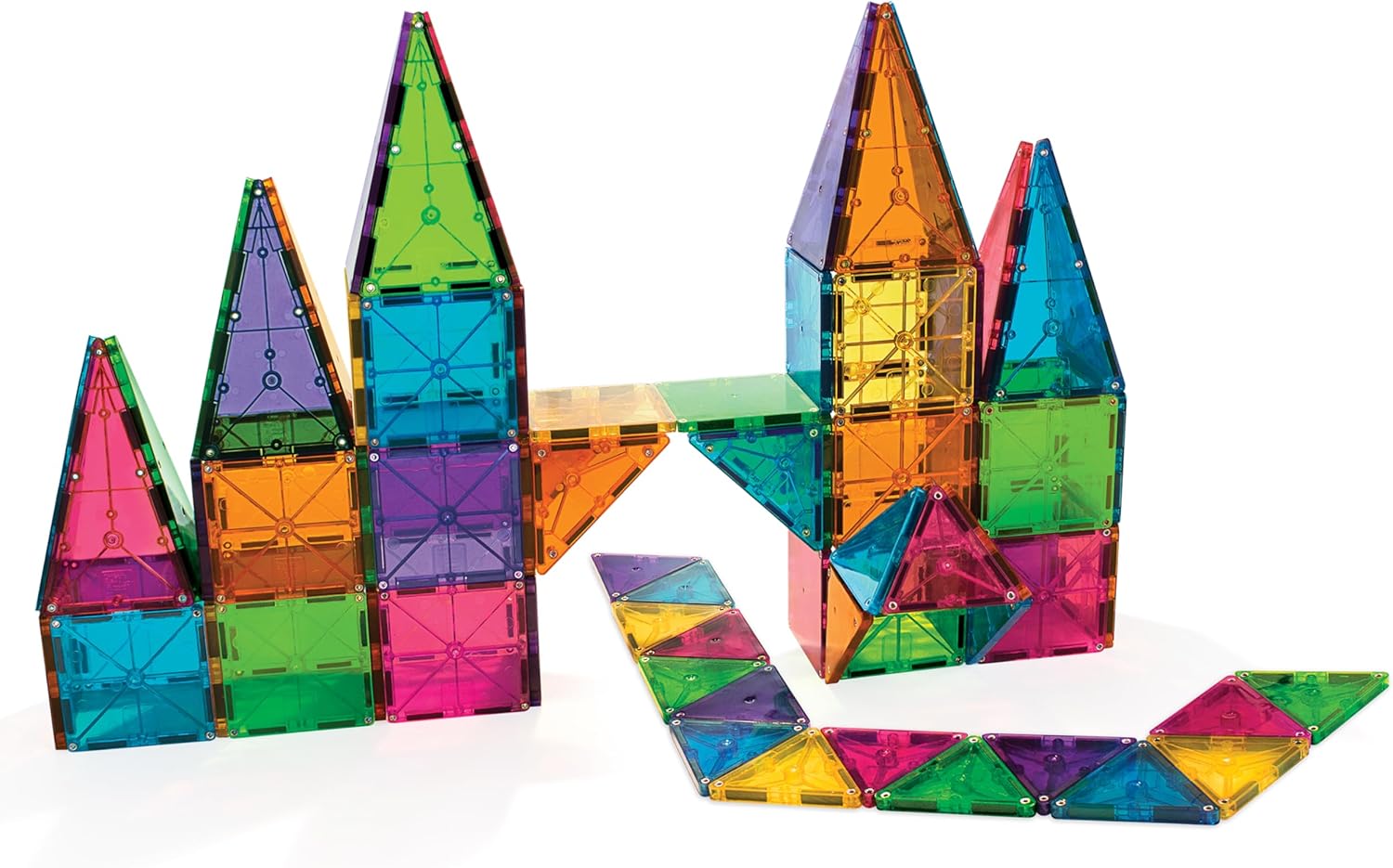
They’re self-correcting through physics.
Build something unstable? It falls. The material itself provides feedback. No adult needed to say “try again.”
They isolate spatial reasoning.
Understanding how 2D shapes become 3D structures is foundational for math, engineering, and problem-solving. Magna-Tiles make this tangible.
They reward experimentation.
The magnetic connection is forgiving. Structures hold together better than regular blocks, which means less frustration and more sustained focus.
They’re genuinely open-ended.
A two-year-old stacks them flat. A four-year-old builds elaborate castles. A six-year-old creates symmetrical patterns. Same material, completely different cognitive work.
But here’s the key: open-ended doesn’t mean aimless.
Children benefit when we prepare invitations that introduce new possibilities without dictating outcomes. That’s what these five setups do.
Amazon Affiliate Link: https://amzn.to/3ZocxBq
1. Light Table Exploration
What you need:
- Magna-Tiles (any set)
- Light source: light table, window with strong sunlight, or large tablet/iPad with white screen
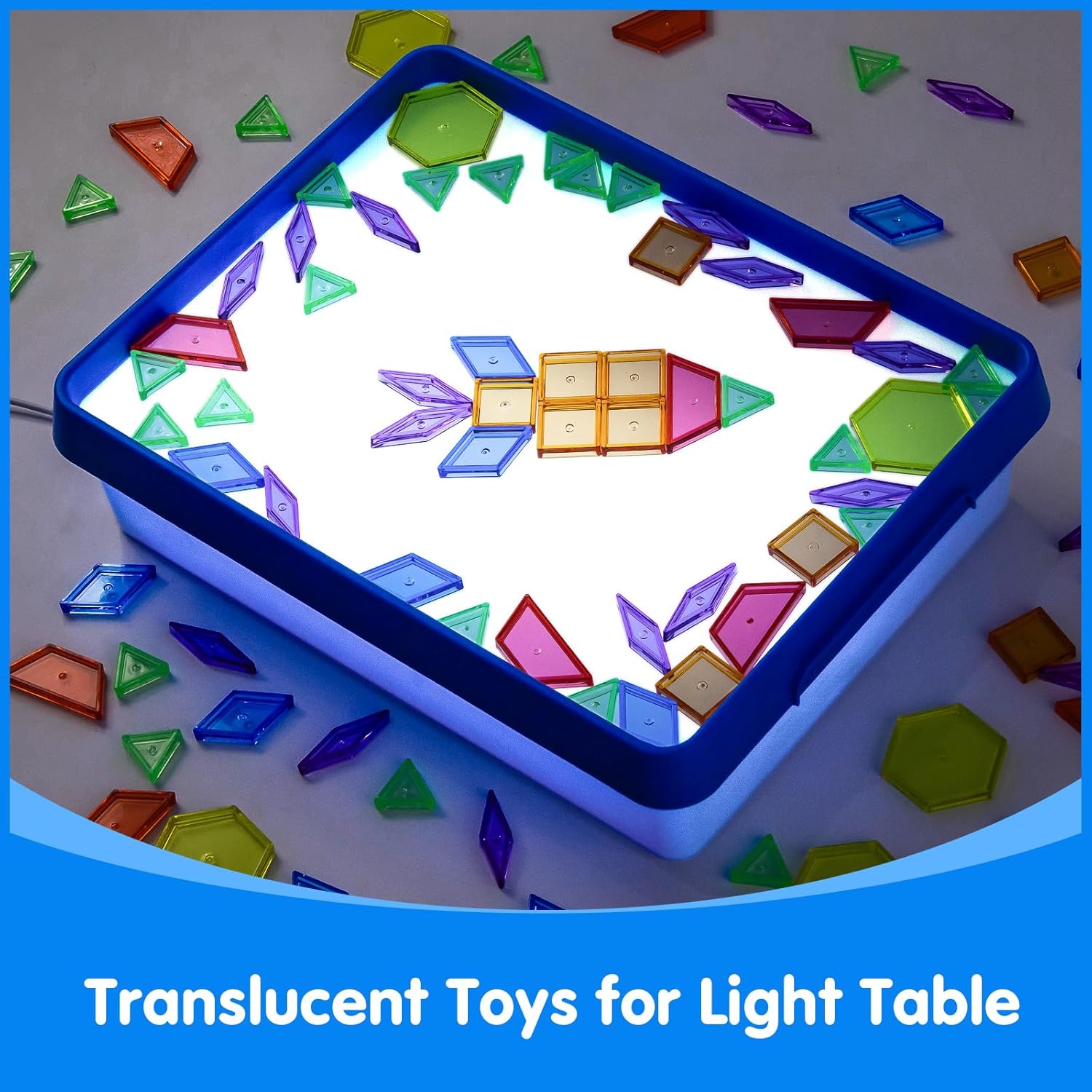
The setup: Place tiles on or against the light source. Step back.
Why this works: Light transforms the tiles completely. Suddenly, they’re not just building materials—they’re color mixers, pattern makers, stained glass windows.https://amzn.to/49FuykH
Children notice things they’ve never seen before: how colors overlap to create new colors, how light passes through transparent materials, and how shadows form. The cognitive shift from building to observing is significant.
This tends to invite quieter, more focused play. Children arrange and rearrange, watching how light changes with each configuration.
Amazon Affiliate Link: https://amzn.to/49FuykH
Age variations:
- 18 months – 2 years: Simply placing tiles on light, observing colors
- 3-4 years: Creating patterns, noticing color mixing (blue + yellow = green)
- 5-6 years: Designing symmetrical patterns, experimenting with layering
Developmental focus: Visual discrimination, cause and effect, color theory, focused attention
2. Flat Pattern Cards
What you need:
- Magna-Tiles
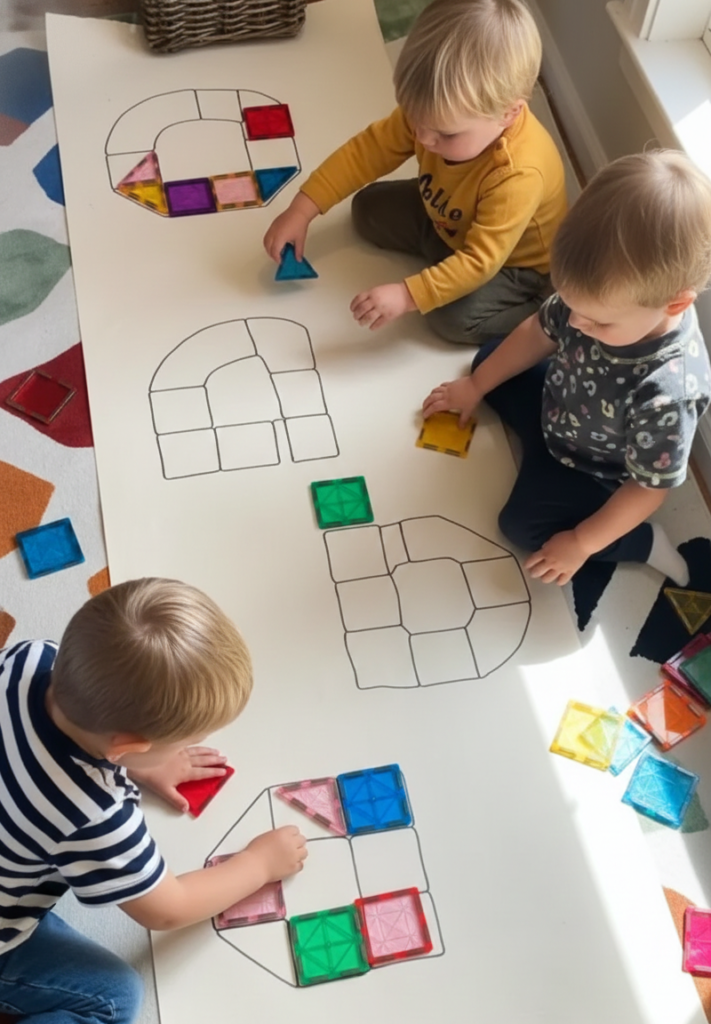
- Pattern cards (you can draw simple designs or print free templates online)
- Flat surface
The setup: Lay out pattern cards showing 2D designs (simple shapes, animals, objects). Child recreates the patterns flat on the table or floor.
Why this works: This introduces visual-spatial planning and one-to-one correspondence. The child must analyze the image, identify which shapes they need, and place them precisely to match.
It’s essentially puzzle-solving, but with tiles they already know how to manipulate. The familiarity of the material lets them focus entirely on the new challenge: accurate replication.
Start absurdly simple—three tiles making a house shape. Complexity can increase as skills develop.
Why this matters developmentally: Before children can build complex 3D structures, they benefit from mastering 2D spatial relationships. This is foundational work, not busy work.
Age variations:
- 2-3 years: Matching 3-4 tile simple shapes (house, tree)
- 4-5 years: More complex patterns (animals, vehicles) with 6-10 tiles
- 5-6 years: Creating their own pattern cards for others to follow
Developmental focus: Visual-spatial skills, pattern recognition, fine motor precision, focus
3. Building with Small World Figures
What you need:
- Magna-Tiles
- Small figures: animals (Safari Ltd, Schleich), people figures, or small vehicles
- Optional: felt or play silks for ground cover
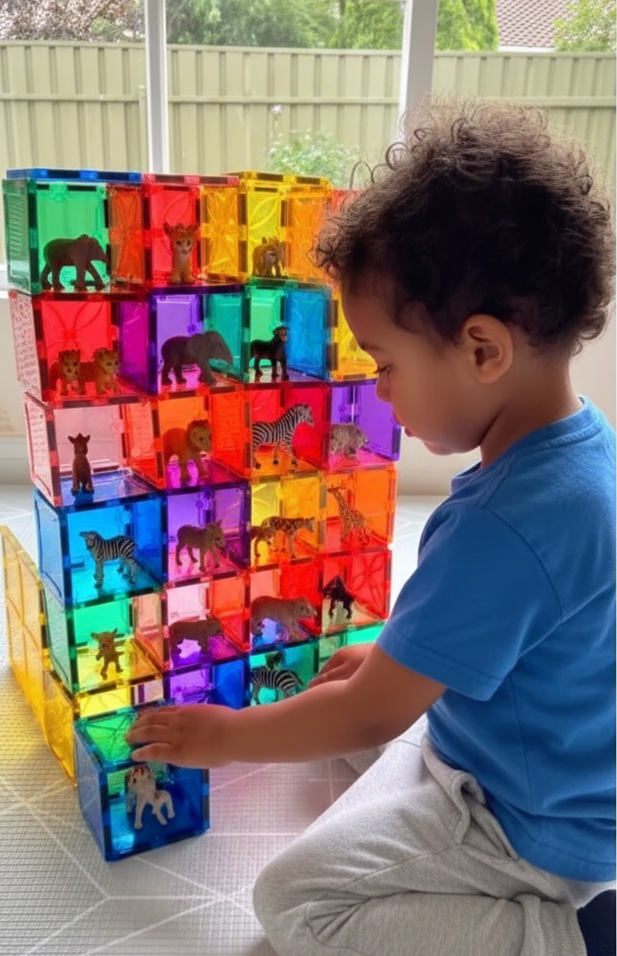
The setup: Instead of building for its own sake, invite building for a purpose: homes for animals, garages for cars, enclosures for a zoo, castles for figurines.
Why this works: Purposeful building requires different thinking than free building. Now the structure needs to serve a function. Is the doorway big enough for the elephant? Does the roof need to be taller so the giraffe fits?
This integrates imaginative play with engineering challenges. The child must solve real problems: stability, size, access, and enclosure.
Children often return to these structures over days, modifying and expanding as their play narratives develop.
What you might observe:
- Initial building (problem-solving phase)
- Play with figures inside structures (imaginative phase)
- Modifications based on play needs (“the horse needs a window”)
- Eventual deconstruction and rebuilding with new ideas
Age variations:
- 2-3 years: Simple enclosures, experimenting with “inside” and “outside”
- 3-4 years: More deliberate structures with specific purposes (barn, house, garage)
- 5-6 years: Complex multi-room structures, incorporating ramps and levels
Developmental focus: Problem-solving, imaginative play, spatial reasoning, planning
4. Collaborative Building
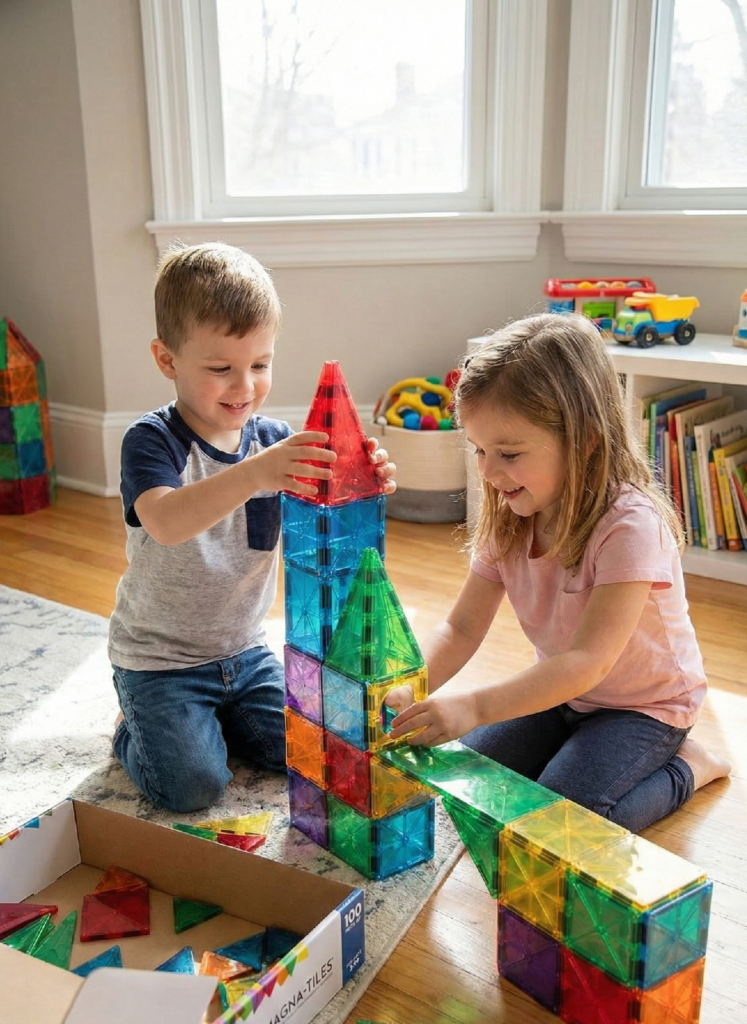
What you need:
- Magna-Tiles (ideally 100+ pieces for multiple builders)
- Two or more children
- Open floor space
The setup: Instead of each child building separately, invite collaborative construction: “Can you build one house together?” or “What if you each build part of a castle and connect them?”
Why this works: This introduces negotiation, spatial cooperation, and perspective-taking. Children must communicate their ideas, compromise on design, and coordinate their building.
It’s significantly more challenging than solo building—which is exactly why it’s valuable.
What this looks like:
- Initial excitement and overlapping ideas
- Potential conflict (normal and developmental)
- Negotiation (“You build this wall, I’ll build that one”)
- Pride in shared creation
The adult’s role: Mostly observation. Resist solving conflicts immediately. Give children space to work through disagreements about design. Intervene only if frustration escalates beyond their capacity to manage.
When to use this: Not every day. Collaborative building is cognitively demanding. Offer it when both children are regulated and genuinely interested, not as forced “sharing practice.”
Age variations:
- 3-4 years: Parallel building that gradually connects (loose collaboration)
- 4-5 years: Genuine partnership with defined roles
- 5-6 years: Complex collaborative projects sustained over multiple sessions
Developmental focus: Social negotiation, perspective-taking, communication, compromise
5. Vertical Building Challenges
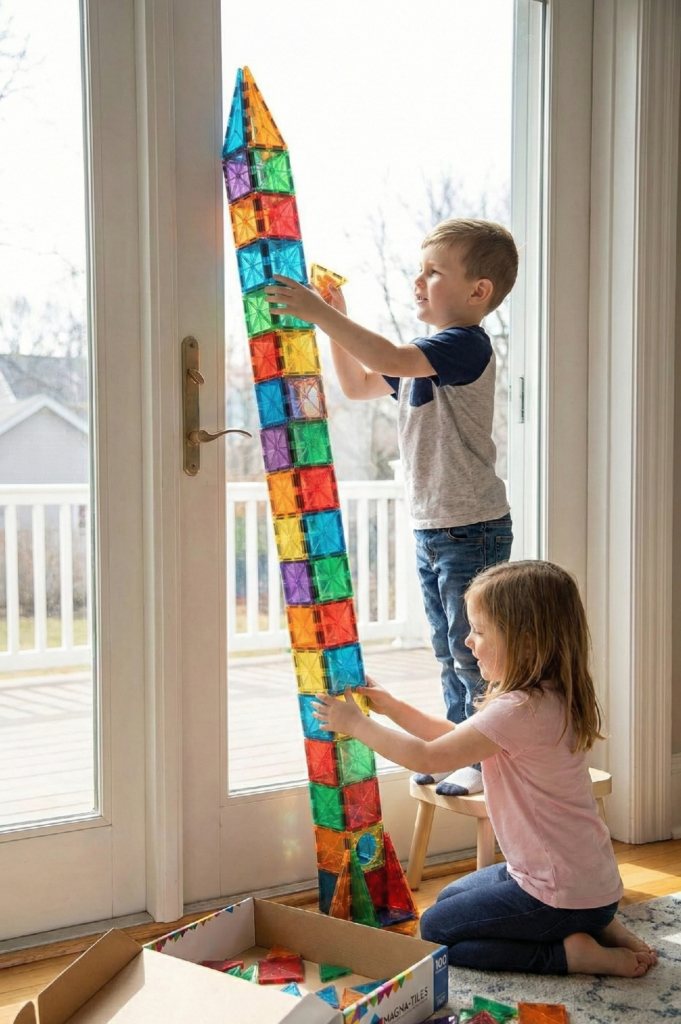
What you need:
- Magna-Tiles
- Wall space (empty wall, window, or magnetic board if available)
- Optional: painter’s tape to mark building boundaries
The setup: Challenge: How tall can you build on a vertical surface before gravity wins?
Why this works: Vertical building introduces entirely different physics than floor building. Magnetism now works against gravity. Weight distribution matters differently. Balance becomes more critical.
This is problem-solving in real time. Structures fall. Children analyze why, adjust, try again. That cycle—attempt, failure, analysis, revision—is where deep learning happens.
What you might observe:
- Initial enthusiasm (“I’m building SO tall!”)
- First collapse
- Frustration (normal)
- Analysis (“It fell because the bottom wasn’t strong enough”)
- Modification
- Success (or productive failure with new insights)
The adult role: Resist explaining. Don’t say “you need a wider base” or “that won’t work.” Let the material teach. Your role is to observe, show interest, and reflect on what you see: “You’re adding more tiles to the bottom now. I wonder what will happen.”
Age variations:
- 3-4 years: Simple vertical stacking (3-5 tiles high)
- 4-5 years: More ambitious height, experimenting with stability
- 5-6 years: Strategic building with deliberate weight distribution
Developmental focus: Physics, cause-and-effect, problem-solving, persistence through failure
What You Don’t Need
Before you feel overwhelmed: you don’t need to do all of these. You don’t need to rotate them weekly. You don’t need Pinterest-perfect setups.
Choose one invitation that genuinely interests you. Set it up. Step back. Observe what happens.
If your child engages for three minutes and walks away, that’s information. Maybe they’re not ready. Maybe they need a simpler version. Maybe they’re just not interested today.
If they return to it repeatedly over several days, you’ve found something developmentally matched. Let them exhaust that interest fully before introducing something new.
One well-timed invitation > five ignored setups.
When Magna-Tiles Stop Working
Sometimes children genuinely outgrow materials. But more often, we misread disinterest for developmental completion.
Before assuming your child is “done” with Magna-Tiles, ask:
Have they actually exhausted the material’s possibilities?
Or have they exhausted the one way they know how to use it?
Are they bored, or are they ready for a new challenge with the same material?
These are different developmental moments requiring different responses.
Has the material been available constantly?
Rotation matters. Toys available 24/7 become invisible. Putting them away for 2-3 weeks often renews interest completely.
The Real Goal
This isn’t about getting more use out of an expensive toy (though that’s a nice side effect).
It’s about supporting your child’s developing capacity to:
- Observe materials closely
- Experiment with new approaches
- Persist through challenges
- Think spatially and creatively
- Work both independently and collaboratively
Magna-Tiles are just the tool. The real work is cognitive.
When we prepare thoughtful invitations, we’re not entertaining children. We’re preparing environments that say: “There’s more here to discover. You’re capable of figuring it out.”
That’s the work.
Getting Started
Choose one invitation from this list. Set it up when your child isn’t watching. Say nothing about it. Let them discover it.
Watch what happens. Take note of what captures their attention and what doesn’t.
That observation will tell you what to offer next.
You already own the Magna-Tiles. Now you know five ways to prepare environments that help your child use them more deeply.