Two-year-olds are fascinating.
One minute, they’re meticulously placing each block in a precise tower. Next, they’re gleefully knocking it down and laughing at the chaos.
They want to do everything themselves—until they don’t. They’re intensely focused—until something else catches their eye. They’re capable of surprising sophistication—and also complete meltdowns over broken crackers.
This is the age of dramatic developmental leaps. Language explodes. Fine motor skills refine rapidly. Independence becomes a fierce priority. Emotional regulation is… a work in progress.
And the toys that worked last month suddenly don’t interest them at all.
If you’re trying to figure out what actually supports a two-year-old’s development—what helps them build the skills they’re working on right now, what invites focus instead of frenzy, what they’ll actually use—this guide is for you.
I’m not going to show you every toy marketed for two-year-olds. I’m going to show you what actually matters at this age, and which materials genuinely support the work they’re doing.
Let me walk you through it.
What’s Actually Happening at Age Two
Before we talk about specific toys, it helps to understand what developmental work two-year-olds are engaged in. This isn’t abstract theory—it’s what you observe daily.
Fine Motor Explosion
Between 24 and 36 months, small muscle control refines dramatically.
Your child is working on:
- Precise pincer grasp (picking up tiny objects with thumb and finger)
- Hand-eye coordination (placing pieces exactly where intended)
- Bilateral coordination (using both hands together purposefully)
- Wrist rotation (turning knobs, screwing lids)
- Tool use (using utensils, crayons, tools with intention)
What this looks like:
Threading beads that would have been impossible at 18 months. Turning pages one at a time instead of in clumps. Manipulating puzzle pieces with increasing precision. Attempting to button, zip, snap.
Why materials matter:
Toys that isolate and support fine motor practice aren’t just entertainment. They’re building the hand strength and control your child will use for writing, self-care, and countless daily tasks for years.
The Drive for Independence
This is the age of “I do it myself!”—often shouted with impressive conviction.
Two-year-olds are working on:
- Doing things without adult help
- Completing tasks from beginning to end
- Participating in real household work
- Making choices and seeing results
- Building confidence through mastery
What this looks like:
Insisting on pouring their own water (and spilling it). Trying to put on their own shoes (backwards, but independently). Wanting to sweep when you sweep, wash when you wash, help when you cook.
Why materials matter:
Toys that support real participation—child-size tools that actually work, materials they can truly use independently—honor this developmental drive. Toys that require constant adult intervention frustrate them.
Cause and Effect Sophistication
At two, cause-and-effect thinking becomes more complex.
Your child is understanding:
- Multi-step sequences (this, then this, then this)
- Tool use for specific purposes (use this to accomplish that)
- Problem-solving through experimentation (trying different approaches)
- How things work mechanically (what makes this happen)
What this looks like:
Not just dropping a ball in a hole, but understanding the ball rolls down the ramp, comes out the bottom, and can be retrieved to start again. Using a step stool to reach something previously inaccessible. Figuring out that if one puzzle piece doesn’t fit, trying another makes sense.
Why materials matter:
Toys with clear, predictable cause-and-effect support this developing logical thinking. Materials that are random or overly complex obscure the learning.
Language and Categorization
Language is exploding. So is the ability to categorize and organize information.
Your child is working on:
- Naming everything (“What’s that?” on repeat)
- Categorizing (these are animals, those are vehicles)
- Understanding relationships (big/small, same/different)
- Following multi-step instructions
- Expressing needs and ideas with increasing clarity
What this looks like:
Sorting toys by type. Grouping animals together. Recognizing patterns. Understanding “put the red one in the basket” or “find all the circles.”
Why materials matter:
Toys that support sorting, matching, and categorization align with this cognitive work. Materials with clear categories and relationships make sense to the two-year-old brain.
Gross Motor Confidence
Physical skills are consolidating and expanding.
Your child is working on:
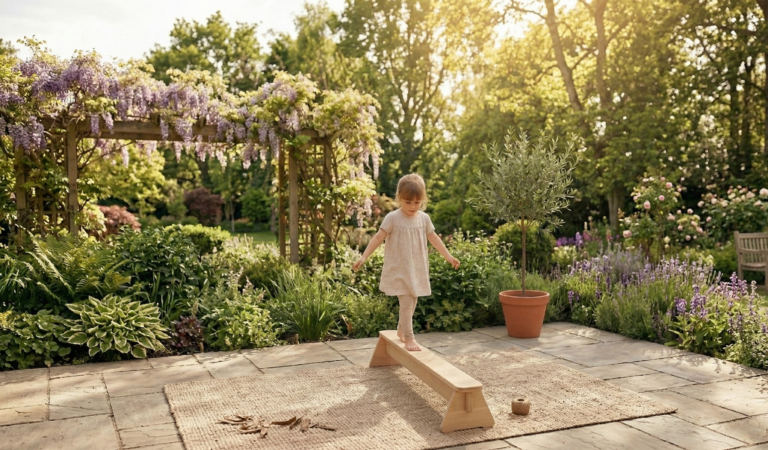
- Balance and coordination (walking becomes running, climbing improves)
- Core strength (supporting more complex movements)
- Spatial awareness (understanding their body in space)
- Risk assessment (testing limits, understanding “too high” or “too fast”)
What this looks like:
Climbing onto furniture. Walking on curbs or low walls. Jumping (or attempting to). Carrying things while walking. Going up stairs one foot per step instead of two feet together.
Why materials matter:
Gross motor toys don’t just burn energy—they build body awareness, confidence, and physical problem-solving that supports all other learning.
What to Look For in Toys for Two-Year-Olds
Not every toy marketed for this age actually serves these developmental needs. Here’s what genuinely matters:
✓ Can be used independently
If the toy requires constant adult setup, direction, or intervention, it’s not supporting independence. It’s creating dependence.
Look for materials your child can access, use, and put away without help.
✓ Supports repetition
Two-year-olds learn through repetition. The same puzzle, again and again. The same stacking sequence, over and over.
Materials that invite repeated practice—not one-time novelty—support the consolidation of skills.
✓ Isolates a specific skill
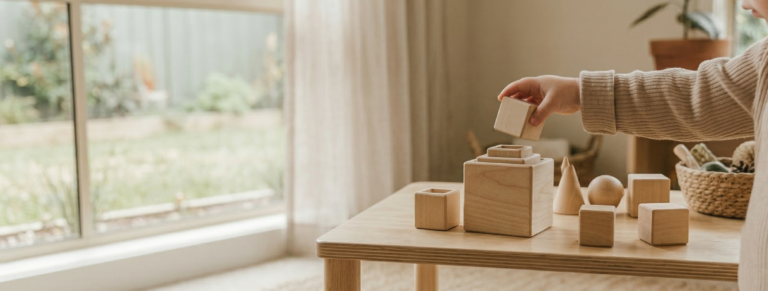
The best Montessori materials teach one thing at a time. A puzzle teaches shape matching. A threading toy teaches hand-eye coordination. A pouring activity teaches control.
Toys that try to teach colors, numbers, letters, and shapes all at once overwhelm rather than educate.
✓ Self-correcting
Materials that provide their own feedback—the puzzle piece either fits or it doesn’t, the tower either balances or it falls—allow children to learn without adult correction.
This builds problem-solving and reduces dependence on external validation.
✓ Natural materials when possible
Wood, metal, fabric, glass—these materials feel different than plastic. They have weight, texture, temperature. They provide richer sensory input.
This isn’t about aesthetics. It’s about the information materials provide to developing senses.
✓ Open-ended potential
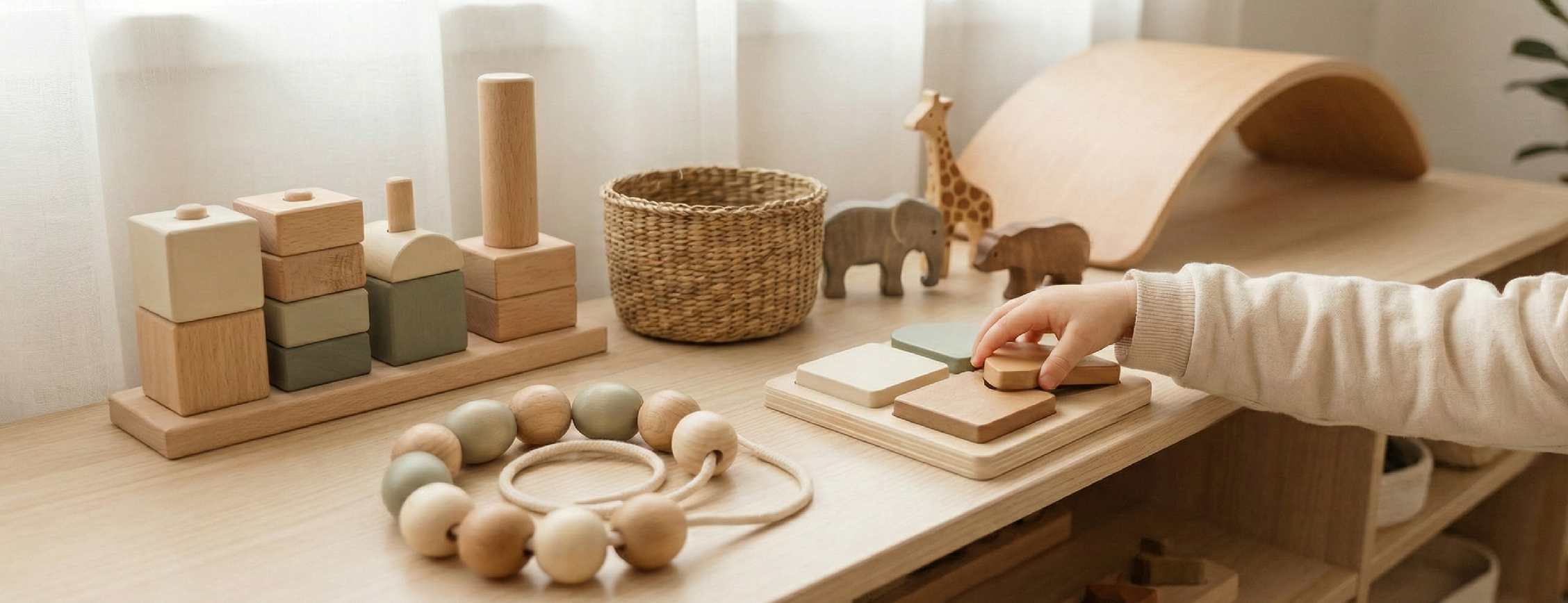
The best toys at this age can be used in multiple ways as skills develop. Blocks that start as stacking practice become elaborate constructions. Animals that start as sorting objects become imaginative play figures.
Materials that grow with the child provide longer-term value.
Fine Motor Development: What Actually Works
Fine motor skills are the foundation for so much future learning. Here’s what supports this development genuinely.
1. Wooden Threading and Lacing Toys
What it does:
Large wooden beads with thick laces or strings for threading practice.
Why it works at this age:
Threading requires intense hand-eye coordination, pincer grasp, and bilateral coordination (one hand holds the bead, the other guides the string). This is genuinely challenging work for two-year-olds—which is exactly why it’s valuable.
The visible result (beads on string) provides completion satisfaction. The activity can be repeated endlessly with different patterns or sequences.
What’s developing:
Fine motor precision, hand-eye coordination, focus, sequencing (if creating patterns), bilateral coordination.
Product example:
Melissa & Doug Primary Lacing Beads

Chunky wooden beads in primary colors with thick laces. The beads are sized perfectly for two-year-old hands—large enough to grasp easily, small enough to require precision. The laces are stiff enough to thread without constant frustration.
Why this specific product:
The bead size and lace stiffness are developmentally appropriate. Too-small beads or too-floppy laces create frustration rather than skill-building. These hit the sweet spot.
Price: $14-18
Melissa & Doug Primary Lacing Beads
2. Simple Wooden Puzzles (6-9 pieces)
What it does:
Set of six wooden peg puzzles featuring realistic animals and objects. Each puzzle has 6-9 pieces with small pegs for grasping.
Why it works at this age:
At two, children are ready for puzzles with more pieces and more visual complexity than basic shape puzzles. These realistic images (animals, vehicles, fruits) support vocabulary development while building spatial reasoning. The peg handles still provide grasping support while children refine their pincer grip.
What’s developing:
Visual discrimination of detailed images, spatial reasoning, problem-solving, fine motor precision, vocabulary expansion, categorization thinking.
Product example:
QUOKKA Wooden Puzzles for Toddlers 1-3 – 6 Pegged Puzzles

Six different wooden puzzles in one set: animals, vehicles, and fruits. Each puzzle has 6-9 pieces with small wooden pegs. Realistic images with vibrant, detailed printing directly on wood.
Why this set works:
The variety prevents boredom—children can choose based on current interest. The realistic, detailed images support accurate learning (this is what a zebra actually looks like). The set provides progression: some puzzles are slightly easier (fewer pieces, simpler shapes), others more challenging.
Educational value:
Beyond spatial reasoning, these puzzles build vocabulary across multiple categories. Children learn animal names, vehicle types, fruit identification—all through hands-on manipulation.
Durability note:
Direct printing on wood (not paper glued to wood) means images won’t peel or wear off. The European plywood construction withstands the dropping and rough handling that’s normal for two-year-olds.
Price: $23
QUOKKA Wooden Puzzles 6-Set for Toddlers
3. Stacking and Nesting Toys
What it does:
Graduated wooden boxes that stack on top of each other or nest inside one another.
Why it works at this age:
Stacking and nesting teach size relationships, order, and sequence through direct physical experience. The self-correcting nature (bigger boxes won’t fit inside smaller ones, unstable stacking falls) allows independent problem-solving. The repetitive nature supports focused practice.
What’s developing:
Size discrimination, ordering and seriation, spatial reasoning, hand-eye coordination, logical thinking, sustained focus.
Product example:
TOWO Wooden Stacking Boxes – Nesting and Sorting Cubes

Ten graduated wooden boxes in natural wood finish. Each box fits inside the next larger one, and all can be stacked to create a tall tower. The boxes can also be turned over and used as building blocks, sorting containers, or imaginative play props.
Why this works developmentally:
The size progression is clear and dramatic—children can see and feel the size differences. The multiple uses (nesting, stacking, building, sorting) mean the material grows with the child. What starts as basic nesting practice at age two becomes complex building and sorting by age three.
Open-ended potential:
These boxes are remarkably versatile. Early on, children work on nesting in correct order. Later, they stack to build towers. Eventually, they use them as containers for sorting small objects, as building blocks for structures, or as props in pretend play (houses, garages, cages).
Why natural wood:
The unfinished wood allows children to see the wood grain, feel the natural texture, and focus on the mathematical relationship of sizes without color distraction.
Price: $37
TOWO Wooden Stacking and Nesting Boxes
4. Counting Peg Board
What it does:
Wooden boards numbered 1-10, each with corresponding holes for placing wooden pegs. Includes 55 colorful wooden counting pegs and storage bag.
Why it works at this age:
While this is technically a “math material,” at two the real learning is in the hands. Placing pegs requires precise pincer grasp, hand-eye coordination, and focused attention. The numbered boards add interest and begin unconscious number recognition, but the developmental work happening is fine motor.
What’s developing:
Pincer grasp strength, hand-eye coordination, one-to-one correspondence (one peg in one hole), focus and concentration, early number awareness, color recognition.
Product example:
Counting Peg Board – Montessori Math and Numbers for Kids
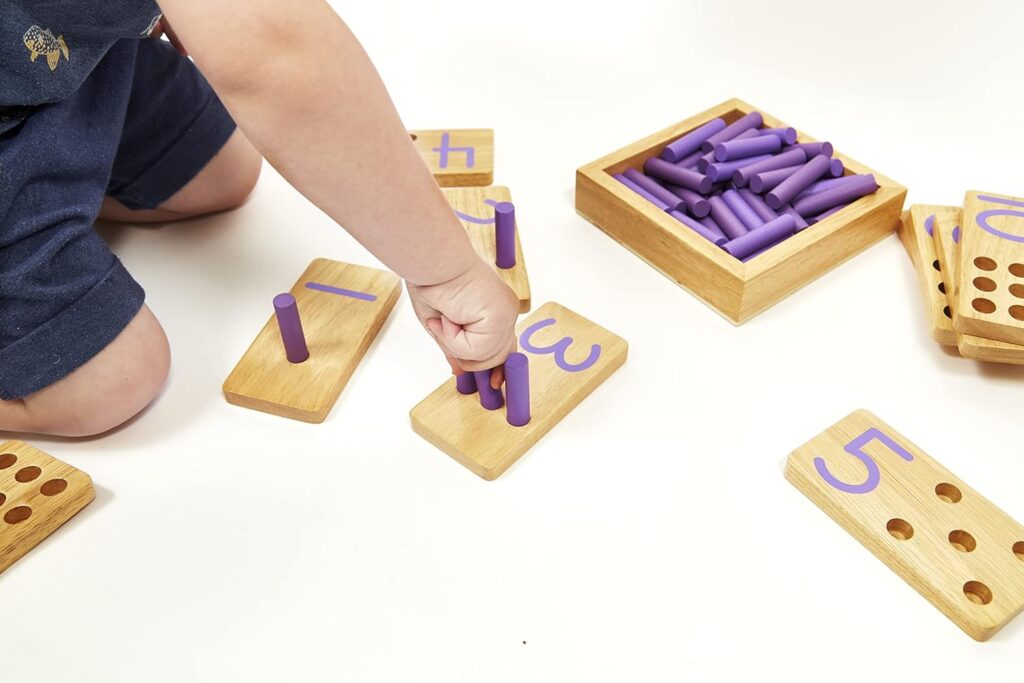
Ten wooden boards (numbers 1-10) with corresponding holes, 55 wooden pegs in multiple colors, canvas storage bag, and wooden storage box. Natural hardwood construction with child-safe lacquer finish.
Why this specific design:
The graduated progression (1 hole to 10 holes) provides built-in challenge advancement. Children can start with board 1 (easy, quick success), then progress to higher numbers as skill builds. The pegs are sized perfectly for two-year-old hands—substantial enough to grasp easily, small enough to require precision.
Extended use:
At two, children place pegs in holes (fine motor practice). At three, they might sort pegs by color. At four, they use it for actual counting and number recognition. At five, they create patterns or use it for early addition. This is genuine “grows with your child” material.
Teacher-approved:
Montessori educators recommend this type of material because it isolates fine motor work while introducing mathematical concepts naturally, without forcing counting before the child is developmentally ready.
Price: $33
Counting Peg Board – Wooden Math Manipulative
Practical Life: Building Real Independence
Practical life materials are the heart of Montessori for two-year-olds. These aren’t pretend—they’re real tools for real participation.
5. Child-Size Cleaning Tools (That Actually Work)
What it does:
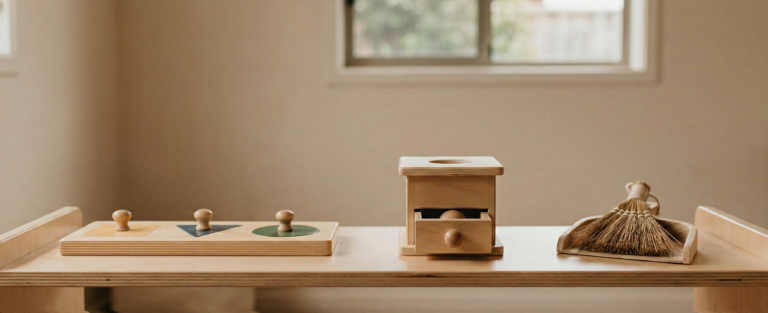
Real broom, real dustpan, real cleaning cloth—sized for small hands and bodies.
Why it works at this age:
Two-year-olds desperately want to participate in household work. When given tools that actually function, they can contribute meaningfully. This builds competence, confidence, and the satisfaction of completing real tasks.
What’s developing:
Gross motor coordination, bilateral coordination, task completion, pride in contribution, independence, practical skills.
A note on product quality:
Most commercial “child cleaning sets” don’t work well. The Melissa & Doug set, while wooden, has a broom with ineffective bristles and handles that are too lightweight.
Better approach:
Source individual pieces:
- Small real broom from hardware store or IKEA children’s section
- Child-height mop (sometimes found at IKEA or specialty stores)
- Metal dustpan that actually scoops (not plastic toy version)
- Real sponges and cloths your child can access independently
Why this matters:
When tools don’t work, children learn that their efforts don’t matter. When tools work, they learn they’re capable.
If assembling feels overwhelming:
Start with one good tool (a real small broom) and a child-accessible cloth for wiping. These two items alone support meaningful participation.
Price: $25-40 (sourced individually) vs $30-35 (commercial set that doesn’t work well)
6. Pouring and Transferring Materials
What it does:
Collection of child-appropriate pitchers, trays, and containers for pouring and transferring activities.
Why it works at this age:
Pouring and transferring develop hand-eye coordination, wrist control, focus, and understanding of full/empty, more/less. Spills provide feedback about control and angle—they’re learning, not failing.
What’s developing:
Fine motor control, wrist rotation, bilateral coordination, hand-eye coordination, concentration, cause-and-effect understanding, self-correction, practical life skills.
What you need:
You can assemble pouring activities from items around your home, or purchase specific materials designed for this purpose.
Option 1: Assembled Pouring Activity Set
Materials needed:
- Small tray (wood grain finish for easy cleanup and aesthetics)
- Small pitchers (glass or stainless steel)
- Small bowls or containers
- Dry materials (rice, beans, water)
Product recommendations:
Wood Grain Plastic Serving Trays (2-pack)

Lightweight trays with raised edges to contain spills. Wood-grain finish looks natural while being practical (easy to wipe, won’t warp with water exposure). Perfect size for two-year-old activities.
Why trays matter:
The tray defines the activity—everything needed is contained in one space. The raised edge catches spills, making cleanup manageable and teaching children that spills are fixable, not catastrophic.
Price: $10 (for 2 trays)
Wood Grain Serving Trays for Montessori Activities
APLAINR Montessori Pitcher for Toddlers
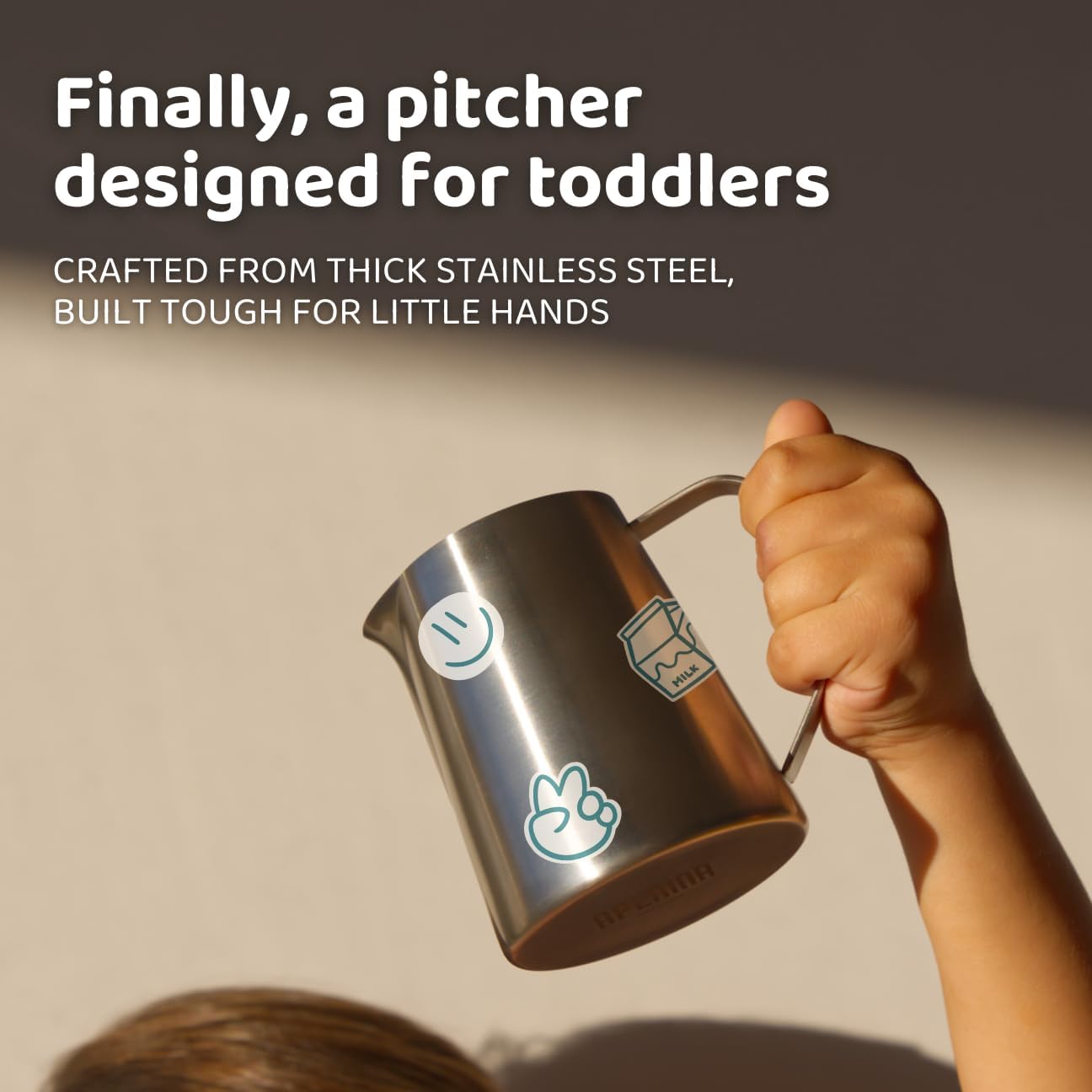
Small stainless steel pitcher (11 fl oz) designed specifically for toddler pouring practice. Lightweight but substantial, easy-grip handle, break-resistant. Comes with personalization stickers for child ownership.
Why stainless steel:
Durable through countless drops (inevitable with two-year-olds). Provides appropriate weight feedback without being too heavy for small hands. Safe alternative to glass while maintaining real-material benefits over plastic.
Size consideration:
11 oz is perfect for this age—substantial enough for meaningful pouring practice, small enough for toddlers to lift and control independently.
Price: $23
APLAINR Montessori Toddler Pitcher – Stainless Steel
Yarlung Small Glass Pitchers (4-pack)

12 oz clear glass pitchers with handles. Square base design provides stability. Heat-resistant borosilicate glass. Compact size perfect for small hands.
Why glass (carefully introduced):
Glass teaches care. Children learn to handle breakable materials with attention and respect. The transparency lets them see exactly how much they’re pouring. Yes, glass can break—that’s part of the learning. Children learn cause and effect, consequences, and careful handling.
When to introduce:
Start with stainless steel or plastic pitchers first. Once pouring is more controlled (usually mid-twos), introduce glass during supervised activities. The care required becomes part of the lesson.
Practical use:
These also work beautifully for family use—small milk portions at meals, juice service, water at the table. Children feel pride using “real” family items, not separate “kid” versions.
Price: $19 (for 4)
Yarlung Small Glass Pitchers – Set of 4
Complete pouring activity setup:
- Wood grain tray: $5 (one from 2-pack)
- Stainless steel pitcher: $23
- Two small bowls (use from your kitchen or get small ceramic/glass bowls)
- Dry materials: rice, beans, or water from pantry
Total investment: ~$30 for a complete pouring station that will be used for years.
How to present:
Place two bowls on the tray with the pitcher beside them. Pour dry material (rice or beans) into one bowl. Show your child once, slowly: “Watch how I pour from this bowl into the pitcher, then from the pitcher into this bowl.” Then step back and let them practice.
The spills are the learning. When spills happen, show them where the cleaning cloth is kept. Let them wipe up. This entire sequence—pouring, spilling, observing the result, getting cloth, cleaning up—is the activity. Don’t rush to fix it for them.
7. Dressing Frames (Practical Life Focus)
What it does:
Set of six wooden frames, each featuring a different real fastener: large buttons, small buttons, buckles, snaps, zippers, and bow ties. Each frame has fabric panels that children open and close using the featured fastener.
Why it works at this age:
Two-year-olds are intensely interested in dressing themselves but struggle with the mechanics of fasteners. Practicing these skills in isolation—on a flat, stable frame rather than on their own moving body while standing—allows focused learning without time pressure or frustration.
What’s developing:
Fine motor precision, bilateral coordination (both hands working together with different jobs), sequencing (first this step, then this step), independence in self-care, problem-solving, persistence through challenge.
Product example:
Kiddison Montessori Dressing Frames Set of 6
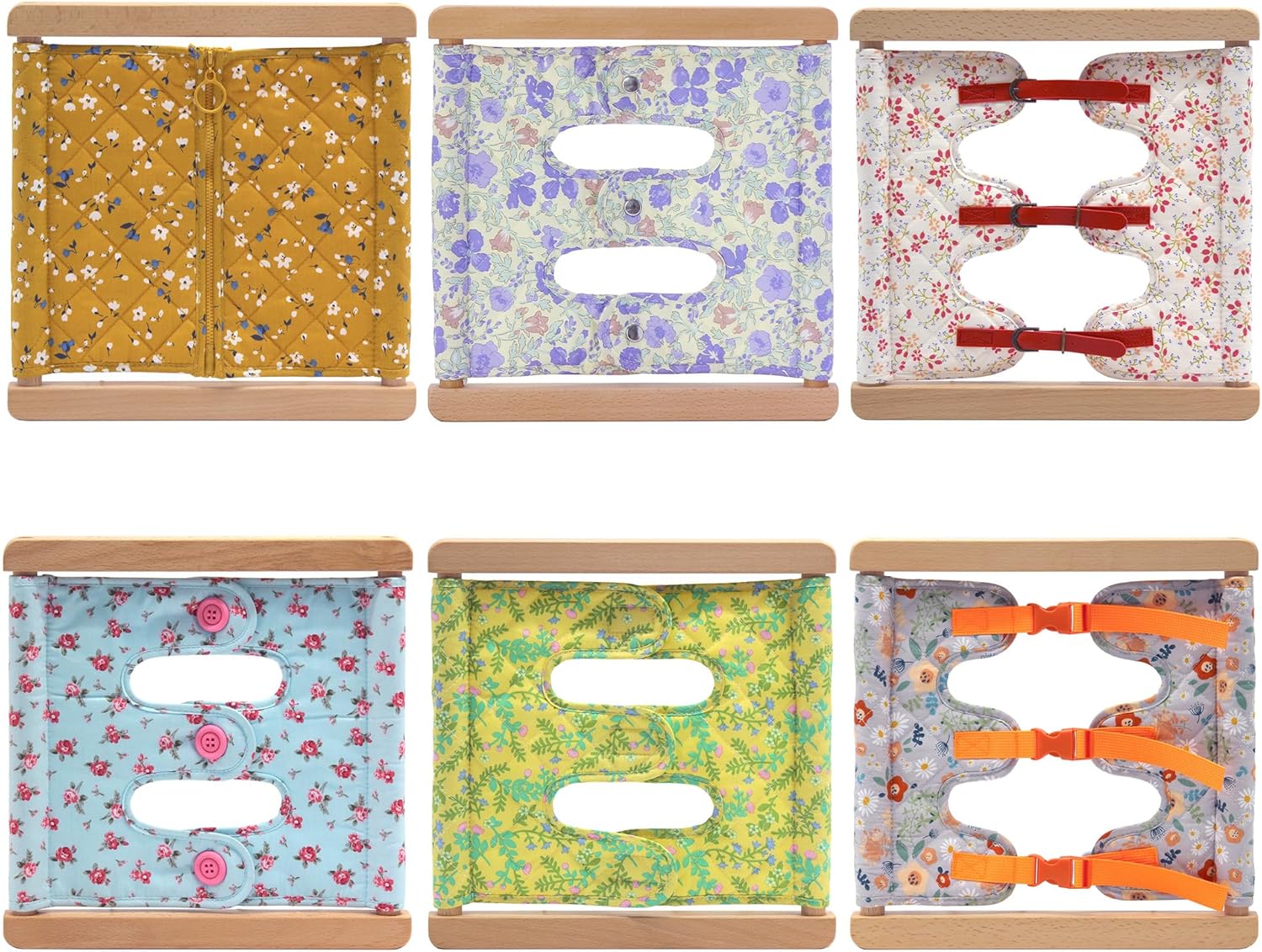
Six wooden frames (12″ x 12″ each) with different fastening systems:
- Large buttons (easiest – usually mastered first)
- Buckles (moderate difficulty)
- Snaps (requires finger strength)
- Small buttons (more precision needed)
- Zippers (coordination of holding and pulling)
- Bow ties (most advanced)
What makes this set developmentally appropriate:
The beechwood frames are durable and sized perfectly for small hands to manipulate. The fabric panels use cotton with batting inside, providing substance that makes the fastening practice realistic—thin, flimsy fabric doesn’t teach the same skill.
The zipper design detail matters:
The zipper frame includes a ring on the zipper pull specifically designed to help toddlers grasp and pull. This small design element makes the difference between frustration and success for two-year-old fingers.
Progressive difficulty:
At age two, most children work on large buttons and buckles. Snaps require more finger strength (often mastered around 2.5-3). Small buttons, zippers, and bow ties typically come later (ages 3-4). Having all six frames means the material grows with your child—they’re not outgrown in a few months.
Why frames vs. real clothing:
Practicing on a stable, flat surface removes variables that make learning on actual clothing difficult:
- The frame doesn’t move (unlike a shirt you’re wearing)
- You can see what you’re doing clearly (not trying to button behind your back)
- There’s no time pressure (“we need to leave NOW”)
- The fabric stays taut (unlike floppy garment fabric)
- Both hands can work at comfortable height
Once the skill is mastered on the frame, it transfers to real clothing with surprising ease.
Real-life application timeline:
Most two-year-olds start with:
- Large buttons: Begin attempting around 24-30 months, master by 3
- Buckles: Understand mechanism around 2.5 years, master by 3.5
- Snaps: Attempt around 2.5-3 years, master by 3.5-4
The progression naturally unfolds through practice. You don’t need to “teach” each one—just make the frames accessible and let your child choose which to practice.
Presentation:
Keep 1-2 frames accessible on the shelf at a time (rotate based on current interest and skill level). When your child shows interest, demonstrate once, slowly, without talking: Unbutton from top to bottom. Open the panels. Close the panels. Button from bottom to top.
Then step back. Let them struggle. The struggle is the learning.
What success looks like:
Initially: Lots of attempts, mistakes, maybe frustration. That’s normal. Your job is to stay calm and available, not to fix it for them.
With practice: Increased persistence, eventual success, visible pride.
Mastery: Completes the frame quickly and confidently, then applies the skill to real clothing.
When to introduce:
Start with the large button frame around age 2-2.5 (or whenever your child shows interest in buttons on their own clothes). Add other frames gradually as skills develop and interest emerges.
The long-term value:
These frames get used for years. What starts as intense concentration practice at age two becomes quick warm-up activity at age four. Some children continue using them at ages 5-6 because the repetitive, focused work is calming.
At $170, this is the most expensive single recommendation in this guide. Is it worth it?
Consider:
- Six frames at $28 each
- Used daily for 2-4 years
- Builds genuine self-care independence
- Can be passed to siblings
- Montessori classroom quality (built to withstand dozens of children)
If budget is constrained:
You can start with a single frame (some brands sell individually for $25-35). Begin with large buttons or buckles. Add others as budget allows.
Or use real clothing: A basket with a jacket (zipper), shirt (buttons), and pants (snap) can serve similar purpose. The frames are superior teaching tools, but real clothes can work if frames aren’t accessible.
Price: $170 (for set of 6)
Kiddison Montessori Dressing Frames – Set of 6
Budget alternative: Individual dressing frame ($25-35 for single frame) or basket of real clothing with various fasteners
Gross Motor Development: Building Physical Confidence
Two-year-olds are consolidating walking and ready for more complex physical challenges.
8. Balance Board (Wobbly/Rocker Board)
What it does:
Curved wooden board that rocks, wobbles, and can be flipped for different balance challenges and open-ended play.
Why it works at this age:
Balance boards build core strength, balance, body awareness, and vestibular system development (how the body understands movement and position in space). They’re also remarkably open-ended—used for intended rocking, as a bridge, as a slide, as part of imaginative play, as a quiet resting spot.
What’s developing:
Core strength, balance and coordination, gross motor skills, body awareness in space, risk assessment, creative problem-solving, imaginative thinking.
Product example:
Gentle Monster Wobble Balance Board

Natural wood curved board with smooth finish. Gentle curve appropriate for beginners. Supports up to 480 lbs (works for children and adults). Dimensions: 33″L x 8″W x 1″H.
Why this design works:
The gentle curve provides enough challenge to engage two-year-olds without being so steep it’s intimidating. The wide base (8 inches) offers stability while still requiring balance work. The smooth natural wood finish is comfortable for bare feet and creates beautiful tactile feedback.
Open-ended use examples:
- Rocking while standing (balance practice)
- Sitting and rocking (vestibular input, calming)
- Flipped over as a bridge to walk across
- Used as a rocker for stuffed animals or dolls
- Incorporated into block building (ramp, roof, slide)
- Balance challenge (walking from one end to the other)
- Adult yoga prop (the 480 lb capacity means parents can use it too)
Developmental progression:
At age two, most children rock while holding a parent’s hand or nearby furniture. By 2.5, they rock independently. By three, they experiment with different positions (sitting, kneeling, standing). By four, they create elaborate uses in imaginative play. The material genuinely grows with the child for years.
Safety note:
The smooth curve and substantial width make this safer than many balance boards. However, supervision is appropriate, especially initially. Let children discover their own limits rather than setting arbitrary rules (“only use it this way”). They’ll naturally regulate their risk-taking to match their current ability.
Why this matters beyond gross motor:
Vestibular input (the rocking sensation) is calming and organizing for many children. Some use it for focused concentration activities. Others use it for sensory regulation when overwhelmed. This makes it valuable beyond pure gross motor development.
Price: $47
Gentle Monster Wooden Balance Board
9. Learning Tower
What it does:
Adjustable wooden tower that brings child to counter height for safe participation in cooking, washing, food prep, and other kitchen activities.
Why it works at this age:
This isn’t a toy—it’s an access tool. It allows real participation in activities that matter to adults, which is exactly what two-year-olds desperately want. Washing vegetables, pouring ingredients, stirring, watching cooking happen at eye level—these are meaningful life skills, not pretend play.
What’s developing:
Gross motor (climbing safely up and down), practical life skills, independence, pride in contribution, vocabulary (cooking and food terms), sequencing (this step, then this step), cause-and-effect (mixing these ingredients creates this result).
Product example:
AVDAR Toddler Standing Tower – Adjustable Kitchen Stool

Wooden learning tower with three adjustable height positions. Enclosed platform with safety rails. Natural wood construction with non-toxic water-based paint. Winner of 2023 Contemporary Good Design Award.
Why learning towers vs. regular step stools:
The enclosed design with safety rails provides security while allowing full arm movement. The child can focus entirely on the task (stirring, pouring, washing) without the parent worrying about balance or falling. This allows genuine participation rather than constant “be careful!” reminders.
The adjustable height feature:
Three height positions mean the tower grows with your child. At age two (shorter), you use the highest platform setting. As your child grows taller, you lower the platform. Usable from approximately age 18 months through age 6.
Premium quality considerations:
This is one of the more expensive recommendations in this guide ($220). Why the investment matters:
- Stability: Multilayer birchwood construction creates solid, wobble-free platform. Cheap towers feel unstable, which defeats the purpose (child can’t focus on task when concerned about balance).
- Safety engineering: Wide base, low center of gravity, enclosed design. Meets heavy-duty safety standards. Not all learning towers are designed with actual toddler physics in mind.
- Durability: Water-based, non-toxic paint. Smooth, burr-free construction. Built to withstand daily climbing by multiple children over years.
- Design recognition: Contemporary Good Design Award winner—this acknowledges thoughtful design that serves function beautifully.
Alternative if budget is constrained:
A sturdy two-step stool with handles ($30-50) provides counter access, though without the enclosed safety. Children need closer supervision but can still participate meaningfully.
Real-life use:
This typically becomes the most-used “toy” in homes with two-year-olds—except it’s not a toy. It’s daily participation. Washing breakfast dishes. Rinsing berries for snacks. Stirring pancake batter. Kneading dough. Pouring measured ingredients. These activities build competence, vocabulary, sequencing skills, and the pride of real contribution.
Worth the investment?
If you can manage the cost, yes. This sees daily use for 4-5 years, supports real skill-building, and creates opportunities for connection (working alongside parents) that cheap alternatives don’t provide as effectively.
Price: $220
AVDAR Toddler Standing Tower – Adjustable
Budget alternative: Stable two-step stool with handles ($30-50) – Provides access without enclosed design, requires closer supervision
Open-Ended Building and Creativity
Materials that can be used in multiple ways support creativity and problem-solving.
10. Wooden Unit Blocks (Simple Set)
What it does:
Plain wooden blocks in standard unit sizes. Rectangles, squares, half-units, quarter-units. No colors, no pictures—just natural wood.
Why it works at this age:
At two, blocks are used for stacking, lining up, building simple structures, and creating enclosures. The simplicity allows focus on the building itself rather than on colors or images. The mathematical precision (two half-units equal one full unit) provides unconscious preparation for mathematical thinking.
What’s developing:
Spatial reasoning, balance, cause-and-effect, problem-solving, focus, math readiness, and creativity.
Product example:

Melissa & Doug Standard Unit Blocks (60-piece set)
Natural wood blocks in standard unit measurements. Includes rectangles, squares, curves, and triangles. Stored in a wooden box.
Why natural wood blocks matter:
The weight provides feedback. The consistent sizing allows predictable building. The natural finish lets the child focus on structure rather than decoration.
Price: $30-50 (60-100 piece sets)
11. Magna-Tiles (Small Starter Set)
What it does:
Magnetic tiles that connect to create flat patterns or 3D structures.
Why it works at this age:
The magnetic connection is forgiving—structures hold together better than blocks, which reduces frustration. At two, children typically build flat patterns or simple 3D structures (houses, enclosures). The transparent colors appeal visually.
What’s developing:
Spatial reasoning, cause-and-effect, problem-solving, color recognition, pattern-making, fine motor (connecting tiles with precision).
Starting point for two-year-olds:
Magna-Tiles Clear Colors 32-Piece Set
Provides enough tiles for meaningful building without overwhelming choice. Includes squares and triangles in various sizes.
Why start smaller at this age:
Two-year-olds don’t yet build the elaborate structures that require 100 pieces. The 32-piece set provides appropriate challenge and room for growth. You can expand later as skills develop.
Important: See our full Magna-Tiles vs. Generic comparison for why quality matters with magnetic tiles (safety, durability, magnetic strength).
Price: $45-55
Magna-Tiles 32-Piece Starter Set
12. Simple Animal Figures (Realistic, Not Cartoons)
What it does:
Wooden or high-quality plastic animal figures. Realistic appearance, appropriately sized for small hands.
Why it works at this age:
At two, animal figures support vocabulary development, categorization (farm animals vs. wild animals), imaginative play, and sorting activities. The realistic appearance helps children connect the figures to real animals they see in books or life.
What’s developing:
Language, categorization, imaginative thinking, fine motor (manipulating small figures), sorting skills.
Product example:
Safari Ltd TOOBS – Farm Animals or Wild Animals
Small, realistic animal figures (8-12 per tube). Detailed sculpting and painting. Appropriately sized for two-year-old hands (2-3 inches).
Why realistic matters:
Children are learning what animals actually look like. Cartoon versions can confuse rather than clarify. Realistic figures support accurate learning.
Use ideas:
Sorting by type (farm vs. wild), matching to pictures in books, building habitats with blocks, simple pretend play.
Price: $12-16 per set
Safari Ltd Animal Figures – Farm or Wild
What to Avoid at This Age
Knowing what doesn’t work saves money and space.
❌ Toys with batteries and electronics
Two-year-olds benefit from toys they control entirely. Electronic toys that light up, make sounds, or play music on their own terms shift control away from the child. The toy becomes the actor; the child becomes the audience.
Better: Simple cause-and-effect toys the child operates mechanically.
❌ Character-branded toys
Branded toys (Disney, Paw Patrol, etc.) dictate how play should go. The child is recreating screen stories rather than creating their own.
Better: Generic figures and props that support child-directed imaginative play.
❌ Toys with too many features
The busy board that has locks, latches, zippers, wheels, beads, mirrors, and bells all on one board isn’t teaching isolation of skill—it’s creating sensory overwhelm and confused focus.
Better: Materials that isolate one skill or concept at a time.
❌ Toys that require constant adult setup
If you have to reset the toy every three minutes, it’s not supporting independence—it’s creating dependence and interrupting the child’s focus.
Better: Materials the child can use and reset independently.
❌ Cheap plastic versions of wooden toys
Lightweight plastic puzzles slide around. Plastic blocks don’t provide weight feedback. Plastic pegboards feel insubstantial. The sensory input is diminished, which diminishes the learning.
Better: Natural materials when choosing manipulative toys that require tactile feedback.
How to Set Up Materials for Success
Having good toys isn’t enough. How you present them matters.
The Low Shelf System
Why it works:
Materials on low, accessible shelves communicate “you can choose, you can use this independently, you are capable.”
Materials in bins or toy chests become invisible and overwhelming. The child can’t see what’s available or access it without dumping everything.
How to set up:
- Use a low shelf (IKEA Kallax works perfectly)
- Place 6-8 activities on the shelf, spaced with breathing room
- Each activity on its own tray or in its own basket (contains materials, defines the activity)
- Rotate weekly or bi-weekly (swap out materials that aren’t being used, bring back old favorites)
Example shelf setup for a two-year-old:
- Puzzle (4-6 pieces)
- Lacing beads with lace
- Pegboard with pegs
- Pouring activity (two bowls, small pitcher, tray)
- Animal figures in basket
- Small block set
- Magna-Tiles in low basket
- Basket with board books
Not every toy needs to be out. In fact, fewer choices support deeper engagement.
Rotation Matters
Why rotation works:
When materials are always available, they become invisible. When you rotate them out and bring them back later, they’re “new” again.
How to rotate:
Keep 60-70% of toys stored. Every 1-2 weeks, swap a few items. Bring out something that hasn’t been available for a while. Put away something that’s getting less attention.
Watch what gets used. If your child ignores a material consistently, it might be too easy (they’ve mastered it), too hard (not developmentally ready), or just not interesting to them. That’s fine. Put it away and try again in a month.
The goal isn’t to use everything. The goal is to have materials available that genuinely match where your child is right now.
Less Is Genuinely More
I know this is counterintuitive. Doesn’t more variety mean more learning opportunities?
No. It means more overwhelm.
Studies on choice and focus show consistently: children engage more deeply with fewer, well-chosen options than with abundant choices.
Six carefully selected toys rotated thoughtfully provide more learning than thirty toys available constantly.
This is the heart of the Montessori approach to materials: carefully chosen, purposefully presented, regularly rotated.
Quality, not quantity. Always.
What About Screen Time?
I’m going to address this briefly because it’s relevant to toy choices.
At two, screens (TV, tablets, phones) compete directly with the hands-on, three-dimensional exploration that builds spatial reasoning, fine motor skills, and problem-solving.
Screen content is passively received. Blocks, puzzles, and pouring activities require active manipulation, experimentation, and problem-solving.
The American Academy of Pediatrics recommends very limited screen time for this age (1 hour or less of quality programming, co-viewed with a parent). Not because screens are evil, but because they displace the active learning that two-year-olds need.
The best “screen-free” toy is often the simplest: blocks, water and cups, a box of scarves, a pile of cushions.
If reducing screen time feels impossible, start by creating irresistible alternatives. A tray with water and cups on the kitchen floor while you cook often beats a show. The puzzle shelf accessible for independent choice often beats the tablet.
You’re not eliminating screens. You’re creating genuinely engaging alternatives.
The Developmental Progression to Expect
As your two-year-old approaches three, you’ll notice shifts:
Early twos (24-28 months):
- Puzzles: 4-6 pieces
- Blocks: Stacking, simple towers
- Fine motor: Large beads, simple pegboards
- Magna-Tiles: Flat patterns mostly
- Independence: Wants to help but needs support
Mid-twos (28-32 months):
- Puzzles: 6-9 pieces
- Blocks: Simple structures, enclosures
- Fine motor: More complex threading, smaller pegs
- Magna-Tiles: Beginning 3D structures (cubes, houses)
- Independence: “I do it myself!” intensifies
Late twos (32-36 months):
- Puzzles: 9-12 pieces, ready for first interlocking puzzles
- Blocks: Deliberate structures, patterns, representations
- Fine motor: Can manage more complex fasteners
- Magna-Tiles: Elaborate 3D buildings
- Independence: Can complete many tasks truly independently
These are approximations. Your child’s timeline is their own. Some two-year-olds master 12-piece puzzles early. Others stay happily with 4-piece puzzles for months. Both are fine.
Follow your child, not timelines.
When Materials Aren’t Working
If you’ve offered materials that seem appropriate but your child isn’t engaging:
Check the difficulty level
Too easy = boredom and avoidance.
Too hard = frustration and avoidance.
The sweet spot: achievable with effort. If materials are consistently ignored, try one level simpler or one level more complex.
Check the presentation
Is it accessible? Can your child see it and reach it independently? Is it on a cluttered shelf competing with ten other things, or presented clearly with space around it?
Often, simply moving a ignored toy to a more visible spot revives interest.
Check your role
Are you hovering? Correcting? Showing them the “right” way repeatedly?
Two-year-olds need space to explore on their terms. Sometimes our well-meaning help undermines their engagement.
Try sitting nearby doing your own activity (folding laundry, reading) while they explore. Proximity without intervention often unlocks focus.
Check timing
Is this material being offered when your child is hungry, tired, or overstimulated? Even perfect materials don’t work at wrong times.
Best engagement often happens: Mid-morning after breakfast, or late afternoon after rest, when energy is regulated and basic needs are met.
The Real Goal
This isn’t about having the perfect Montessori playroom. It’s not about your child mastering specific skills by specific ages.
It’s about supporting the work your child is already trying to do.
At two, they’re working on:
- Using their hands with increasing precision
- Participating in real life meaningfully
- Understanding how things work
- Building independence
- Making sense of the world through direct experience
Good materials support that work. They don’t dictate it, force it, or rush it.
When you choose materials thoughtfully—when you observe what genuinely engages your child, what supports their current capacities, what invites focus rather than frenzy—you’re not teaching them to play.
You’re preparing an environment that says: “You are capable. Explore. Experiment. Figure it out. I trust you.”
That’s the real work.
Getting Started
If you’re feeling overwhelmed by everything in this guide, start here:
The Minimum Montessori Setup for a Two-Year-Old:
Fine motor (choose 2):
- One age-appropriate puzzle (4-9 pieces)
- Threading beads OR pegboard
Practical life (choose 2):
- Pouring activity (use what you have – bowls and pitcher)
- One real cleaning tool (broom or cloth)
Gross motor (choose 1):
- Step stool for counter access
- OR balance board if budget allows
Open-ended (choose 2):
- Simple wooden blocks
- Animal figures OR small Magna-Tiles set
That’s 7 materials. Seven thoughtfully chosen, properly presented materials provide more learning than thirty random toys in a bin.
Start small. Observe what engages. Adjust from there.
You don’t need everything. You need the right things for your specific child, right now.
Trust yourself. Observe your child. Choose less, choose better.
That’s the work.
Related Posts:
The Wooden Puzzle Progression: How to Know When Your Child Is Ready for More
Beyond Basic Building: 5 Ways to Extend Magna-Tiles Play
Do Montessori Toys Actually Work? What to Look for Instead of Labels
Too Many Toys: The Montessori Approach to Toy Rotation (coming soon)
Disclaimer: This post contains Amazon affiliate links. When you purchase through these links, I may earn a small commission at no additional cost to you. This supports the site and allows me to continue sharing thoughtful recommendations based on developmental principles and years of classroom observation.