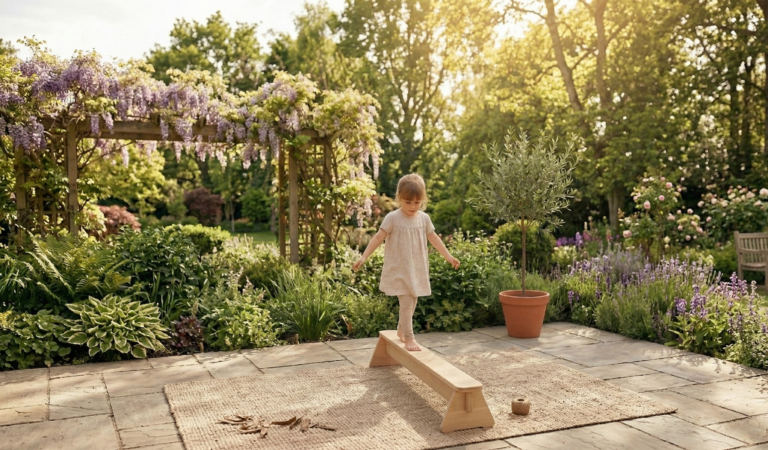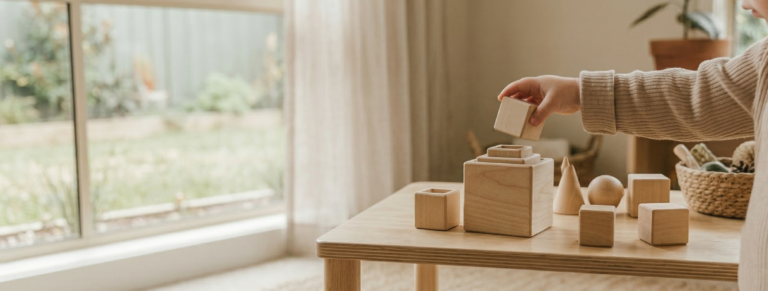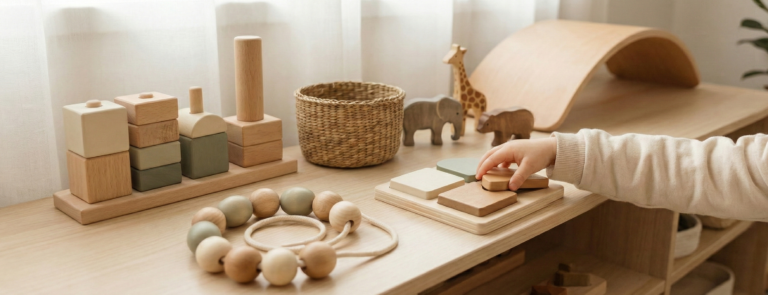
Three-year-olds are fascinating.
One moment they’re intensely focused on buttoning their own coat for five full minutes. The next, they’re narrating an elaborate story about how their stuffed bear needs to go to the doctor because he ate too much honey.
They want to do everything themselves—until they don’t. They’re building increasingly complex structures with blocks, then gleefully knocking them down. They’re practicing real skills (pouring water, sweeping floors) and exploring imaginary worlds (this stick is a magic wand, those rocks are dinosaur eggs).
This is the age where independence, imagination, and skill-building converge.
The toys that work best for three-year-olds honor all of this: the drive to master real skills, the explosion of imaginative play, the need for increasingly complex challenges, and the fierce determination to do things independently.
Here’s what actually supports a three-year-old’s development—and what you can skip.
What’s Actually Happening at Age Three
Before we talk about specific toys, let’s understand what developmental work three-year-olds are engaged in. This isn’t about hitting milestones on a chart—it’s about what you observe daily.
The Independence Explosion
By three, children have moved from “I want to help” to “I can do it myself!”
What this looks like:
- Dressing themselves (mostly successfully, occasionally backwards)
- Pouring their own drinks (with varying degrees of spilling)
- Using the toilet independently (for many, though accidents still happen)
- Helping with real household tasks (setting the table, sorting laundry, sweeping)
- Making simple choices (which shirt to wear, what snack to have)
Why materials matter:
Toys and tools that support genuine independence—real pitchers they can pour from, child-sized brooms that actually sweep, puzzles they can complete without help—build competence and confidence.
Fine Motor Refinement
Between ages 2 and 3, fine motor skills make a significant leap.
What this looks like:
- Precise pincer grasp (picking up tiny objects with thumb and finger)
- Beginning scissor use (cutting along lines with supervision)
- Drawing recognizable shapes (circles, crosses, early attempts at letters)
- Threading beads with increasing speed
- Manipulating fasteners (large buttons, zippers, snaps)
- Using utensils effectively
Why materials matter:
Activities that isolate and practice these skills—threading, cutting, pegboards, dressing frames—build the hand strength and coordination needed for future writing and countless daily tasks.
Imaginative Play Deepening
Three is when pretend play becomes elaborate and sustained.
What this looks like:
- Extended scenarios (“We’re going on a trip. Pack your suitcase. Now we’re on the airplane.”)
- Role-playing (playing house, pretending to be animals, acting out stories)
- Using props symbolically (a block becomes a phone, a scarf becomes a river)
- Creating narratives (telling stories through play, talking to toys as characters)
Why materials matter:
Open-ended toys that can become anything the child imagines—simple figures, fabric scraps, blocks, natural materials—support this psychological and cognitive work better than toys with predetermined functions.
Spatial Reasoning and Building Skills
Three-year-olds can create increasingly complex structures and patterns.
What this looks like:
- Building elaborate block towers and structures
- Creating patterns (color patterns, shape patterns)
- Completing 12-24 piece puzzles
- Understanding spatial relationships (inside/outside, on top/underneath, next to)
- Beginning to plan structures before building (not just random stacking)
Why materials matter:
Building materials that offer progressive challenge—blocks, magnetic tiles, interlocking toys—support this developing spatial intelligence and problem-solving capacity.
Language Explosion
Vocabulary and grammar explode around age three.
What this looks like:
- Speaking in complex sentences (5-6 words or more)
- Asking constant “why?” questions
- Telling simple stories
- Beginning to understand and tell jokes
- Using language to negotiate and problem-solve
Why materials matter:
Toys that invite conversation—animal figures to name and categorize, books to discuss, materials that prompt questions—support this language development naturally.
What to Look For in Toys for Three-Year-Olds
Not every toy marketed for this age actually serves three-year-old development. Here’s what genuinely matters:
✓ Supports Real Independence
Can your child use this toy from start to finish without adult help? Does it support real skills (pouring, cutting, fastening) or real contribution (cooking tools, cleaning tools)?
Good: Child-sized pitcher, real scissors with rounded tips, dressing frame
Not ideal: Complicated toy requiring adult setup every time, pretend tools that don’t actually function
✓ Offers Progressive Challenge
Does the toy have room to grow? Can it be used simply at first, then in more complex ways as skills develop?
Good: Wooden blocks (simple stacking → complex structures), Magna-Tiles (flat patterns → 3D buildings)
Not ideal: Single-function toy that’s mastered in one session with no room for advancement
✓ Open-Ended and Imaginative
Can this become different things based on the child’s imagination? Does it invite creative thinking rather than dictating one “correct” use?
Good: Play silks, simple wooden figures, natural materials, blocks
Not ideal: Electronic toys with predetermined responses, character toys that only “are” one thing
✓ Natural Materials When Possible
Does the toy provide real sensory information through weight, texture, temperature? Or is it lightweight plastic that all feels the same?
Good: Wooden toys, metal tools, fabric, natural objects
Not ideal: Hollow plastic that provides minimal tactile feedback
✓ Self-Correcting
Does the material provide its own feedback? Can the child tell if they’re successful without adult validation?
Good: Puzzles (pieces fit or they don’t), pouring activities (water stays in cup or spills), blocks (tower stands or falls)
Not ideal: Toys requiring constant adult confirmation of “correct” use
Fine Motor Development: The Foundation
Fine motor skills are developing rapidly at three. These materials support that work genuinely.
1. Threading and Lacing Activities
What it does:
Develops hand-eye coordination, bilateral coordination (both hands working together), focus, and pincer grasp refinement.
Why it works at this age:
Three-year-olds can handle smaller beads and more complex lacing patterns than younger toddlers. The activity invites sustained concentration and visible completion (you can see the beads collecting on the string).
Product recommendation:
Melissa & Doug Primary Lacing Beads

Large wooden beads in primary colors with thick laces. The beads are sized well for three-year-old hands—small enough to require precision, large enough to prevent frustration. The laces are stiff enough to thread without constant frustration.
What’s developing: Hand-eye coordination, focus, bilateral coordination, pattern-making (if the child chooses to create color patterns), fine motor precision.
How to present: Beads in a small basket with 1-2 laces. Child chooses beads, threads them, creates their own pattern or follows a simple card if interested. Can string them all, then slide them off to start again. The repetition is the learning.
Price: $14-18
Melissa & Doug Primary Lacing Beads
2. Counting Peg Board
What it does:
Isolates fine motor skill (placing pegs precisely in holes) while introducing early math concepts naturally.
Why it works at this age:
The pincer grasp and hand-eye coordination required to place pegs develops the exact finger movements used in writing. The numbered boards (1-10) begin unconscious number recognition without forcing counting if the child isn’t ready.
Product recommendation:
Montessori Counting Peg Board Set
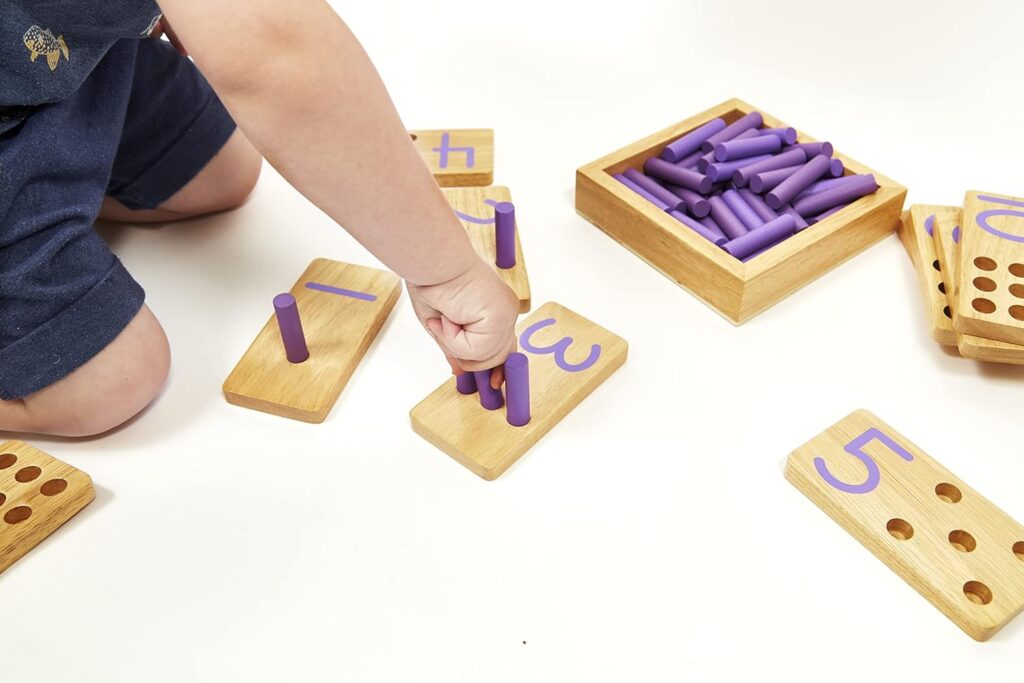
Ten wooden boards numbered 1-10 with corresponding holes. 55 wooden pegs in multiple colors. Storage bag and box included. Natural hardwood construction.
What’s developing: Pincer grasp strength, hand-eye coordination, one-to-one correspondence (one peg per hole), focus and concentration, early number awareness, color recognition and sorting.
How to present: Start with boards 1-3. Child places pegs in holes. The activity is the placement—the fine motor work. Counting can come later if/when the child shows interest. At three, the hand work matters more than the math.
Extended use: At three, it’s fine motor practice. At four, they might sort pegs by color or create patterns. At five, they use it for actual counting and early addition. One material, multiple years of use.
Price: $30-35
Counting Peg Board – Wooden Math Manipulative
3. Child-Safe Scissors and Cutting Activities
What it does:
Develops bilateral coordination (one hand holds paper, the other cuts), hand strength, and the specific thumb/finger motion used in scissor cutting.
Why it works at this age:
Most three-year-olds are ready to begin scissor work with supervision. The motion builds hand strength and coordination while providing visible, satisfying results (I cut the paper!).
Product recommendation:
Fiskars Blunt-Tip Kids Scissors

These have safety features (blunt tips, finger guards) while still actually cutting paper. Many “kid scissors” are so dull they don’t work—these cut real paper while remaining safe for supervised use.
What’s developing: Bilateral coordination, hand strength, thumb opposition (the movement of thumb moving away from and toward fingers), focus, sense of capability.
How to present: Start with cutting playdough snakes (easier than paper). Then strips of paper. Then cutting along lines. Provide scrap paper, old magazines, construction paper. The cutting itself is the activity—they don’t need to “make” anything.
Safety note: Always supervised. Store scissors out of reach when not in use. Three-year-olds are ready for scissor practice, not unsupervised scissor access.
Price: $4-6
Fiskars Blunt-Tip Kids Scissors
4. Dressing Frames (Practical Life Skills)
What it does:
Isolates specific dressing skills (buttoning, zipping, snapping, buckling) for focused practice outside the time pressure of actually getting dressed.
Why it works at this age:
Three-year-olds desperately want to dress themselves but struggle with fasteners. Practicing on a flat, stable frame (not on their own moving body) allows skill development without frustration.
Product recommendation:
Kiddison Montessori Dressing Frames – Set of 6
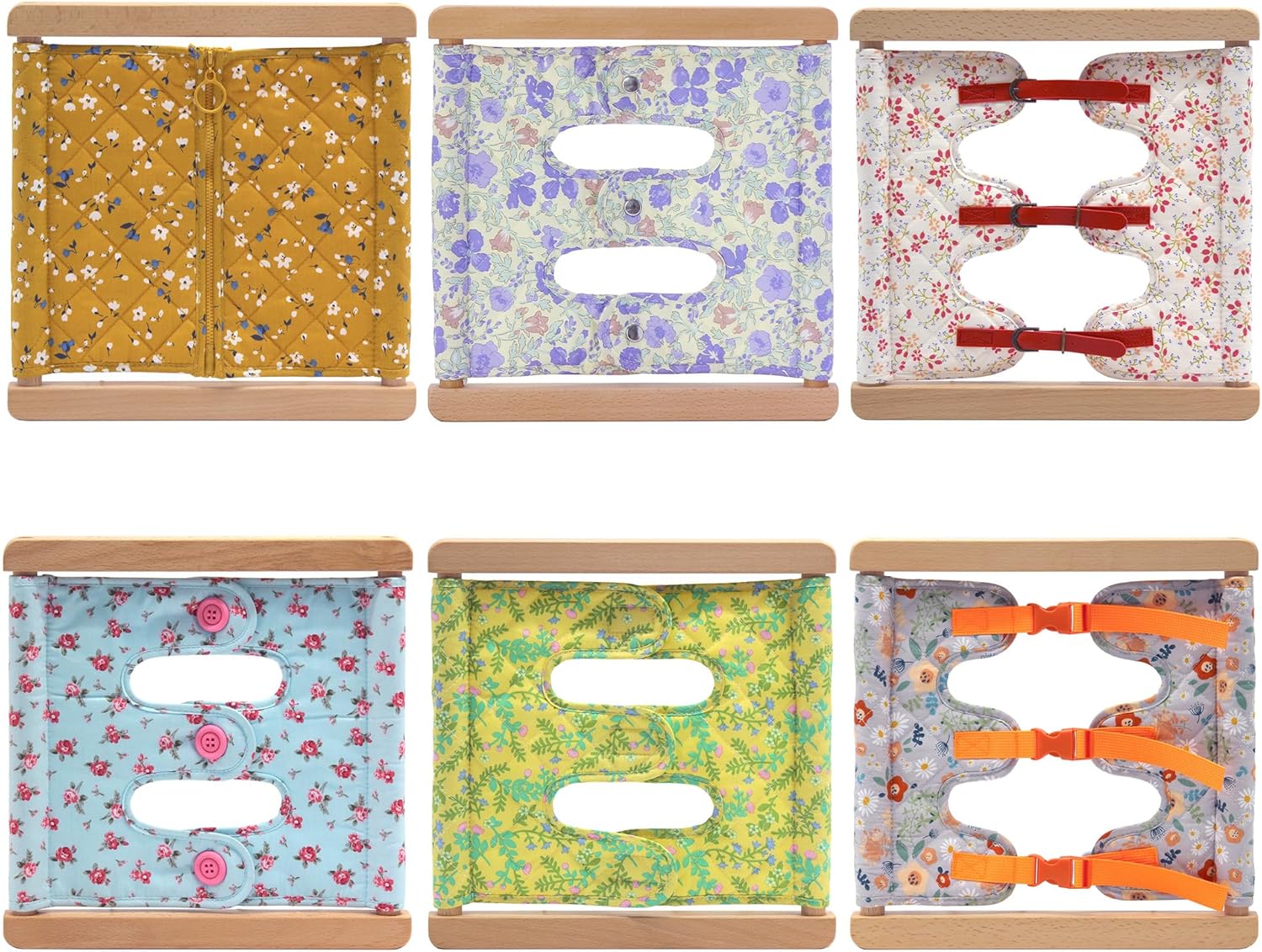
Six wooden frames featuring: large buttons, small buttons, buckles, snaps, zippers, and bow ties. Each 12″ x 12″ frame has fabric panels with functional fasteners.
What’s developing: Fine motor precision, bilateral coordination, sequencing (button from bottom to top), problem-solving, independence in self-care, persistence.
Developmental progression:
- Age 3: Work on large buttons and buckles
- Age 3.5: Add snaps (requires more finger strength)
- Age 4+: Small buttons, zippers, bow ties
How to present: Keep 1-2 frames accessible. Demonstrate once slowly without talking. Then let them practice. The struggle is the learning. Resist fixing mistakes immediately.
Price: $160-170 for set of 6
Kiddison Montessori Dressing Frames
Budget alternative: Basket with real clothing items (jacket with zipper, shirt with buttons, pants with snap) serves similar purpose.
Practical Life: Real Work, Real Skills
Three-year-olds want to participate in real household work. These materials support genuine contribution.
5. Child-Size Kitchen Tools (Functional, Not Pretend)
What it does:
Allows real participation in food preparation—cracking eggs, stirring, spreading, pouring, measuring.
Why it works at this age:
Three-year-olds can handle real food preparation tasks with appropriate tools. This builds competence, contributes meaningfully to the household, and develops practical skills they’ll use for life.
What you need:

Learning Tower/Step Stool:
Brings child to counter height for safe participation.
AVDAR Toddler Standing Tower ($220) – Adjustable, stable, enclosed platform
OR budget alternative: Sturdy two-step stool with handles ($30-50)
AVDAR Adjustable Kitchen Learning Tower

Crinkle Cutter or Lettuce Knife:
Wavy blade, child-safe, cuts soft foods effectively ($8-12)
Child-Safe Knife:
Look for nylon or wooden knife designed for children. Actually cuts soft foods (bananas, cooked vegetables, cheese) while being safe for supervised use.
What’s developing: Real life skills, confidence, contribution to family, sequencing (first this step, then this), measurement concepts, cause-and-effect, fine and gross motor skills.
How this works: Child helps with actual meal preparation. Making scrambled eggs together. Washing vegetables for dinner. Spreading peanut butter on bread. Pouring ingredients for pancakes. This isn’t pretend—it’s real contribution.
6. Pouring and Transferring Materials
What it does:
Develops wrist control, hand-eye coordination, concentration, and understanding of volume, capacity, full/empty.
Why it works at this age:
Three-year-olds have the control for more precise pouring than younger toddlers. They can work with smaller containers, liquid (not just dry materials), and more complex transferring sequences.
What you need:

Small Pitchers:
Yarlung Glass Pitcher Set – 12 oz clear glass pitchers (4-pack), square base for stability, see-through for learning ($19)
Yarlung Small Glass Pitchers – Set of 4
Trays for Containing Activities:

Wood Grain Serving Trays – Raised edges contain spills, easy to clean ($10 for 2)
Materials to transfer: Water, dried beans, rice, small pompoms, shells, marbles
How to present: Two bowls on a tray with a pitcher. Pour from one bowl to pitcher, then pitcher to second bowl. The activity is the pouring—the control, the concentration. Spills provide feedback (angle was wrong, pour was too fast). Child cleans spills with accessible cloth.
What’s developing: Hand-eye coordination, wrist rotation and control, concentration, cause-and-effect understanding, self-correction, independence (can do entire sequence alone including cleanup).
7. Child-Size Cleaning Tools That Actually Work
What it does:
Allows real participation in household cleaning—sweeping, mopping, wiping surfaces, dusting.
Why it works at this age:
Three-year-olds genuinely want to help clean. When given tools that actually function (not toy versions), they can contribute meaningfully. This builds competence and belonging.
The challenge: Most commercial “child cleaning sets” don’t work well. The Melissa & Doug wooden set has ineffective bristles and lightweight handles.
Better approach – source individual pieces:
Small Real Broom:
Look for child-height broom (24-30″) with actual bristles that sweep. IKEA children’s section, hardware stores, or quality Montessori suppliers.
Metal Dustpan:
Real metal dustpan that actually scoops (not toy plastic). Child-height handle.
Spray Bottle and Cloth:
Small spray bottle filled with water (or water with tiny bit of vinegar). Accessible cloth on low hook.
What’s developing: Gross motor coordination, bilateral coordination, task completion, pride in contribution, understanding of cause-and-effect (if I sweep, the floor gets clean), independence, practical life skills.
How this works: Child sees you sweeping. They get their broom. They sweep alongside you or in their own area. The floor might not get perfectly clean—that’s not the point. The point is real participation, skill practice, contribution.
Price: $35-50 (sourced individually for quality) vs. $30-35 (commercial set that frustrates more than it helps)
Puzzles and Problem-Solving
Three-year-olds are ready for significantly more complex puzzles than they handled at two.
8. Wooden Interlocking Puzzles (24-48 Pieces)
What it does:
Develops spatial reasoning, visual memory, problem-solving, pattern recognition, and sustained focus.
Why it works at this age:
Three-year-olds can handle puzzles where pieces connect to each other (not just fit in frame). This is a significant cognitive leap—understanding that pieces relate to adjacent pieces, not just to a fixed board.
Product recommendation:
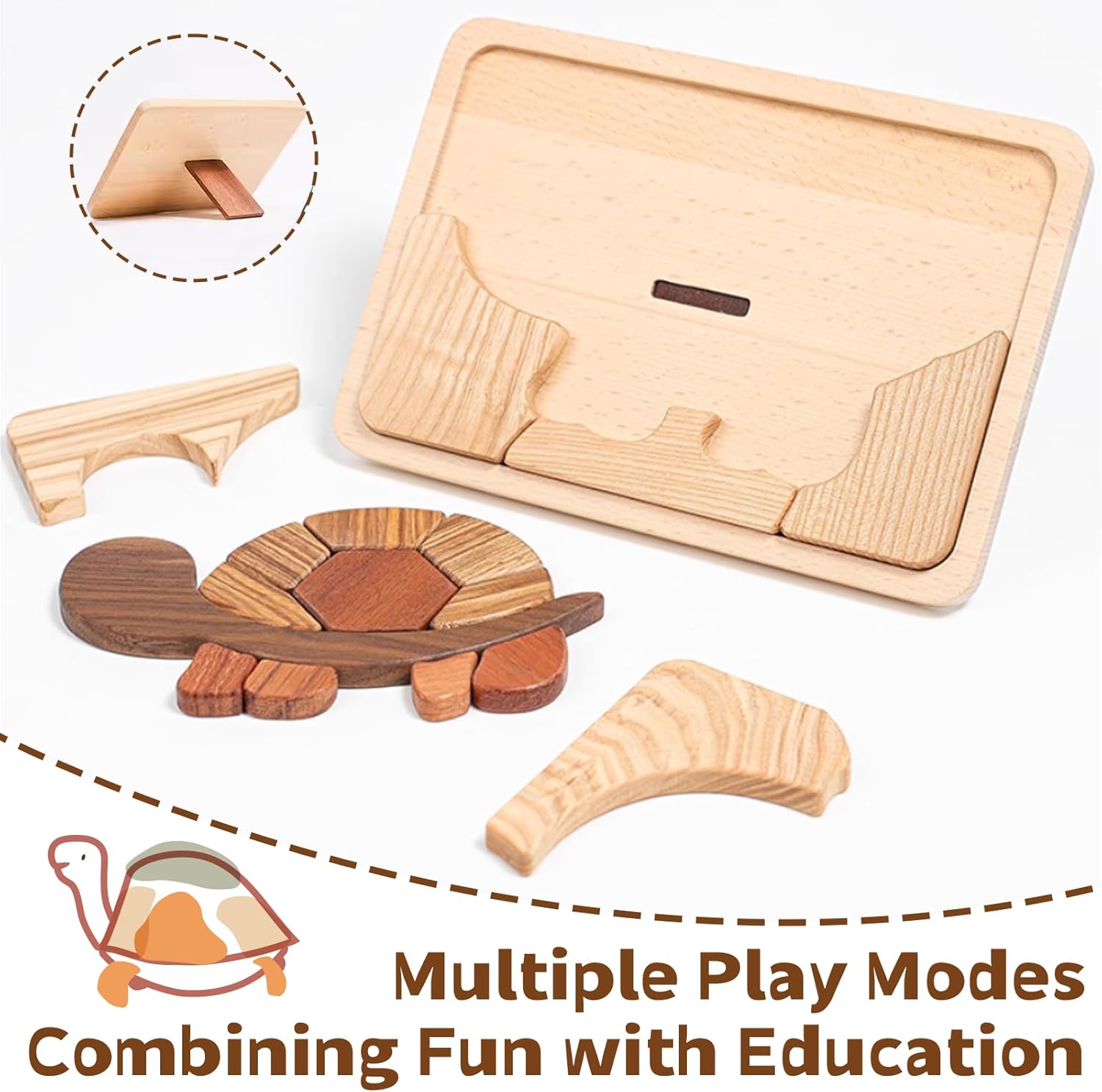
Adena Montessori 3D Creative Wooden Puzzle Set – Turtle
A wooden puzzle featuring a detailed turtle design with interlocking pieces. The three-dimensional aspect means pieces have depth and create a sculptural quality when assembled.
Developmental progression:
- Early threes (3.0-3.5): 12-24 piece puzzles
- Mid-threes (3.5-4): 24-36 piece puzzles
- Late threes (approaching 4): 36-48 piece puzzles
The cognitive leap:
Interlocking pieces require understanding that shapes must match on multiple sides—not just fitting into a space, but connecting to adjacent pieces. This demands spatial reasoning at a more abstract level.
What’s developing:
Abstract spatial reasoning, systematic problem-solving (testing piece orientations), visual memory (remembering what part of the image you’re looking for), pattern recognition, persistence through challenge.
Price: $20
Adena Montessori 3D Wooden Turtle Puzzle
9. Pattern Blocks
What it does:
Teaches shape recognition, pattern-making, spatial relationships, early geometry concepts, and creative design.
Why it works at this age:
Three-year-olds love creating patterns and designs. Pattern blocks can be used simply (filling in pattern cards) or creatively (free design). They grow with the child for years.
Product recommendation:
Wooden Pattern Blocks Set with Pattern Cards

300 wooden geometric shapes (triangles, squares, diamonds, hexagons, trapezoids). Includes pattern cards showing designs to recreate. Natural wood or colored.
What’s developing: Shape recognition and naming, spatial reasoning, pattern-making, understanding geometric relationships (two triangles make a square), creativity, problem-solving, visual discrimination.
How to use:
- Age 3: Simple pattern card following (match shapes to template)
- Age 4: More complex patterns, beginning free design
- Age 5+: Creating original designs, understanding shape relationships
Why wooden over plastic: Weight and tactile feedback. The substantial feel of wooden blocks provides sensory information plastic doesn’t. Pieces stay where placed rather than sliding around.
Price: $17
Wooden Pattern Blocks with Design Cards
Building and Construction
Three-year-olds can create increasingly sophisticated structures.
10. Wooden Unit Blocks (Expanded Set)
What it does:
Supports spatial reasoning, balance, cause-and-effect, planning, creativity, and mathematical thinking (proportions, symmetry, patterns).
Why it works at this age:
Three-year-olds move beyond simple stacking to deliberate construction. They plan structures (“I’m building a garage for my cars”), problem-solve when designs don’t work, and create increasingly elaborate buildings.
Product recommendation:
Pidoko Kids Wooden Blocks (100-piece set)

Natural wood blocks in standard unit measurements. Includes rectangles, squares, curves, triangles, columns, arches. Stored in wooden box.
Why unit blocks specifically: The mathematical precision (two half-units equal one full unit, four quarter-units equal one full unit) provides unconscious preparation for mathematical thinking. Children don’t need to know this consciously—they absorb it through building.
What’s developing: Spatial reasoning, balance, gravity and cause-and-effect, planning and problem-solving, creativity, early mathematical concepts (size relationships, symmetry), focus.
How this evolves:
- Age 3: Simple buildings, towers, enclosures, roads
- Age 4: More complex structures with planning (“I’m making a castle with a bridge”)
- Age 5+: Elaborate multi-level structures, integration with other toys
Price: $30-40 (100-piece set)
11. Magna-Tiles Clear Colors (100-Piece Set)
What it does:
Magnetic tiles that connect to create flat patterns or 3D structures. Translucent colors beautiful with light.
Why it works at this age:
The magnetic connection is forgiving—structures hold together better than blocks alone. Three-year-olds can create successful buildings with less frustration. The transparent colors add visual interest and exploration (what happens when colors overlap?).
Product recommendation:
Magna-Tiles Clear Colors 100-Piece Set
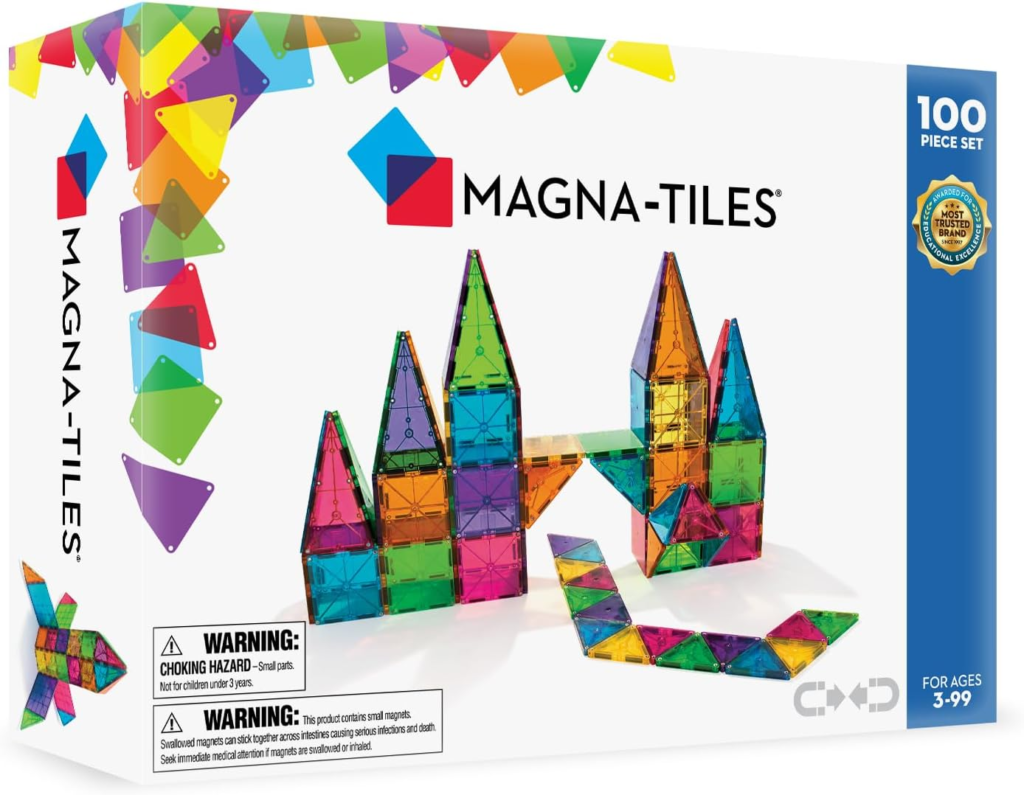
Includes squares and triangles in various sizes. All pieces compatible with each other and with additional Magna-Tiles sets if you expand later.
What’s developing: Spatial reasoning, pattern-making, problem-solving, color exploration, 3D thinking (flat patterns become dimensional structures), creativity, engineering concepts.
Developmental progression:
- Early threes: Flat pattern-making, simple 3D cubes and houses
- Mid-threes: More complex structures (garages, castles, towers)
- Late threes: Elaborate buildings, understanding of structural stability
Why the 100-piece set: Provides enough tiles for ambitious projects without overwhelming choice. Can always add more later if interest is sustained.
Investment note: At $113, this is expensive. But ask parents who own them—Magna-Tiles consistently get used daily for years. Calculate cost per use over 3-4 years of regular play.
Price: $110-120
Magna-Tiles Clear Colors 100-Piece Set
See our complete Magna-Tiles vs. Generic comparison for why quality matters with magnetic tiles.
Imaginative Play Materials
Three is when pretend play deepens significantly. These materials support that work.
12. Realistic Animal Figures
What it does:
Supports vocabulary development, categorization, imaginative play, and understanding of the natural world.
Why it works at this age:
Three-year-olds engage in elaborate pretend scenarios with figures. Animal figures become characters with relationships, habitats, problems to solve. The realistic appearance helps children learn what animals actually look like while supporting imaginative narratives.
Product recommendations:
Safari Ltd TOOBS – Wild Animals

8-12 realistic animal figures per tube. Detailed sculpting and painting. Appropriately sized (2-3 inches). Multiple themes available (safari, farm, ocean, dinosaurs).
What’s developing: Language (naming animals, describing actions, creating narratives), categorization (farm vs. wild, habitats), imaginative thinking, fine motor (manipulating small figures), sorting and organizing.
How children use these:
- Creating habitats with blocks or play silks
- Acting out animal behaviors and relationships
- Sorting by type, size, habitat
- Combining with puzzles or books about animals
- Creating stories and scenarios
Why realistic vs. cartoonish: At three, children are still building understanding of what animals actually are. Realistic figures support accurate learning. Cartoon versions can come later when foundation is solid.
Price: $12-16 per set
Safari Ltd. South American Animals TOOB
13. Play Silks (Natural Fabric)
What it does:
Becomes literally anything the child imagines—capes, rivers, blankets, tents, mountains, scarves, costumes, tablecloths.
Why it works at this age:
The open-endedness is perfect for three-year-old imaginative play. The fabric drapes, flows, and transforms based entirely on the child’s ideas. No predetermined function means infinite possibilities.
Product recommendation:
Sarah’s Silks Rainbow Play Silk Set

Three large squares (35″ x 35″) of real silk in rainbow, sky blue, and purple. Hand-washable, gets softer over time.
What’s developing: Imaginative thinking, creative problem-solving, fine and gross motor (draping, arranging, tying), narrative building, symbolic thinking.
How children use these:
- Dress-up (capes, scarves, skirts, crowns)
- Building (tents, caves, walls, roofs)
- Pretend scenarios (ocean, sky, grass, lava)
- With other toys (blankets for dolls, rivers for animals, roads for cars)
- Dancing and movement
Why real silk: The material matters. Silk drapes and flows in ways polyester doesn’t. It’s naturally beautiful, feels wonderful, and transforms easily. The sensory quality is part of the value.
Price consideration: At $50-55 for three silks, this is an investment. Polyester alternatives cost $15-20 but don’t drape or feel the same. Consider which matters more for your family.
Price: $50-55 for set of 3
Sarah’s Silks Rainbow Play Silk Set
14. Simple Wooden Dolls or Peg People
What it does:
Provides open-ended figures that can represent anyone/anything the child imagines.
Why it works at this age:
Unlike character toys (which can only be that character), simple wooden figures can be family members, friends, people in the child’s stories—whoever the narrative needs.
Product recommendation:
Natural Unfinished Wooden Peg Doll Bodies

Simple wooden figures without facial features or fixed identities. Natural wood or rainbow colors. Various sizes available (representing adults, children, babies).
What’s developing: Imaginative narrative building, role-playing, social/emotional processing (playing out relationships and scenarios), language development, creative thinking.
How children use these:
- Family play (creating household scenarios)
- Acting out stories
- Combining with blocks (building houses for people)
- Processing experiences (playing doctor, playing school, playing scenarios they’ve experienced)
Why without faces: The lack of predetermined features means the figure can be anyone. Today it’s mommy, tomorrow it’s a firefighter, next week it’s a character from a story. The ambiguity supports imagination rather than limiting it.
Price: $20-30 for a set
Natural Unfinished Wooden Peg Doll Bodies
Art and Creative Expression
Three-year-olds are ready for more varied art materials and sustained creative work.
15. Quality Art Supplies
What it does:
Provides materials for creative expression, fine motor development, color exploration, and process-focused art making.
Why it works at this age:
Three-year-olds can handle more art materials than younger toddlers. They have the fine motor control for drawing recognizable shapes, the focus for sustained art projects, and the creative thinking for self-directed expression.
What to provide:
Drawing Materials:
- Crayons: Beeswax crayons (richer colors, better for young hands than standard wax)
- Markers: Washable broad-tip markers
- Colored pencils: Triangular grip pencils for proper hold development
Painting:
- Watercolors: Quality watercolor set (not the $2 plastic ones—colors should actually be vibrant)
- Brushes: Various sizes, thick handles for easier grip
- Paper: Heavy paper that won’t disintegrate when wet
3D Materials:
- Playdough: Homemade or natural store-bought
- Clay: Natural clay for more permanent creations
- Collage materials: Paper scraps, fabric, natural materials to glue
What’s developing: Fine motor control (precise hand movements), creativity and self-expression, color recognition and mixing, process over product thinking, focus and concentration.
How to present: Accessible art shelf with rotating materials (not everything out at once). Child can choose materials and work independently. No “making” anything specific—process matters more than product.
Price range: $40-60 for quality basic art supply collection
Specific recommendations:
- Stockmar Beeswax Crayons ($15-20 for stick or block crayons)
- Melissa & Doug Deluxe Standing Art Easel ($60-80) if space and budget allow
- Natural Earth Paint Kit ($25-35) for nature-based painting
What to Skip at This Age
Knowing what doesn’t serve three-year-old development saves money and space.
❌ Electronic Learning Toys
Why skip: Three-year-olds learn through hands-on manipulation and real-world experience, not through screens or buttons that respond automatically. Electronic feedback is arbitrary—it doesn’t provide the concrete cause-and-effect learning that physical materials do.
Better: Simple materials that respond to the child’s actions (blocks fall or stand, puzzles fit or don’t, pouring succeeds or spills).
❌ Character-Branded Toys
Why skip: Branded toys (Disney, superhero, TV characters) dictate how play should go. The child recreates screen stories rather than creating their own. This limits rather than expands imaginative thinking.
Better: Generic figures and materials that can become anything the child imagines.
❌ Toys with Too Many Features
Why skip: Busy boards trying to teach colors, numbers, letters, shapes, and animal sounds all at once create confusion, not learning. When a toy tries to do everything, it teaches nothing clearly.
Better: Materials that isolate one skill or concept at a time.
❌ Cheap Versions of Quality Toys
Why skip: Puzzles with pieces that don’t fit properly, blocks that are too lightweight to stack well, plastic pegboards that slide around—these create frustration rather than skill-building.
Better: Fewer, higher-quality materials that actually function as intended. One good wooden puzzle beats three cheap ones that frustrate.
❌ Toys That Require Constant Adult Setup
Why skip: If you have to reset the toy every few minutes, it’s preventing independence, not supporting it. It also interrupts the child’s focus constantly.
Better: Materials the child can use from start to finish independently—puzzles they can complete and dump out themselves, activities they can set up and clean up alone.
How to Set Up Materials for Three-Year-Olds
Having good toys is half the equation. Presentation matters too.
The Low Shelf System
Why it works:
Materials on low, accessible shelves communicate: “You can choose. You can use this independently. You are capable.”
How to set up:
- Low shelf at child height (IKEA Kallax is standard)
- 8-12 activities visible and accessible
- Each activity on its own tray or in its own basket
- Space between materials (not crowded)
- Rotate materials every 1-2 weeks
Example shelf for a three-year-old:
- Puzzle (12-24 pieces)
- Lacing beads with lace
- Counting peg board
- Small basket with animal figures
- Magna-Tiles in low bin
- Pattern blocks with cards
- Art basket (accessible materials rotating)
- Small basket with books
Rotation Prevents Overwhelm
Why rotation matters:
When materials are always available, they become invisible. When rotated out and brought back, they’re interesting again.
How to rotate:
- Keep 40-50% of toys in storage
- Swap 2-4 items weekly or bi-weekly
- Watch what gets used—keep those accessible longer
- Rotate out mastered items or things consistently ignored
See our complete guide: The Montessori Toy Rotation System
Age-Appropriate Expectations
Independent Play Duration
Realistic for age three: 20-30 minutes of sustained, focused play
What this looks like:
- Building with blocks for 25 minutes
- Working on a puzzle for 20 minutes
- Extended pretend play scenario for 30 minutes
- Art project for 20-30 minutes
This assumes: Child is rested, fed, emotionally regulated, and has materials at appropriate challenge level.
Not realistic: Hour-long independent play sessions. That comes later (ages 4-5+).
Frustration Tolerance
What to expect:
Three-year-olds can persist through moderate challenge but still need adult support during genuine frustration.
Your role:
- Observe from nearby (secure base)
- Resist jumping in to fix immediately
- Acknowledge frustration: “That’s challenging. You’re working hard on it.”
- Offer help only if truly stuck: “Would you like me to hold this while you…?”
The balance: Enough challenge to build skills, not so much that they give up entirely.
Cleanup Capability
What’s realistic:
Three-year-olds can clean up independently IF:
- Materials have clear homes (tray, basket, specific shelf spot)
- Number of items is manageable (not 60 pieces scattered everywhere)
- Adult models the process initially
- Expectations are clear and consistent
How to support: “Time to clean up. Let’s put the animals back in their basket. The blocks go on this shelf.”
Initially you work alongside. Gradually you step back: “You’re putting the animals away. I’ll watch.”
Eventually: “Clean up time” is enough—the child knows the routine and manages independently.
Investment Priorities for Three-Year-Olds
If budget is limited, invest in these categories first:
Priority 1: Practical Life Tools
Learning tower or step stool, small pitcher, basic kitchen participation tools. Why: Real skill-building, genuine contribution, builds confidence through real capability.
Priority 2: Fine Motor Materials
Quality puzzles (2-3 at different difficulty levels), threading/lacing activity, pegboard OR dressing frames. Why: Hand development foundational for all future skills.
Priority 3: One Quality Building Material
Wooden blocks OR Magna-Tiles (not necessarily both immediately). Why: Spatial reasoning, creativity, open-ended use for years.
Priority 4: Imaginative Play Materials
Animal figures OR simple dolls/people, play silks OR fabric scraps. Why: Supports psychological work and creative thinking.
Priority 5: Art Supplies
Basic quality materials (good crayons, paints, paper). Why: Creative expression and fine motor development.
Everything else can wait. You don’t need it all at once. Build slowly, thoughtfully, based on demonstrated interest.
When Materials Aren’t Working
If your three-year-old consistently ignores materials that should be developmentally appropriate:
Check the difficulty level
Too easy = boredom and avoidance
Too hard = frustration and avoidance
Just right = engaged focus for 15-30 minutes
Try: One level easier or one level harder. Observe what changes.
Check the presentation
Is it visible and accessible? Is it crowded on a cluttered shelf competing with 15 other things? Does it have a clear spot to return to?
Try: Moving it to more prominent shelf placement with space around it.
Check your involvement
Are you hovering? Correcting? Showing the “right way” repeatedly?
Try: Being nearby (secure base) but engaged in your own task. Let them explore without commentary.
Check timing
Is this being offered when they’re hungry, tired, or dysregulated?
Try: Offering during optimal times (mid-morning after breakfast, late afternoon after rest).
The Real Goal
This isn’t about having the perfect Montessori playroom. It’s not about your three-year-old mastering specific skills by specific deadlines.
It’s about supporting the work they’re already doing:
- Building independence through real capability
- Refining fine and gross motor skills
- Exploring imaginative worlds
- Developing spatial reasoning and problem-solving
- Contributing to the household meaningfully
- Expressing creativity and ideas
Good materials support this work. They don’t force it, rush it, or overcomplicate it.
When you choose thoughtfully—when you observe what genuinely engages your child, what matches their current capabilities, what invites sustained focus—you’re not teaching them to play.
You’re honoring the work they’re already trying to do.
That’s what the best three-year-old “toys” actually are: tools for the work of childhood.
Related Posts:
What Makes a Toy “Montessori”? (And What Doesn’t) – Understanding the principles behind these recommendations
Complete Montessori Toy Guide for 2-Year-Olds – What worked at two, and what’s ready for retirement
How to Rotate Toys the Montessori Way (Less Overwhelm, More Engagement) – How to organize these materials for maximum engagement
Montessori vs. Waldorf: What’s the Actual Difference? – Different approaches to toy selection
The Wooden Puzzle Progression – Detailed guide to puzzle difficulty by age
Disclaimer: This post contains Amazon affiliate links. When you purchase through these links, I may earn a small commission at no additional cost to you. I only recommend products that genuinely align with Montessori principles and support three-year-old development based on my years as a Montessori Lead Guide and understanding of child psychology.