You’re standing in the playroom.
Toys everywhere. Bins overflowing. Shelves crowded. Things scattered across the floor that haven’t been touched in weeks.
Your child walks in, looks around, and says: “I’m bored. There’s nothing to play with.”
How is there nothing to play with when there are literally sixty toys in this room?
Here’s what’s actually happening: your child isn’t bored because they don’t have enough toys. They’re overwhelmed because they have too many.
The question isn’t “how can I get more interesting toys?” The question is: “How many toys does my child actually need?”
And the answer might surprise you.
The Research: What Studies Actually Show
Before I give you the practical answer, let’s look at what research tells us about children and toy quantity.
The German Study: Zero Toys for Three Months
In the 1990s, researchers in Germany tried something radical. They removed all toys from a preschool classroom for three months.
Zero toys. Nothing.
What happened?
The first week was difficult. Children didn’t know what to do with themselves. There was boredom, some conflict, uncertainty.
Then something shifted.
Children started creating games from nothing. They used chairs, blankets, their own bodies. They negotiated more, cooperated more, invented more. Their play became more creative, more sustained, more socially complex.
When toys were slowly reintroduced, children played differently. They were more selective, more focused, more creative with what they had.
The finding: Fewer toys encouraged deeper, more creative, more social play.
The University of Toledo Study: 4 Toys vs. 16 Toys
Researchers gave toddlers either 4 toys or 16 toys to play with during a session.
The result?
Children with 4 toys played longer with each toy, explored more ways to use each toy, and showed more creative and varied play.
Children with 16 toys flitted between toys, played superficially with each, showed less creativity, and had shorter attention spans.
The finding: Fewer toys = longer, deeper, more creative play.
What Child Development Research Tells Us
Across multiple studies, the pattern is consistent:
More toys correlates with:
- Shorter attention spans
- More superficial play
- Less creativity
- More overwhelm
- Less sustained focus
Fewer toys correlates with:
- Longer play sessions
- Deeper exploration
- More creative use of materials
- Better focus
- More invention and imagination
This isn’t about deprivation. It’s about optimal development.
The Actual Number (And Why It’s Not What You Think)
So what’s the magic number?
Here’s what I’ve observed after years in Montessori classrooms and working with families:
Children thrive with 6-12 toys accessible at once.
Not 60. Not 30. About 6-12.
Let me break down why—and what this actually looks like.
Why 6-12 Works
The brain can meaningfully process this many choices.
When faced with 6-12 clear options, a child can:
- Actually see what’s available
- Evaluate options without overwhelm
- Make a real choice based on interest
- Remember what they chose yesterday and decide if they want to return to it
When faced with 40+ toys:
- The brain goes into decision paralysis
- Nothing looks appealing because everything competes for attention
- The child can’t remember what’s even available
- Choice becomes meaningless noise
Each toy gets actual use.
With 6-12 accessible toys:
- Each material gets chosen and used regularly
- The child has time to develop mastery
- Repetition (the way children actually learn) is possible
- You notice what’s genuinely engaging
With 40+ toys:
- Most never get touched
- The child skims surfaces without depth
- Mastery doesn’t develop
- You have no idea what they actually like because nothing gets sustained attention
The environment stays manageable.
With 6-12 toys:
- Cleanup is actually possible for a child to do independently
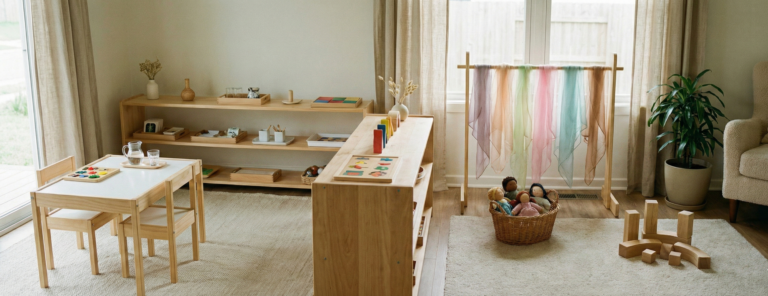
- Materials can have clear homes (this basket, that tray, specific shelf spot)
- The space feels calm, not chaotic
- You can maintain organization
With 40+ toys:
- Cleanup is impossible without adult intervention
- Nothing has a clear home
- The space feels chaotic
- Organization breaks down immediately
What “6-12 Toys” Actually Means
Before you panic and start counting every single item, let me clarify what we’re talking about.
One “Toy” = One Activity or Material Set
Examples of what counts as “one toy”:
- One puzzle (even if it has 24 pieces)
- One set of blocks (even if there are 60 individual blocks)
- One basket of animal figures (even if there are 10 animals)
- One Magna-Tiles set (even if there are 100 tiles)
- One art basket (with crayons, paper, scissors)
- One set of threading beads with laces
- One pegboard with pegs
- One play silk or set of silks
We’re counting coherent activities, not individual pieces.
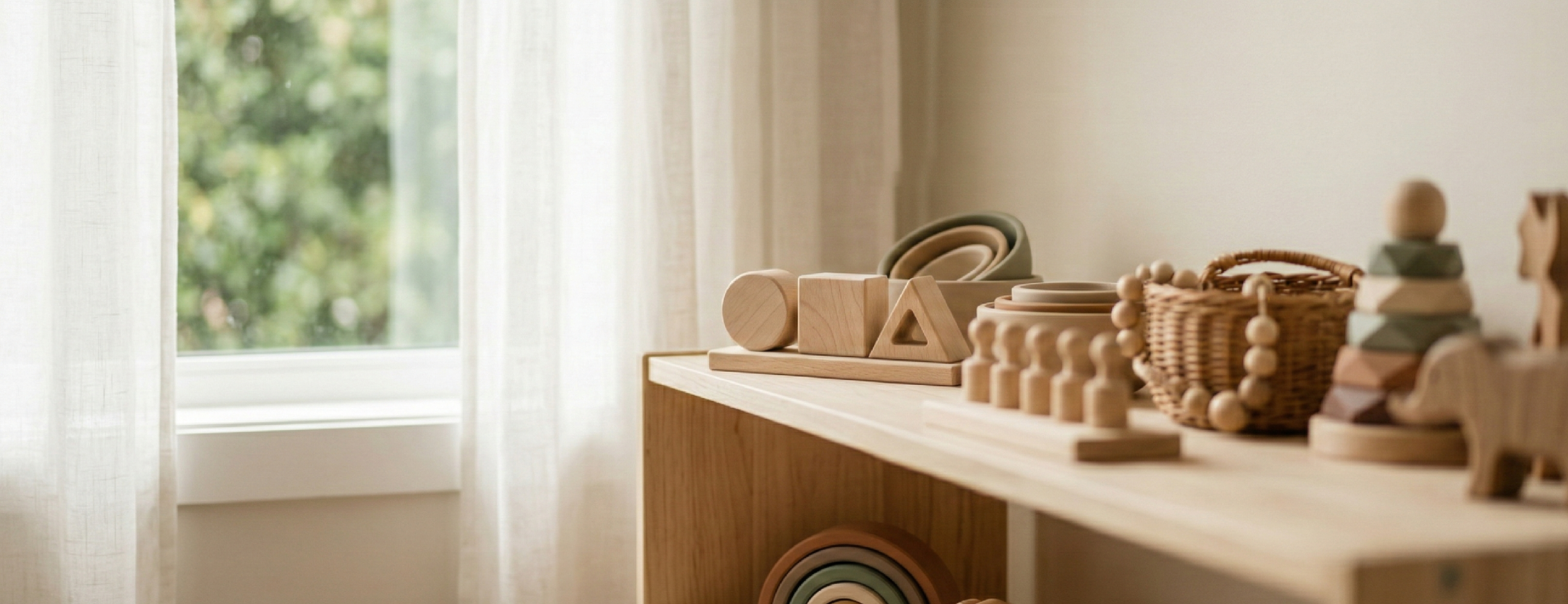
What an Actual 8-Toy Setup Looks Like
Here’s a real example for a 3-year-old:
Shelf setup:
- Wooden puzzle (12 pieces)
- Basket with animal figures (8-10 animals)
- Small set of wooden blocks (40-60 blocks)
- Magna-Tiles (in accessible bin)
- Threading beads with lace (on tray)
- Counting peg board with pegs
- Art basket (crayons, paper, simple materials)
- Small basket with 3-4 board books
That’s it. Eight activities. The entire accessible playroom.
And this is enough for hours of daily play, skill development, creativity, and engagement.
“But What About All the Other Toys?”
This is where rotation comes in.
You don’t need to own only 6-12 toys total. You need 6-12 accessible at once.
The rest are in rotation.
How Rotation Works
Total toy ownership: 20-40 toys (quality materials, not cheap plastic accumulation)
Accessible at once: 6-12 toys
In storage: The rest, organized in bins by category
Rotation schedule: Swap 2-4 toys every 1-2 weeks
The result: Materials feel new again when they reappear. Novelty is built into the system without constant purchasing.
See our complete guide: The Montessori Toy Rotation System for detailed how-to.
How Many Toys by Age
The 6-12 range is general guidance. Here’s how it adjusts by developmental stage:
Ages 6-12 Months
Accessible toys: 4-6 items
Why fewer: Young babies are still developing focus. Too many options create overwhelm. A few carefully chosen items allow sustained exploration.
What this looks like:
- Object permanence box
- Soft ball for grasping
- Simple rattle or shaker
- Board book
- Stacking rings or cups
- Wooden grasping toy
That’s enough. Babies return to the same items repeatedly—this repetition is how learning happens.
Ages 12-24 Months
Accessible toys: 6-8 items
Why this range: Toddlers can handle slightly more variety but still benefit from clear, limited choices. Focus is developing but still fragile.
What this looks like:
- Simple knobbed puzzle (3-4 pieces)
- Basket with 3-4 animal figures
- Stacking or nesting toy
- Push toy or pull toy
- Ball
- Board books
- Large wooden beads for threading (with adult supervision)
- Small basket with scarves or fabric scraps
Notice: Still very contained. Still manageable for a toddler to see, choose from, and help clean up.
Ages 2-3 Years
Accessible toys: 6-10 items
Why this range: Two-year-olds are developing sustained focus and can handle more variety. But too many choices still overwhelm.
What this looks like:
- 1-2 puzzles (different difficulty levels)
- Building material (blocks or Magna-Tiles)
- Basket with animal figures or dolls
- Threading or lacing activity
- Art supplies (crayons, paper)
- Play silks or fabric
- Simple musical instrument
- Books
- Practical life activity (pouring, transferring)
8-10 materials total. This provides variety across skill areas (fine motor, imaginative play, building, art) without overwhelming.
Ages 3-5 Years
Accessible toys: 8-12 items
Why this range: Preschoolers can sustain longer play sessions and handle more complex materials. They can manage slightly more variety while still benefiting from limitation.
What this looks like:
- 2-3 puzzles (progressive difficulty)
- Building materials (blocks and/or Magna-Tiles)
- Animal figures or small world play items
- Arts and crafts supplies
- Threading/lacing/pegboard activities
- Play silks or dress-up materials
- Books
- Board game or card game
- Science/exploration materials (magnifying glass, natural objects)
- Musical instrument
10-12 materials. Notice we’re still not talking about dozens. We’re talking about thoughtfully chosen materials across developmental areas.
Ages 5+ Years
Accessible toys: 10-15 items
Why more: Older children can manage more complexity, have broader interests, often have specific hobbies or passions developing.
What this looks like: Materials become more specialized based on demonstrated interests:
- Multiple building systems (LEGO, blocks, marble runs)
- Art supplies (expanded based on interest)
- Science materials (microscope, nature study tools)
- Sports equipment
- Musical instruments
- Books and puzzles
- Board games
- Craft materials
Even at this age, 10-15 accessible items is plenty. The difference is these materials are often more complex and open to longer, deeper engagement.
Quality Over Quantity: What Actually Matters
The number matters less than the quality and appropriateness of what you choose.
What Makes a Toy Worth Keeping
Before you decide what stays accessible, ask these questions:
1. Does my child actually use this?
If it’s been available for 3+ months and never chosen, it’s not serving them. Someone else could be using it.
2. Is it developmentally appropriate right now?
Too easy = boredom. Too hard = frustration. Just right = sustained engagement.
Materials can be stored and brought out later if they’re too advanced. No need to keep them accessible “just in case.”
3. Is it open-ended or single-use?
Open-ended materials (blocks, silks, figures, art supplies) = used in multiple ways, grow with the child, support creativity
Single-use materials (puzzle completed once with no replay value, toy that does one thing and gets boring) = limited value
4. Is it quality construction that will last?
Broken toys, incomplete puzzles, materials in poor condition = frustration and message that “things don’t matter”
Well-made materials = can be used fully, passed to siblings or friends, signal respect
5. Does it support real skill development?
Does it build fine motor skills, spatial reasoning, creativity, problem-solving, practical life skills, imagination?
Or is it just… there? Filling space but not actually contributing to development?
The One Good Toy > Five Mediocre Toys Rule
This is where the “less is more” principle becomes practical:
Scenario A:
Five cheap puzzles ($5 each = $25 total)
- Pieces don’t fit well
- Images are unclear
- Frustration rather than skill-building
- Break within months
- End up in the trash
Scenario B:
One quality wooden puzzle ($25)
- Pieces fit precisely
- Image is clear and engaging
- Actually teaches shape matching and spatial reasoning
- Lasts for years
- Gets passed to younger siblings
Same money. Wildly different outcomes.
This applies across categories:
- One good set of blocks > three sets of cheap blocks that don’t stack well
- One quality animal figure set > five random plastic animals
- One real art supply > five cheap markers that dry out
Buy less. Choose better. Use fully.
What This Looks Like in Real Life
Let me show you what happens when families actually implement this.
Before: The Overwhelmed Playroom
The situation:
- 60+ toys accessible
- Bins overflowing
- Shelves crowded
- Floor constantly covered in scattered toys
- Child says “I’m bored” despite abundance
- Parent spends 30+ minutes daily managing toy chaos
What the child does:
- Pulls out toy after toy
- Plays with each for 2-3 minutes
- Moves on without cleaning up
- Never develops mastery of anything
- Seems distracted, unfocused, “difficult”
The parent’s experience:
- Constantly buying new toys to combat boredom
- Frustrated by mess and lack of engagement
- Feels like nothing they buy is “right”
- Exhausted by the management
After: The Simplified Space
The change:
- Reduced to 8 accessible toys
- Each has clear spot on low shelf
- Everything else stored in closet
- Rotation happens every 2 weeks
What the child does:
- Spends 20+ minutes with single activities
- Returns to same materials multiple days in a row
- Completes puzzles multiple times (mastery-building)
- Plays more creatively with open-ended materials
- Can clean up independently (everything has a clear home)
The parent’s experience:
- Cleanup takes 5 minutes, child does most of it alone
- No longer buying toys constantly
- Can actually observe what child is working on
- Space feels calm
- Child seems more focused, content
This shift typically happens within 2-3 weeks of simplification.
The Psychological Reason This Works
Understanding why fewer toys create better outcomes helps you stick with it when you’re tempted to add more.
Decision Fatigue in Children
Adults experience decision fatigue—after making many decisions, our decision-making quality decreases.
Children experience this too, but more intensely.
When faced with 50 toy choices:
- The brain can’t process all options
- Decision-making becomes overwhelming
- The child shuts down or acts out
- Nothing seems appealing because everything is noise
When faced with 8 clear choices:
- The brain can evaluate options
- Decision-making is manageable
- The child can make a real choice based on interest
- Engagement follows
This is why children often play better at preschool (where 15 kids share limited materials) than at home (where one child has unlimited access to everything).
The Paradox of Choice
Psychologist Barry Schwartz documented this extensively: more choices often make us less happy, not more.
For children, this manifests as:
With too many toys:
- “I’m bored”
- Flitting between activities without depth
- Meltdowns and difficulty focusing
- Dissatisfaction despite abundance
With appropriate limitation:
- Sustained engagement
- Creative use of what’s available
- Ability to focus deeply
- Contentment with less
Limitation isn’t deprivation. It’s optimization for how the developing brain actually works.
The Development of Mastery
Children develop skills through repetition and mastery.
This requires:
- Returning to the same material multiple times
- Exploring it fully
- Practicing until competence develops
- Experiencing success
When toys are always available:
- There’s no reason to return to yesterday’s puzzle
- Mastery doesn’t develop because nothing gets sustained attention
- The child skims surfaces without depth
When toys are limited and rotated:
- The child returns to the same materials because they’re what’s available
- Repetition happens naturally
- Mastery develops
- Confidence builds
Less variety = more depth = actual learning.
How to Actually Reduce to This Number
If you’re currently at 60+ toys and need to get to 8-12, here’s how.
Step 1: The Audit (1-2 Hours)
Pull out every toy from every room, closet, and bin.
Yes, everything. You need to see the actual volume.
Sort into categories:
- Fine motor (puzzles, threading, pegboards)
- Building (blocks, Magna-Tiles, LEGO)
- Imaginative play (figures, dolls, dress-up)
- Art supplies
- Books
- Outdoor toys (separate—usually don’t rotate these)
- Random/miscellaneous
Step 2: The Evaluation (30 Minutes per Category)
For each category, evaluate each item:
Keep if:
- Age-appropriate right now
- In good condition (complete, functional, clean)
- Child has shown interest in past 3 months
- Open-ended with room for growth
- Quality construction
Discard/donate if:
- Broken, incomplete, or in poor condition
- Outgrown (too easy, no longer interesting)
- Never used despite being available for months
- Single-use with no replay value
- Poor quality (frustrates rather than engages)
Store for later if:
- Too advanced right now but will be appropriate within a year
- Sentimental value but not currently age-appropriate
- Seasonal (winter/summer specific)
Be ruthless. If it hasn’t been touched in 3 months, it’s not serving your child.
Step 3: Create the Active Set (30 Minutes)
From what you’re keeping, choose 6-12 items for immediate access.
Selection criteria:
Variety across developmental areas:
- 2-3 fine motor activities (puzzles, threading, pegboards)
- 1-2 building materials (blocks or Magna-Tiles, not necessarily both)
- 1-2 imaginative play items (animals, figures, silks)
- 1-2 art/creative materials
- 2-3 books
Range of difficulty:
- 2-3 items they’ve mastered (confidence builders)
- 3-4 items at current challenge level (where they’re working)
- 1-2 items slightly above (to grow into)
Current demonstrated interests:
- If they’re in a “building phase,” prioritize building materials
- If they’re into animals, include animal figures and related books
- Match the selection to what you’ve observed them gravitating toward
Step 4: Organize Storage (1 Hour)
For the active set:
- Place on low shelf at child height
- Each item in its own basket/tray/designated spot
- Space between items (not crowded)
- Clearly visible and accessible
For rotation materials:
- Organize in bins by category
- Label bins (helps you remember what’s stored)
- Store in closet, garage, under bed—accessible but out of child’s sight
- Keep organized enough that rotation is easy
For donate/discard:
- Pack immediately into donation bags
- Remove from house within 48 hours
- Don’t second-guess
- Someone else will actually use what your child has outgrown
Step 5: The Rotation Schedule (Ongoing)
Weekly or bi-weekly:
- Observe what’s getting used
- Notice what’s consistently ignored
- Note what seems mastered
- Watch for emerging interests
When rotating:
- Remove 2-4 items (mastered, ignored, or temporarily stored)
- Add 2-4 items from storage (haven’t been out recently, match current interests)
- Keep total accessible items at 6-12
The goal: Keep materials fresh and matched to current developmental work without accumulating clutter.
What About Gifts and Holidays?
This is where the system often breaks down. Here’s how to handle influx.
Before the Event: Set Expectations
With gift-givers:
“We’re working on reducing toy overwhelm. If you’d like to give [child] a gift, here are some ideas that would be wonderful:
- Experiences (zoo membership, museum passes, activity classes)
- Consumables (art supplies, playdough, bubbles, craft materials)
- Books
- Outdoor equipment (bike, sports items)
- Contributions to savings/future needs”
Most people appreciate guidance. They want to give something the child will use and enjoy.
During the Event: Manage the Opening
Birthday/holiday morning:
- Let the excitement happen
- Open gifts as they come
- Don’t immediately limit the joy
Later that day or next day:
- Keep 2-3 favorites accessible
- Store the rest as “new rotation materials”
- Explain to the child: “We’re keeping these out now. The others will take turns being out.”
Most children accept this easily, especially if the routine is already established.
After the Event: Evaluate and Decide
Within a week, assess:
- Which gifts are actually being used?
- Which align with your quality standards?
- Which duplicate what you already have?
Then decide:
- Keep and rotate: High-quality items the child enjoys
- Return/exchange: Items you can return for something more appropriate
- Donate immediately: Poor quality, duplicates, or things clearly not a fit
- Store for later: Too advanced but will be appropriate eventually
Don’t feel obligated to keep everything. Someone else can use what doesn’t serve your child.
Common Pushback (And Responses)
“Won’t my child feel deprived?”
Reality check: Children don’t experience “deprivation” when they don’t have 60 toys accessible.
They experience calm. Focus. Mastery. Contentment with less.
Deprivation is:
- No toys at all
- No access to materials for learning and development
- No variety or rotation
- Genuinely not having enough
8-12 quality, rotated toys is abundance, not deprivation.
Your child isn’t comparing their toy quantity to other children’s. You are. They’re experiencing their environment—either overwhelming chaos or calm engagement.
“But what if they get bored?”
Good. Boredom is productive.
Boredom is the space where creativity emerges. When children can’t default to infinite toy variety, they:
- Use what they have more creatively
- Invent games from nothing
- Develop imagination
- Learn to self-entertain
Constant stimulation and infinite choices prevent boredom—but they also prevent creative thinking.
Some boredom is healthy and developmentally appropriate.
“I spent money on all these toys!”
Sunk cost fallacy. The money is spent whether the toys are sitting unused in your playroom or sitting unused in someone else’s home.
Consider:
- Keeping toys your child ignores doesn’t make the money un-spent
- Donating them allows someone else to benefit
- Simplifying now prevents future wasteful purchases
- Your child’s development is more important than justifying past spending
Let it go. The investment was made. Learn from it. Move forward.
“What about variety and trying new things?”
Rotation provides variety without overwhelm.
Your child isn’t stuck with the same 8 toys forever. They’re experiencing 8 toys for 2 weeks, then some swap out, new ones come in.
Over a month, they’ve had access to 12-16 different items. That’s variety.
Over a year, they’ve engaged with 20-40 different materials in rotation. That’s extensive exposure.
Variety through rotation > overwhelming abundance.
The Benefits You’ll Actually Notice
When families make this shift, here’s what changes:
For the Child:
✓ Longer attention span
✓ Deeper engagement with materials
✓ More creative play
✓ Development of mastery and competence
✓ Ability to clean up independently
✓ Less overwhelm and fewer meltdowns
✓ More contentment with less
For the Parent:
✓ Dramatically easier cleanup (5-10 minutes vs 30-45)
✓ Child can clean up with minimal help
✓ Stop buying toys constantly
✓ Can actually observe child’s interests and development
✓ Calmer home environment
✓ Less guilt about unused toys
✓ More mental space
For the Space:
✓ Visually calm and organized
✓ Easy to maintain
✓ Clear where things belong
✓ Accessible to child
✓ Doesn’t accumulate clutter
These aren’t small changes. These transform daily life.
Start Where You Are
If you’re overwhelmed by this entire concept, start small.
This Week:
Choose one category (puzzles, or building toys, or stuffed animals).
Reduce that category to 2-3 items. Store or donate the rest.
Just that one category. Notice what changes.
Next Week:
Choose another category.
Apply the same process.
One category at a time is manageable. You don’t have to overhaul everything at once.
This Month:
Get to 12-15 total accessible toys.
Not perfect. Not minimalist extremes. Just… less than you have now.
See what happens. You can always add back if needed (though you probably won’t want to).
The Bottom Line
How many toys does a child actually need?
Accessible at once: 6-12 quality materials
Total ownership: 20-40 items, rotated thoughtfully
Not hundreds. Not dozens constantly available. About 6-12 at a time.
This isn’t about deprivation, minimalism as ideology, or following someone else’s rules.
This is about optimal development.
Research shows it. Experience confirms it. Families who implement it report dramatic positive changes.
Fewer toys = deeper play = better development = calmer home.
Your child doesn’t need more toys. They need fewer, better-chosen materials, rotated thoughtfully, presented clearly.
You already have what you need. You just need less of it accessible at once.
Start this weekend. Pull everything out. Be ruthless. Keep 8-12 items accessible.
Within two weeks, you’ll see the difference.
Your child will play differently. Focus differently. Engage differently.
And you’ll wonder why you didn’t do this years ago.
Related Posts:
How to Rotate Toys the Montessori Way – Complete how-to guide for rotating materials
What Makes a Toy “Montessori”? (And What Doesn’t) – Choosing quality over quantity
Complete Montessori Toy Guide for 2-Year-Olds – What Actually Supports Development
Montessori vs. Waldorf: What’s the Actual Difference? – Different approaches to simplicity
Disclaimer: This post contains Amazon affiliate links. When you purchase through these links, I may earn a small commission at no additional cost to you. The focus here is on buying less, choosing better, and using what you have fully—not on purchasing more.