There’s something that happens when you open the back door.
Your toddler—who was just melting down over snack choices—runs outside and transforms. Suddenly they’re climbing, jumping, digging, exploring. The tension releases. The focus shifts. The body takes over.
Outdoor play isn’t optional enrichment. It’s developmental necessity.
Young children (especially ages 18 months to 5 years) need big, physical, outdoor movement daily. Not just “nice to have”—actually need. Their developing brains, their growing bodies, their nervous systems all require the kind of sensory input and physical challenge that only outdoor play provides.
But here’s what matters as much as the outdoor time itself: what they do outside.
Generic plastic playsets? They work. But Montessori-aligned outdoor materials—climbing structures that challenge appropriately, real gardening tools that allow genuine contribution, open-ended equipment that supports creative play—these do something more.
They build bodies while teaching real skills. They develop confidence while connecting children to the natural world.
Let me show you what actually supports development in outdoor play—and why getting your hands dirty together matters more than any equipment.
Why Outdoor Play Matters More Than You Think
Before we talk about specific materials, let’s understand what’s actually happening when young children play outside.
The Sensory Input Children Need
Outdoor play provides sensory experiences indoor play can’t replicate:
Vestibular input: The inner ear system that processes movement and balance. Swinging, spinning, climbing, sliding—these build vestibular processing that supports everything from reading to riding a bike later.
Proprioceptive input: Understanding where your body is in space. Jumping, climbing, carrying heavy objects (like watering cans), digging—these teach body awareness and control.
Tactile input: Touching grass, dirt, sand, water, bark, leaves, rocks. The variety of textures outdoor environments provide develops tactile processing and sensory integration.
Visual-spatial processing: Navigating outdoor spaces, judging distances, understanding terrain. This builds spatial reasoning that supports math, science, and physical confidence.
Indoor play provides some of this. Outdoor play provides all of it, intensely.
The Gross Motor Development Window
Ages 1-5 are peak gross motor development years. This is when children:
- Master walking, running, jumping
- Develop climbing and balancing skills
- Build core strength and coordination
- Integrate bilateral movements (both sides working together)
- Develop confidence in their physical capabilities
Outdoor play provides the space and equipment for this work to happen naturally.
A living room can’t accommodate the running, climbing, and full-body movement young children need. Outside can.
The Nature Connection That Regulates
There’s research showing that time in nature regulates children’s nervous systems in ways indoor time doesn’t.
What this looks like practically:
- The child who’s been dysregulated all morning goes outside and calms
- Focused outdoor play is followed by better focus indoors
- Children who spend time outside sleep better
- Outdoor play reduces stress and anxiety
This isn’t mystical. It’s neuroscience. Natural settings, natural light, physical movement, varied sensory input—these support nervous system regulation.
But Here’s What Underlies All of It: Connection
The best outdoor play happens when adults are present and engaged—not directing every moment, but genuinely participating sometimes and observing with interest always.
Your child climbs higher when you’re watching with calm interest (not anxiety).
They dig more purposefully when you’re digging alongside them.
They explore more confidently when they know you’re nearby as a secure base.
The outdoor materials matter. Your presence and engagement matter more.
Now let’s talk about what actually supports outdoor development—with this foundation in mind.
GROSS MOTOR CHALLENGE: Climbing, Balancing, and Building Physical Confidence
Young children are driven to test their bodies. Climbing, balancing, jumping—these aren’t misbehavior. They’re developmental imperatives.
Your role: Provide appropriate challenge. Stay calm during risk. Resist preventing every fall. Allow them to discover their own limits.
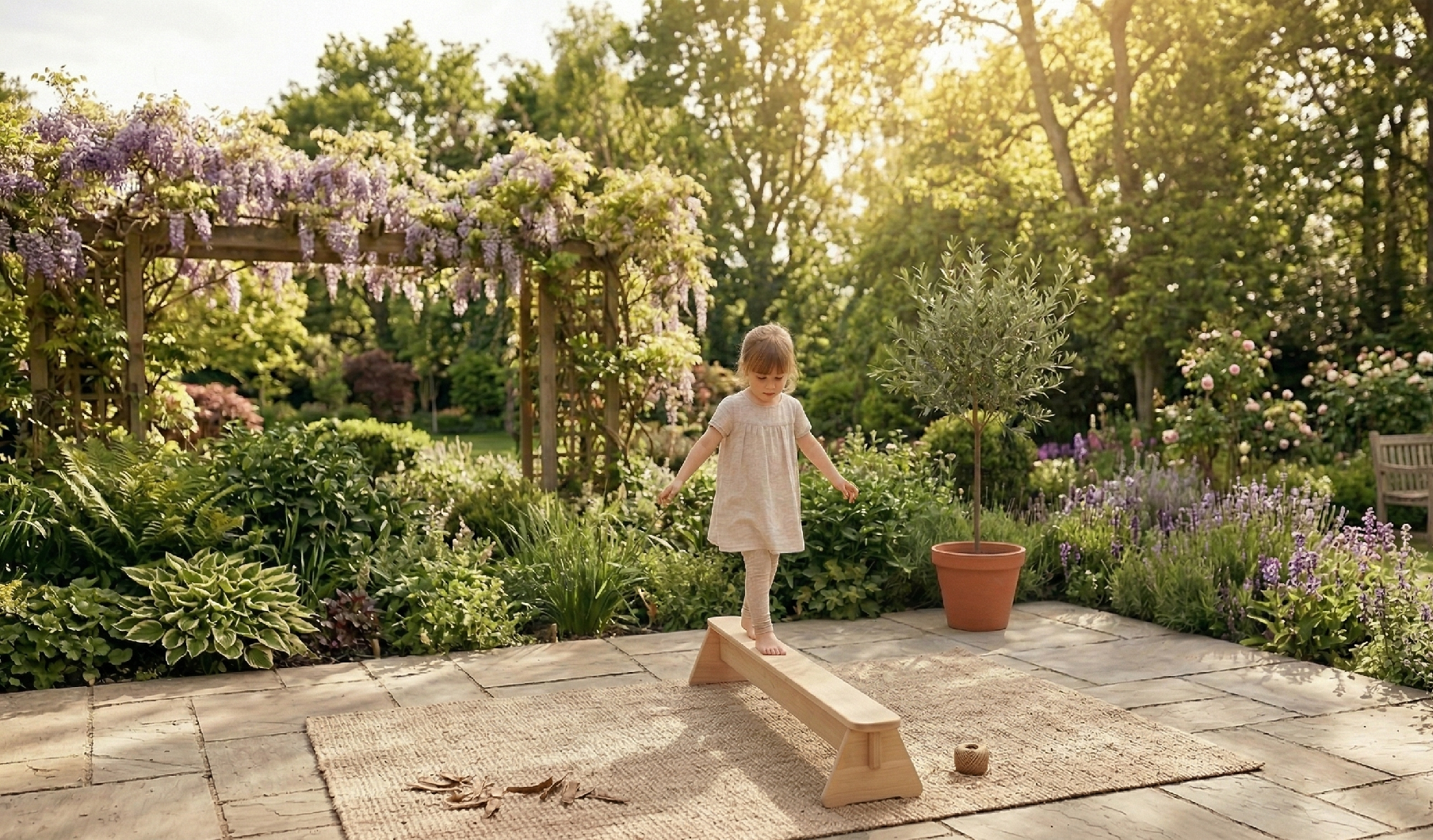
1. Balance Beam and Stepping Stones
What it does:
Provides progressive balance challenges—walking across beams, stepping from stone to stone, navigating different heights and distances.
Why it matters:
Balance is foundational for all future physical activity. Core strength, spatial awareness, body confidence—these all develop through balance practice. But here’s what matters more than the equipment: your response to wobbling and falling.
When your child uses balance equipment:
- Stay nearby without hovering
- Keep your face calm (your anxiety transfers instantly)
- When they wobble: resist gasping or grabbing
- When they fall onto soft surfaces: pause before rushing in (allow them to assess if they’re hurt)
- When they succeed: “You walked all the way across” (description, not praise)
- When they’re scared: “You’re deciding if you want to try” (trust their assessment)
Your calm during their challenge teaches: “I can handle this. My body is capable. Falling isn’t catastrophic.”
Product recommendation:
INFANS Wooden Balance Beam for Kids Toddler with Stepping Stones
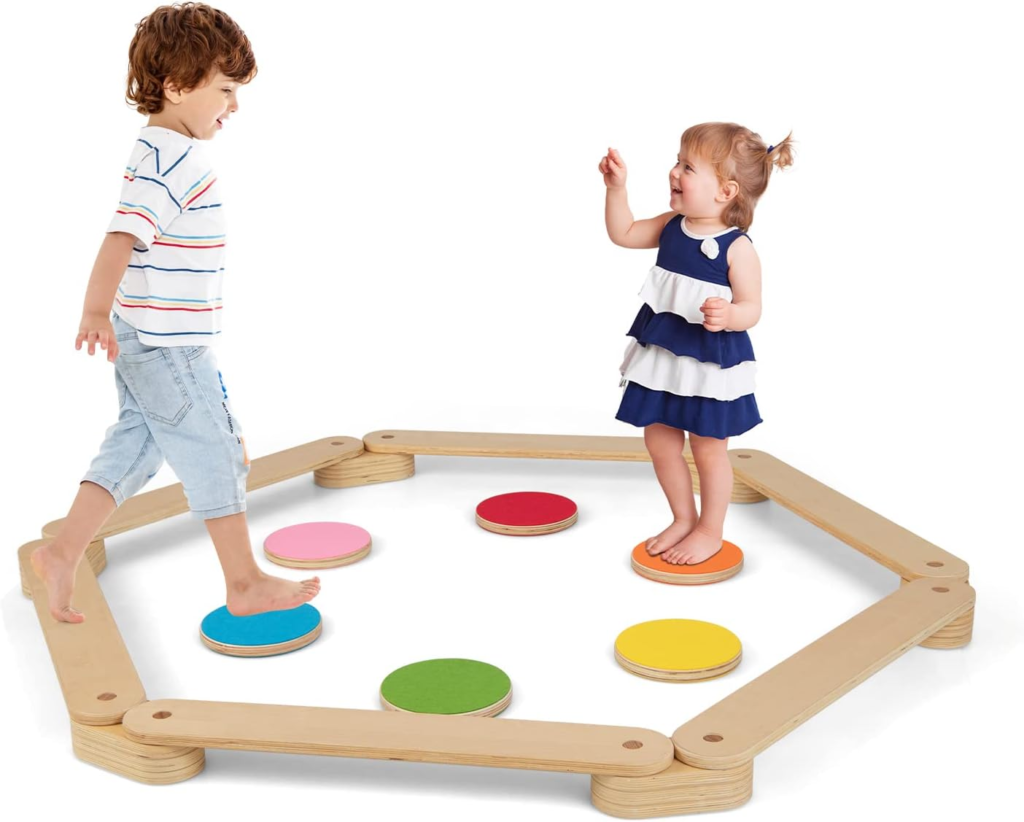
Set includes 6 balance beams and 6 stepping stones in graduated heights. Natural wood construction. Beams connect to create various configurations—straight lines, curves, zig-zags. Stones vary in height from low to moderately challenging.
What makes this set developmental:
The variety allows progressive challenge. Start with low, straight beams. Progress to curves. Add height gradually. Create complex courses as confidence builds. The stepping stones add another dimension—judging distance between stones, landing accurately.
The open-ended design means this grows with your child:
- 18 months-2 years: Walking straight, low beams with hand-holding
- 2-3 years: Independent walking across beams, beginning to try stones
- 3-4 years: Complex courses, higher configurations, confident stone navigation
- 4-5 years: Creating their own challenging courses, using in imaginative play
What’s developing: Balance, core strength, body awareness, spatial judgment, confidence, risk assessment, problem-solving (how to navigate a tricky section).
Your role: Secure base. Calm observer. Resisting the urge to spot every step. Allowing manageable risk. Sometimes walking the course yourself (modeling and companionship).
Price: $63
INFANS Wooden Balance Beam and Stepping Stones
2. Climbing Triangle (Pikler Triangle)
What it does:
Provides climbing, sliding, and spatial navigation opportunities. The triangle shape allows climbing from multiple angles, testing different muscle groups and problem-solving approaches.
Why it matters:
Climbing develops upper body strength, bilateral coordination, spatial reasoning, and physical confidence. But here’s what matters more: climbing without constant adult intervention.
When your child climbs:
- Set it up, then step back
- Observe from nearby (not underneath spotting every move)
- Let them discover how high they want to go
- If they look uncertain, acknowledge: “You’re up high. You’re thinking about whether to go higher.”
- Resist saying “be careful!” every few seconds (transmits anxiety)
- When they navigate down successfully: “You climbed up and climbed down” (simple acknowledgment)
Your trust in their body builds their trust in their body.
Product recommendation:
BlueWood Pikler Triangle Set 7-in-1 Foldable Climbing Toys
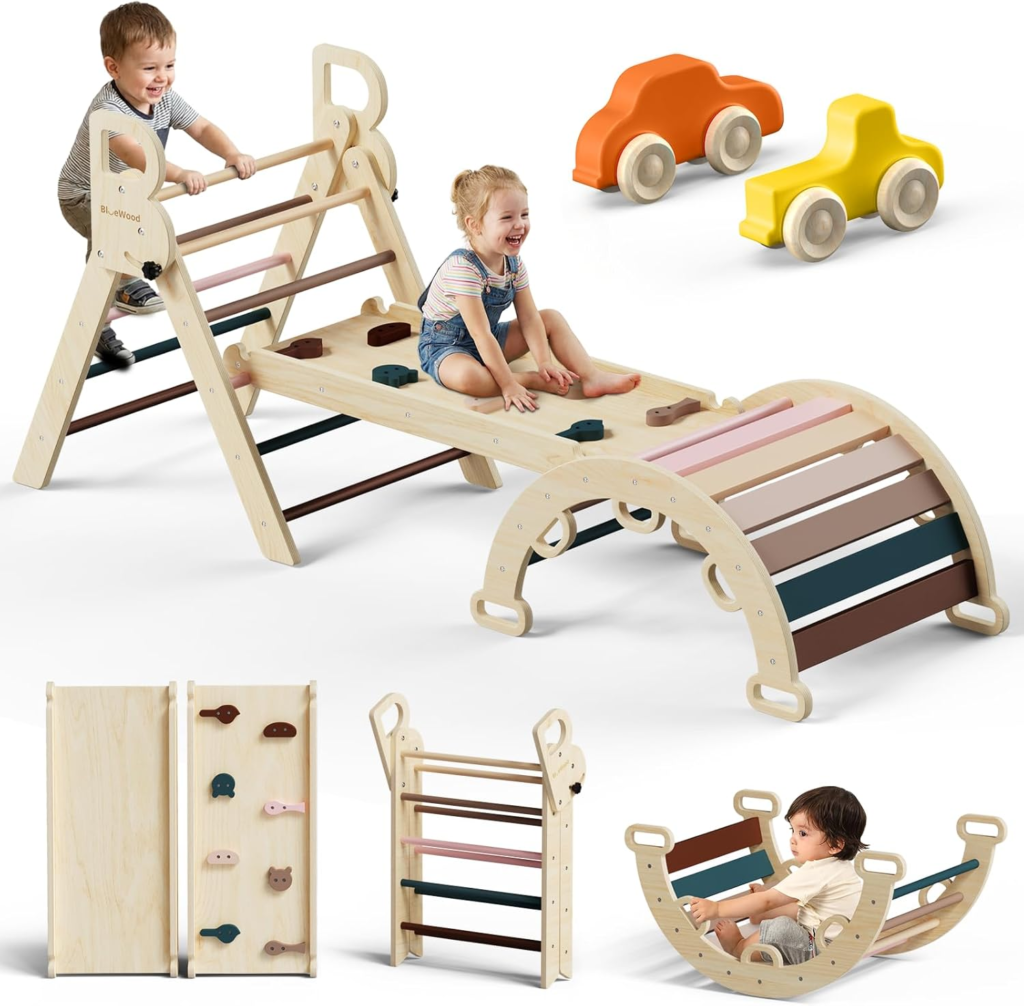
Wooden climbing triangle with multiple configuration options: arch, ramp, ladder, climbing wall. Foldable for storage. Natural wood construction. Includes car accessories for added play value.
What makes this set versatile:
The 7-in-1 design means it evolves with your child. The arch can be climbed over, crawled under, or used as a rocker. The ramp provides sliding. The ladder offers different climbing challenges. Different angles = different muscle groups and problem-solving approaches.
The foldable feature matters for real homes: Not everyone has space for permanent climbing equipment. Being able to fold and store makes this practical for apartments or smaller yards.
What’s developing: Upper body strength, bilateral coordination, spatial reasoning, problem-solving (which route to take?), confidence, risk assessment, core strength.
Developmental progression:
- 18 months-2 years: Climbing lower rungs, crawling through arch
- 2-3 years: Climbing to top, beginning to navigate down independently
- 3-4 years: Creating games, using all configurations, confident climbing
- 4-5 years: Elaborate obstacle courses, imaginative play integration
Your role: Set up safely (on soft surface—grass, mulch, foam mat). Then observe. Trust their assessment of what’s manageable. Resist constant spotting. Allow them to work out navigation challenges.
Price: $140
BlueWood Pikler Triangle Climbing Set
3. Sports Balls for Active Play
What it does:
Supports throwing, kicking, catching, rolling, chasing—building coordination, bilateral movement, and cardiovascular fitness through active play.
Why it matters:
Balls are simple, but they develop crucial skills: tracking moving objects, bilateral coordination (both hands/feet working), cause-and-effect understanding, turn-taking. But here’s what matters more: playing together.
When playing with balls outdoors:
- Kick the ball back and forth (turn-taking, relationship)
- Chase balls together (shared joy in movement)
- Roll balls down hills or ramps (gravity exploration)
- Create simple games together (not competitive, just fun)
- Match their energy (your enthusiasm matters)
- Laugh when balls go rogue (unexpected outcomes are learning)
This isn’t about developing athletic skills. It’s about active play, shared joy, and movement confidence.
Product recommendation:
AppleRound 4-Pack Sports Balls with Pump

Set includes: 5-inch soccer ball, basketball, playground ball, and 6.5-inch football. Soft material safe for indoor/outdoor. Includes pump. Appropriately sized for toddler and preschool hands.
Why variety matters:
Different balls teach different skills. Soccer balls = kicking accuracy. Basketballs = two-handed throwing. Footballs = grip and throw. Playground balls = easy rolling and kicking. Having all types allows exploring different movements.
The soft material means: Safe for younger toddlers. Won’t damage windows or hurt when thrown. Can be used indoors on rainy days. Appropriate for learning without intimidation.
What’s developing: Gross motor coordination, eye-hand coordination, tracking moving objects, bilateral movement, cause-and-effect, turn-taking (social skill), cardiovascular fitness.
Your role: Play partner. Sometimes active participant (kicking, throwing, chasing), sometimes observer. Following their lead about what’s fun. Not coaching technique—just playing.
Price: $12
AppleRound 4-Pack Sports Balls
REAL-WORLD SKILLS: Gardening and Outdoor Work
Here’s where Montessori outdoor play differs from just “outside time”: children doing real work with real tools.
Not pretend gardening. Actual gardening. Real digging, real planting, real watering, real weeding. Real contribution to the household or yard.
This builds:
- Fine and gross motor skills (digging, raking, carrying)
- Understanding of natural cycles (planting, growing, harvesting)
- Responsibility and follow-through (tending plants requires return visits)
- Connection to where food comes from
- Pride in real contribution
But here’s what matters most: doing it together.
4. Child-Size Wheelbarrow and Garden Tools
What it does:
Provides real tools for real gardening work—digging, raking, transporting soil or leaves, planting, weeding.
Why it matters:
Children desperately want to help with real work. Pretend tools miss the opportunity for genuine contribution. Real tools (sized appropriately) allow actual participation. But here’s what matters more: working alongside them.
When gardening together:
- Work in parallel (you dig here, they dig there)
- Narrate what you notice: “You’re filling your wheelbarrow with leaves”
- Don’t correct technique (there are many ways to use a rake)
- Allow them to set the pace (gardening with a toddler is slow)
- Share the satisfaction: “We cleared all these leaves together”
- Follow through over time (return to check on planted seeds together)
You’re not teaching gardening skills. You’re sharing real work and building relationship.
Product recommendation:
Duckura Kids Gardening Tools Set – 7-Piece Wheelbarrow Set
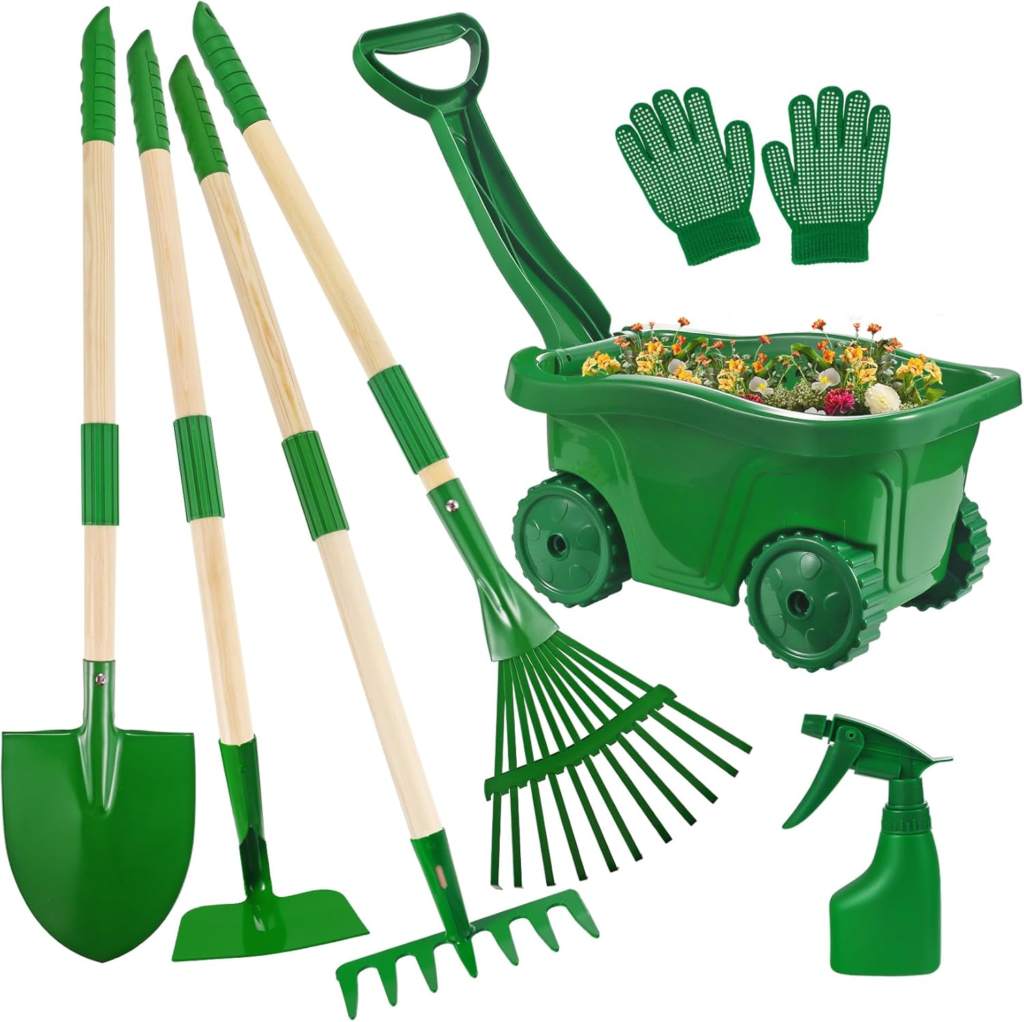
Includes: child-size metal wheelbarrow, shovel, rake, hoe, leaf rake, spray bottle, and gloves. Real metal and wood tools (not plastic toys). Wheelbarrow sized for toddler/preschool strength.
Why real tools matter:
Plastic toy tools don’t actually dig. They don’t actually rake. They don’t provide real feedback or allow real contribution. These metal tools work—they dig real dirt, rake real leaves, actually contribute to yard work.
The wheelbarrow is key: Allows transporting—moving leaves, carrying tools, hauling harvested vegetables. Builds gross motor strength (pushing loaded wheelbarrows), spatial navigation (steering around obstacles), practical skills.
What’s developing: Gross motor strength, tool use, bilateral coordination, practical life skills, understanding of gardening, pride in contribution, responsibility, connection to nature.
Real work opportunities:
- Raking leaves into piles (then jumping in them!)
- Digging holes for planting
- Transporting mulch or soil
- Harvesting vegetables
- Weeding (pulling dandelions)
- Watering with the spray bottle
Your role: Work alongside. Share the task. Appreciate real contribution (not just cute participation). Follow through over time.
Price: $45
Duckura Kids Wheelbarrow and Garden Tool Set
5. Complete Kids Gardening Kit with Tote
What it does:
Provides portable gardening tools for planting, watering, digging—encouraging hands-on participation in growing plants.
Why it matters:
Gardening teaches patience (seeds take time), responsibility (plants need tending), cause-and-effect (watering makes plants grow), and connection to food sources. But here’s what matters more: tending the garden together over time.
When gardening with young children:
- Start small (a few pots or small bed, not overwhelming garden)
- Choose fast-growing plants (radishes, lettuce, beans—success in weeks)
- Visit the garden together daily (checking growth becomes ritual)
- Notice changes together: “The bean plant is taller today”
- Share the harvest (eating something you grew together is powerful)
- Accept “help” that’s messy (soil spills, overwatering—that’s learning)
The garden becomes a long-term shared project. The relationship deepens through tending something together.
Product recommendation:
Gardening Set Tool Kit for Kids – STEM Learning Set
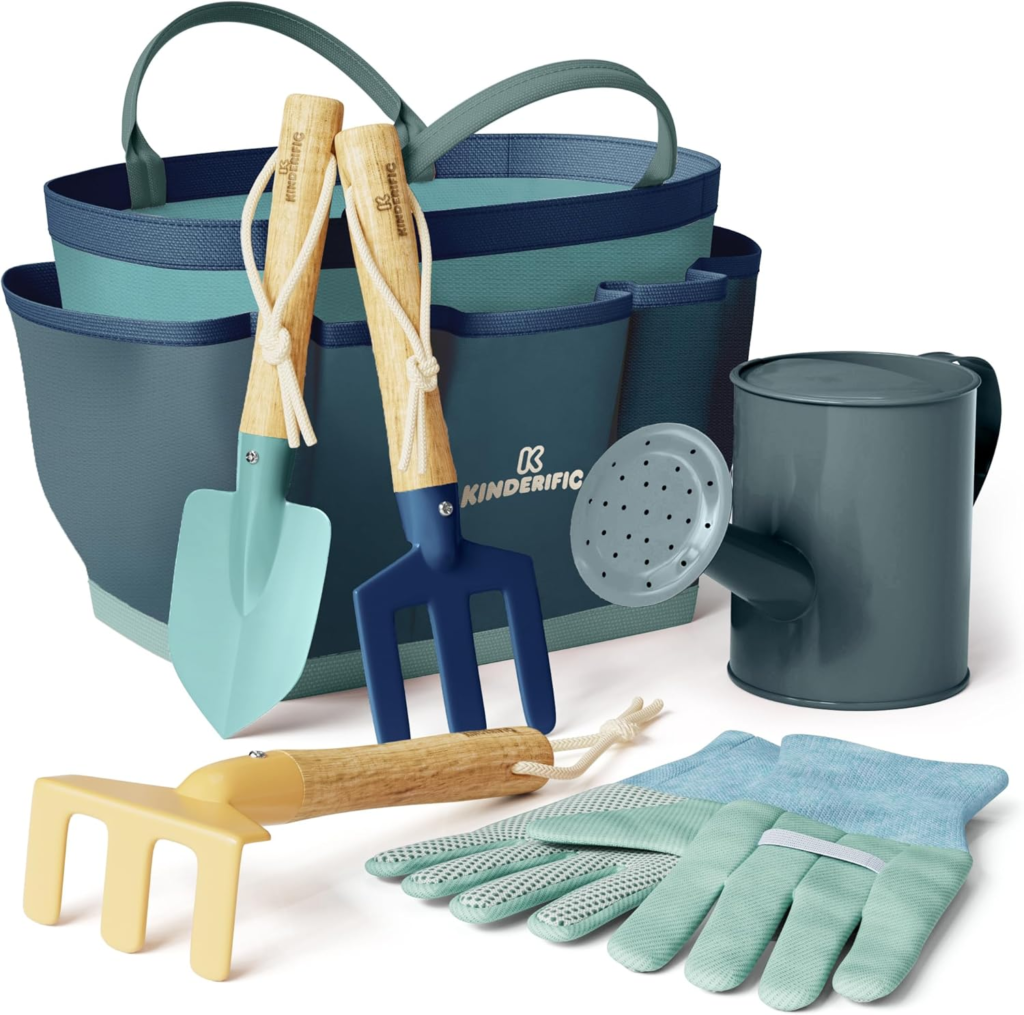
Includes: tote bag, large watering can, gardening gloves, rake, shovel, fork, trowel, and wooden handles. Tools are child-sized but functional. Canvas tote keeps everything organized.
Why this particular set:
The watering can is large enough to actually water a garden bed (not just symbolic). The tools are metal (actually dig), not plastic (frustration). The tote makes tools portable—carry them to different parts of the yard, clean up and store easily.
The STEM element: Gardening naturally teaches science (plant life cycles, what plants need), technology (tool use), engineering (how to support tall plants), math (measuring growth, counting seeds).
What’s developing: Fine motor (using trowel, planting seeds), gross motor (digging, raking, watering), responsibility, patience, understanding of natural cycles, connection to food sources.
Gardening projects for young children:
- Sunflowers (dramatic growth, large seeds easy to handle)
- Cherry tomatoes (sweet, rewarding, kids actually eat them)
- Lettuce (fast-growing, can harvest multiple times)
- Radishes (ready in 3-4 weeks—good for toddler patience)
- Beans (climb dramatically, pods fun to pick)
- Herbs (sensory—smelling, touching)
Your role: Garden companion. Return visitor to check progress. Harvester and cook of produce. Documenter of growth (“Look how much taller it is than last week!”).
Price: $28
Kids Gardening Tool Kit with Tote
Alternative/companion product:
Kinderific Kids Gardening Set (Ocean Blue)
Similar concept, different color option, includes small stool for sitting while gardening. ($28)
Why Gardening Specifically Matters
Of all the outdoor activities available, gardening offers something unique:
It’s slow work in a fast world. Seeds don’t sprout instantly. Plants grow gradually. This teaches patience and understanding of natural time.
It requires return and responsibility. Gardens need tending. This builds follow-through and care for living things.
It connects to real life. Food comes from somewhere. Understanding “we planted this, we watered it, now we eat it” is foundational.
It’s genuinely useful contribution. Unlike many “chores,” gardening produces something valuable—food, flowers, beauty.
It’s naturally sensory. Dirt textures, plant smells, vegetable tastes, bug discoveries—all rich sensory input.
And it’s best done together. Gardening alone at 3 years old is difficult. Gardening with an interested adult is meaningful shared work.
6. Outdoor Play Kitchen (Mud Kitchen)
What it does:
Provides a dedicated space for outdoor “cooking” with natural materials—mud, water, leaves, flowers, rocks—encouraging imaginative play and sensory exploration.
Why it matters:
Mud kitchens combine imaginative play with sensory exploration and practical skills (pouring, mixing, stirring). But here’s what matters more: the permission to get genuinely messy.
When children use mud kitchens:
- Provide real water (not pretend)
- Allow actual mud (not just clean sand)
- Expect mess (have hose or bucket nearby for cleanup)
- Sit with them sometimes (making mud pies alongside)
- Admire their “cooking”: “You’re making soup with leaves and water”
- Don’t worry about keeping clean (that’s the point)
The freedom to be truly messy—without adult anxiety—is developmentally valuable.
Product recommendation:
Hape Outdoor Kitchen Mud Kitchen Wooden Toy Playset
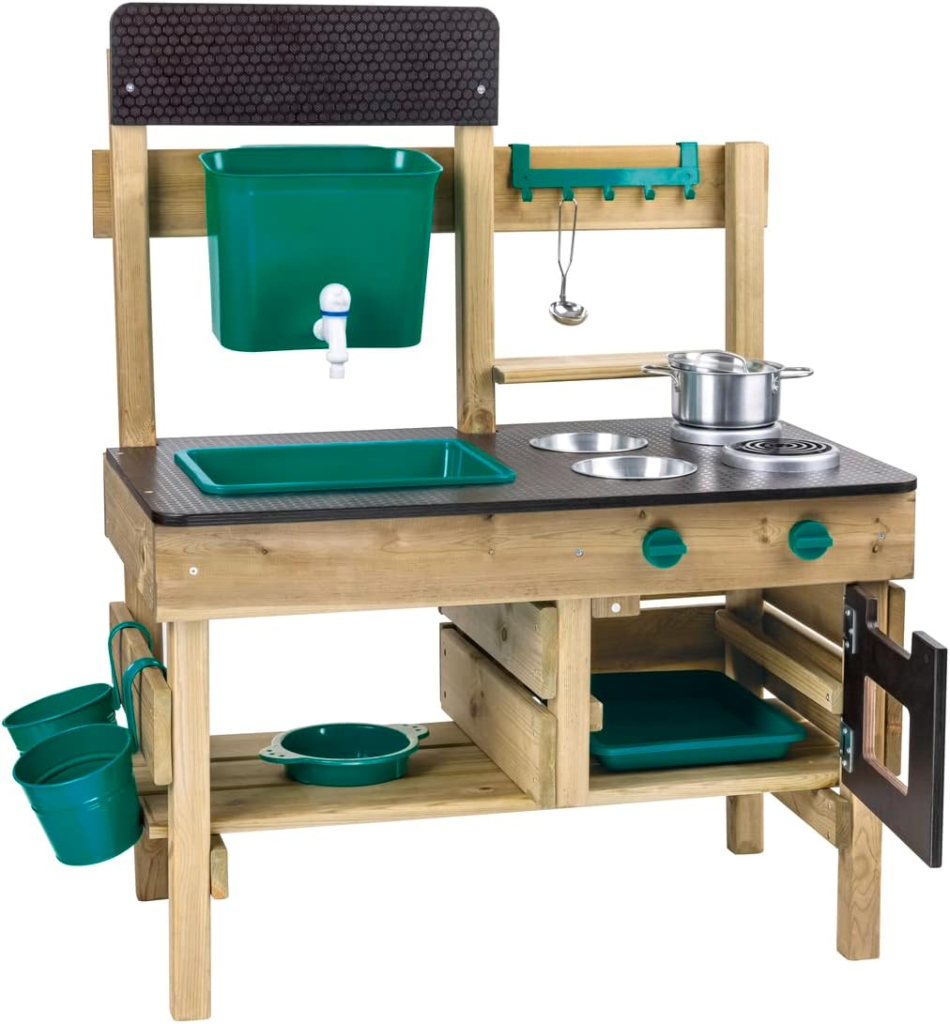
Wooden outdoor kitchen with sink, stove burners, pot hooks, shelving for supplies. Includes metal bowls, accessories. Designed for outdoor use (weather-resistant treatment).
Why a dedicated mud kitchen:
Having a specific station for messy play signals: “This is where getting dirty is encouraged.” It’s not using the indoor kitchen (where you have to be careful), it’s outdoor play with permission to experiment.
The setup encourages:
- Collecting natural materials (leaves, flowers, rocks, mud)
- Mixing and pouring (sensory exploration)
- Imaginative cooking scenarios
- Tool use (spoons, whisks, bowls)
- Water play (mixing mud, washing “dishes”)
What’s developing: Imaginative play, sensory exploration, fine motor (pouring, stirring, mixing), creativity, understanding of natural materials, gross motor (collecting materials from yard).
Real activities children do:
- Making “soup” from water, leaves, and flowers
- Creating mud “cakes” molded in bowls
- Washing rocks in bowls of water
- Mixing different mud consistencies
- Creating elaborate cooking scenarios
- Collecting natural materials to “cook” with
Your role: Provider of water and permission. Sometimes co-creator of mud pies. Admirer of creations. Person who hoses child off afterward without complaint.
Price: $200
Hape Outdoor Mud Kitchen Playset
Budget alternative: DIY mud kitchen from old furniture or pallets, using real bowls and utensils from thrift stores.
7. Magnifying Glass for Nature Exploration
What it does:
Allows close-up examination of natural objects—insects, leaves, flowers, rocks, bark texture—turning outdoor time into scientific exploration.
Why it matters:
Young children notice everything—the ant carrying a crumb, the pattern on a leaf, the texture of tree bark. A magnifying glass honors this natural curiosity and deepens observation. But here’s what matters more: exploring together, noticing alongside them.
When exploring nature with magnifying glasses:
- Follow their discoveries (they spot the interesting thing, you look together)
- Narrate what you notice: “The leaf has lines running through it” or “The ant has six legs”
- Ask genuine questions (not testing): “I wonder what that texture feels like?”
- Take your time (five minutes examining one flower is valuable)
- Avoid turning it into a lesson (let wonder be enough)
- Share your own discoveries: “Look at this rock under the magnifier!”
The magnifying glass is a tool. Your shared curiosity creates the learning.
Product recommendation:
2-Set 75mm Hand-Held Reading Magnifier with Non-Slip Rubber Grip
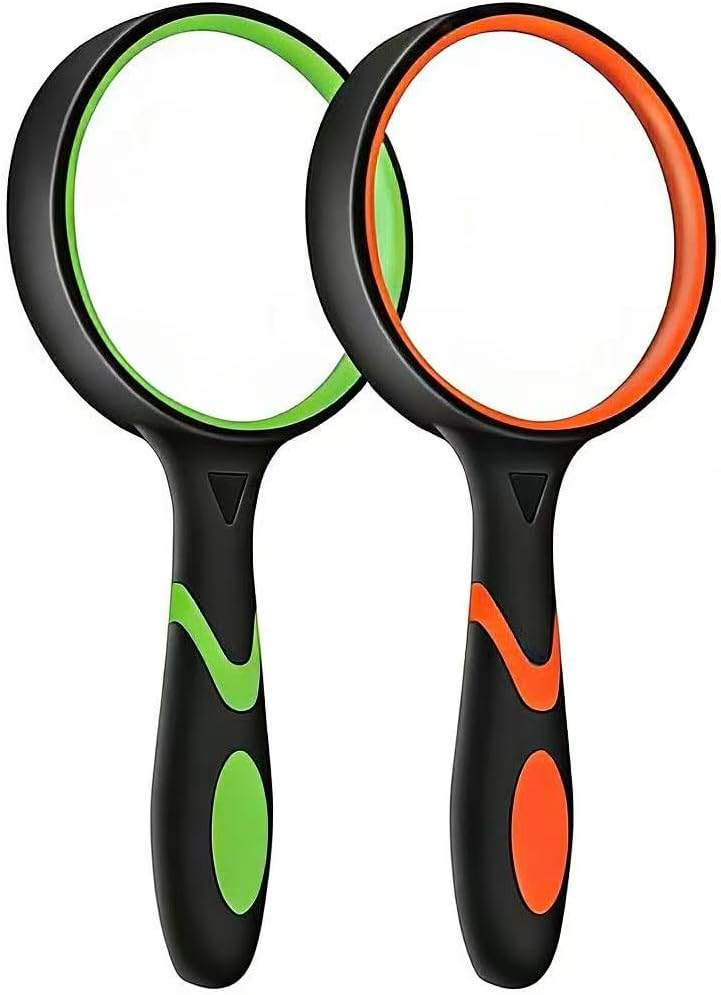
Two magnifying glasses (one green, one orange) with large 75mm (3-inch) lenses. Non-slip rubber grips sized appropriately for small hands. Shatterproof glass lenses. Comfortable ergonomic handles.
Why two magnifiers matter:
One for the child, one for you. Or one for each child. Exploring together, each with your own magnifier, creates parallel investigation and conversation. “What do you see in yours?” becomes natural dialogue.
The large lens size is developmentally appropriate: Easier to hold steadily than small magnifiers. Provides a good viewing area for examining larger objects (whole leaves, flowers, insects). Easier for young children to position correctly.
What’s developing: Scientific observation skills, patience and focus, vocabulary (describing what’s seen), fine motor (holding magnifier steady), understanding that tools extend our capabilities, curiosity and wonder.
Real exploration activities:
- Examining insects (ants, beetles, ladybugs—looking without touching or harming)
- Looking at leaf veins and patterns
- Observing flower structures (petals, centers, pollen)
- Examining bark texture on different trees
- Looking at rocks and crystals close-up
- Inspecting spider webs (the intricate patterns!)
- Observing seeds and seed pods
Your role: Co-explorer. Equal participant in discovery. Narrator of what you notice. Asker of genuine questions. Provider of vocabulary (“those are the veins in the leaf”). Protector of insects and plants (we look carefully, we don’t harm).
The connection to gardening: When you garden together, the magnifying glass deepens that work. Examine seeds before planting. Watch for the first tiny sprout. Look at root structures. Identify beneficial vs harmful insects. The tool extends the learning naturally.
Price: $7
2-Set Hand-Held Magnifying Glass
What You Don’t Need
Knowing what to skip saves money and space.
❌ Plastic Play Structures That Do Everything
Why skip: Those huge plastic structures with slides, tunnels, playhouses, and climbing walls built in—they’re expensive, take up enormous space, and often limit play to predetermined ways.
Better: Separate, simpler equipment (balance beam, climbing triangle) that can be rearranged, combined creatively, and used in non-prescribed ways.
❌ Battery-Operated Outdoor Toys
Why skip: Ride-on cars that drive themselves, water tables with electronic features—these prevent the physical work and problem-solving that simple versions require.
Better: Push/pedal ride-ons that require actual leg work. Simple water tables or bins that rely on child-powered pouring.
❌ Toys That Prevent Getting Dirty
Why skip: The whole point of outdoor play is sensory exploration. Tools and setups that keep children clean defeat the purpose.
Better: Embrace mess. Provide tools for real digging, real mud play, genuine exploration. Have the hose ready afterward.
Setting Up for Outdoor Success
Having good equipment is half the equation. Setup and approach matter too.
Create Zones
Even small yards can have distinct areas:
- Active zone: Climbing, running, ball play
- Gardening zone: Raised beds or pots for planting/tending
- Creative zone: Mud kitchen, water play, natural materials
- Quiet zone: Sitting spot, nature observation
This doesn’t require a large yard. Even a small patio can have a corner for each.
Rotate Outdoor Materials
Just like indoor toys, outdoor equipment can be rotated:
- All balance equipment out this month
- Gardening tools featured next month
- Balls and active play emphasized in summer
Rotation keeps interest high without accumulating overwhelming amounts of equipment.
Make Outdoor Time Daily
Not when weather is perfect. Daily.
Light rain? Go outside.
Cold? Bundle up and go outside.
Hot? Go early or late, but go outside.
Young children need outdoor time daily for regulation, development, and health.
30-60 minutes minimum. More is better.
Your Presence Matters Most
The best outdoor setup with you absent or distracted doesn’t match a simple yard with your engaged presence.
Be there sometimes:
- Garden together
- Build obstacle courses together
- Kick the ball back and forth
- Make mud pies alongside them
- Observe ants together
- Collect leaves and examine them
And be nearby always:
- Even when they’re playing independently
- As secure base while they climb
- Watching with genuine interest
- Available without hovering
They explore more confidently when you’re present. They develop more fully when you’re engaged.
Age-Appropriate Outdoor Play
18 months – 2 years:
Focus: Exploring textures, early climbing, walking on uneven surfaces, carrying and transporting, water and sand play
What they need: Low climbing options, balls to roll and kick, simple gardening involvement (watering, digging), messy play permission
Your role: Very close proximity. Lots of parallel play. Protection from genuine danger while allowing manageable challenge.
2-3 years:
Focus: More confident climbing, jumping attempts, running, gardening participation, imaginative outdoor play beginning
What they need: Progressive climbing challenges, balance practice, real gardening tools, mud kitchen or sensory play station
Your role: Nearby secure base. Resisting over-protection. Allowing more independence while remaining available.
3-4 years:
Focus: Complex climbing, jumping confidently, ball skills developing, sustained gardening work, elaborate imaginative outdoor play
What they need: Challenging balance/climbing equipment, balls for games, garden bed to tend, props for imaginative outdoor scenarios
Your role: Companion in activities sometimes, observer other times. Appreciating real contribution (gardening harvest, obstacle course completion).
4-5 years:
Focus: Physical confidence, complex games, sustained gardening projects, using outdoor space for elaborate play scenarios
What they need: Equipment that still challenges (higher climbing, complex balance courses), serious gardening responsibility, space for creation
Your role: Conversation partner about what they’re working on. Collaborator in garden projects. Admirer of physical achievements. Less constant proximity needed.
The Real Goal
This isn’t about having the perfect outdoor playspace.
It’s about:
- Daily time in nature and physical movement
- Opportunity for genuine physical challenge
- Real work (gardening) alongside imaginary play
- Connection to natural materials and cycles
- Your presence and engagement
The equipment facilitates this. Your approach makes it meaningful.
A small yard with simple equipment and engaged parent beats an elaborate setup with distracted adult every time.
Start here:
Choose one:
- Balance/climbing equipment (physical challenge)
- Gardening setup (real work)
- Balls and active play (movement and connection)
Then:
- Go outside daily
- Work and play alongside your child sometimes
- Observe with genuine interest always
- Allow mess, challenge, and managed risk
- Build on what engages them
The outdoor materials support development. Your presence creates the foundation.
That’s what actually matters.
Related Posts:
Best Montessori Toys for 18-Month-Olds – Indoor materials that complement outdoor play
Best Montessori Toys for 3-Year-Olds – Age-specific recommendations across environments
How Many Toys Does a Child Actually Need? – The case for simplicity (including outdoor equipment)
Disclaimer: This post contains Amazon affiliate links. When you purchase through these links, I may earn a small commission at no additional cost to you. I recommend these outdoor materials because they genuinely support physical development, nature connection, and real-world skills—but I want to be clear that your engaged presence matters far more than any equipment.