Eighteen months is extraordinary.
Your baby—who just months ago was learning to walk—is now running, climbing, and testing every physical boundary they can find. They’re scaling the couch, attempting the stairs, and figuring out how to open every cabinet in the house.
They’re also sitting for surprisingly long stretches, focused intently on fitting shapes into holes, stacking rings, or transferring objects from one container to another with intense concentration.
This is the age of explosive motor development—both gross and fine.
But here’s what matters more than any toy I’m about to recommend: your presence.
The best “toy” for an 18-month-old isn’t a thing. It’s you—calm, nearby, watching with genuine interest as they master their body and the physical world.
The materials I’ll recommend matter. But they matter most when paired with your warm, attentive presence.
Let me show you what actually supports development at this age—and how your role creates the foundation everything else builds on.
What’s Actually Happening at 18 Months
Before we talk about specific materials, let’s understand what developmental work 18-month-olds are engaged in.
The Big Two: Gross Motor and Fine Motor Explosions
Development at this age focuses primarily on mastering the body.
Gross motor: Large movements—walking, running, climbing, balancing, jumping (or attempting to jump).
Fine motor: Small, precise movements—pincer grasp, placing objects deliberately, early tool use, manipulating fasteners.
Both are happening simultaneously and intensely.
You’ll see your 18-month-old alternate between these:
- Running full-speed across the room (gross motor)
- Then sitting down to carefully place pegs in holes (fine motor)
- Then climbing the entire play structure (gross motor)
- Then sitting to work on a puzzle for ten full minutes (fine motor)
This back-and-forth isn’t random. It’s the body integrating different systems, practicing different skills, building the foundation for everything that comes next.
But Here’s What Underlies All of It: Attachment Security
Eighteen-month-olds explore confidently when they have a secure base.
What this means practically:
Your child climbs the play structure because you’re nearby. They check—visually or verbally—to make sure you’re still there. When you are, they keep going. If you leave without warning, they often stop exploring and search for you.
They sit focused on a puzzle for ten minutes because you’re in the room. Not hovering, not directing—just present. Your calm proximity allows their nervous system to relax into focus.
Your presence is the invisible foundation that allows all the visible development to happen.
This is why the materials matter, but your attunement matters more.
What Attunement Looks Like at This Age
It’s not:
- Constantly entertaining
- Directing every activity
- Praising every action
- Hovering anxiously
- Teaching through instruction
It is:
- Being nearby and available
- Watching with genuine interest
- Staying calm during struggles
- Acknowledging without over-praising (“You stacked all three blocks”)
- Allowing repetition without interruption
- Protecting their focus from unnecessary disruption
Psychologists call this “serve and return.” The child explores (serve), you respond with calm presence and appropriate acknowledgment (return). This back-and-forth builds the secure attachment that allows confident exploration.
The toys facilitate this dance. But you’re the partner that matters.
Now let’s talk about what materials support the motor development work happening at this age.
GROSS MOTOR DEVELOPMENT: Building Strength, Balance, and Confidence
Eighteen-month-olds are working intensely on physical mastery. They’re building the strength, coordination, and confidence that will support all future physical activity.
But they’re also doing psychological work through gross motor activity: testing limits, building courage, developing self-trust.
Your role: Provide safe opportunities for physical challenge. Stay close enough to be a secure base. Resist the urge to prevent every fall. Allow manageable risk.
Here’s what supports this work:
1. Climb and Slide Structures (Indoor or Outdoor)
What it does:
Provides opportunity for climbing, balancing, sliding—building core strength, spatial awareness, risk assessment, and physical confidence.
Why it works at 18 months:
This is peak climbing age. Toddlers are driven to climb everything. Providing an appropriate structure channels this drive safely while building real skills.
But here’s what matters more than the structure: your response.
When your child climbs:
- Stay nearby (secure base)
- Resist saying “be careful!” every three seconds (transmits anxiety)
- Watch calmly with genuine interest
- Allow them to assess their own limits (they’ll stop when it feels too high)
- If they look at you uncertainly, acknowledge: “You’re up high. You’re deciding if you want to go higher.”
- When they succeed: “You climbed all the way to the top” (description, not judgment)
Your calm presence allows them to focus on their body, not on managing your anxiety.
Product recommendation:
Step2 Naturally Playful Lookout Treehouse Climber
Compact indoor/outdoor climber with low platform, gentle slide, climbing steps. Appropriate height for 18-month-olds (not too intimidating, still challenging). Sturdy construction.
What’s developing: Core strength, bilateral coordination (both sides of body working together), spatial awareness (where is my body in space?), balance, risk assessment, confidence.
Your role: Nearby presence. Calm observation. Resisting the urge to spot constantly. Allowing falls onto soft surfaces (this is feedback about balance and limits).
Price: $90-110
Step2 Naturally Playful Lookout Treehouse
Budget alternative: Outdoor playground visits (free), sturdy cardboard boxes for climbing ($0), cushions and pillows arranged as climbing landscape ($0).
2. Push and Pull Toys
What it does:
Supports walking stability, builds leg strength, provides proprioceptive feedback (understanding where your body is), encourages movement with purpose.
Why it works at 18 months:
Most 18-month-olds walk confidently but are still refining balance. Push toys provide stability while encouraging movement. Pull toys add the challenge of walking while looking behind.
But here’s what matters more than the toy: walking together.
When your child uses push/pull toys:
- Walk alongside them (companionship, not instruction)
- Match their pace (they’re slow—that’s appropriate)
- Talk about what you notice: “You’re pushing the wagon. Now you’re turning around.”
- Allow them to set the direction and destination
- If they’re stuck, wait to see if they solve it before offering help
Your parallel presence turns the activity from motor practice into relationship building.
Product recommendation:
Radio Flyer Classic Walker Wagon
Wooden push wagon with sturdy handle at appropriate height for toddlers learning to walk. Red wooden construction with metal handle. Can be used as walker for stability and as wagon for transporting toys, stuffed animals, or treasures.
Why this one lasts:
I still have this toy, and my four-year-old enjoys it today. At 18 months, it provided walking support and stability. At two, it became a wagon for transporting blocks and dolls. At three, it was part of elaborate pretend play scenarios. At four, it’s still being used to haul collections of nature finds or create “delivery” games.
This is what quality construction looks like—one toy that grows with your child for years.
What’s developing: Walking stability, balance, coordination, leg strength, spatial navigation, imaginative play (as it transitions from walking aid to wagon for pretend scenarios).
The sturdiness matters: Cheap push toys tip or fall apart quickly, creating frustration. This wagon is weighted and constructed to withstand years of real use. My four-year-old loads it with heavy items and pushes it around the house—it’s holding up beautifully after three years of daily use.
Your role: Walk with them sometimes. Watch from nearby other times. Provide the gift of unhurried time—let them push the wagon back and forth across the room twelve times if that’s what they want. The repetition is the learning. Later, when they fill it with every stuffed animal they own and push it to the “store,” appreciate the imagination developing.
Price: $50-65
Radio Flyer Classic Walker Wagon
Pull toy alternative:
PlanToys Dancing Alligator Pull Toy ($20-25) – Wooden pull toy for adding the challenge of walking while looking behind
3. Balls (Various Sizes)
What it does:
Develops throwing, kicking, rolling, chasing—building coordination, tracking skills, bilateral movement, and cause-and-effect understanding.
Why it works at 18 months:
Balls are endlessly engaging at this age. Rolling, throwing (usually not where intended), chasing, dropping, retrieving. Simple, open-ended, active.
But here’s what matters more than the ball: the connection.
When playing with balls:
- Roll the ball back and forth together (turn-taking, relationship)
- Kick the ball and chase it together (shared joy)
- Narrate what you notice: “You kicked it! It’s rolling away. You’re chasing it.”
- Laugh together when something unexpected happens
- Match their enthusiasm (your genuine delight in their delight is powerful)
This isn’t about teaching ball skills. It’s about shared joy in movement and connection.
Product recommendation:
Set of 3-4 balls in different sizes:
- Large playground ball (8-10 inches)
- Medium rubber ball (5-6 inches)
- Small soft ball (3-4 inches)
- Soccer-size ball (7-8 inches)
Why variety: Different sizes teach different skills. Large balls are easier to kick. Small balls require more precise grasping. Medium balls work for both throwing and rolling.
What’s developing: Gross motor coordination, eye-hand coordination, tracking moving objects, bilateral coordination, cause-and-effect, turn-taking (social skill).
Your role: Play partner. Sometimes active (rolling, chasing), sometimes observing (letting them explore independently). Following their lead about what’s interesting.
Price: $15-25 for set
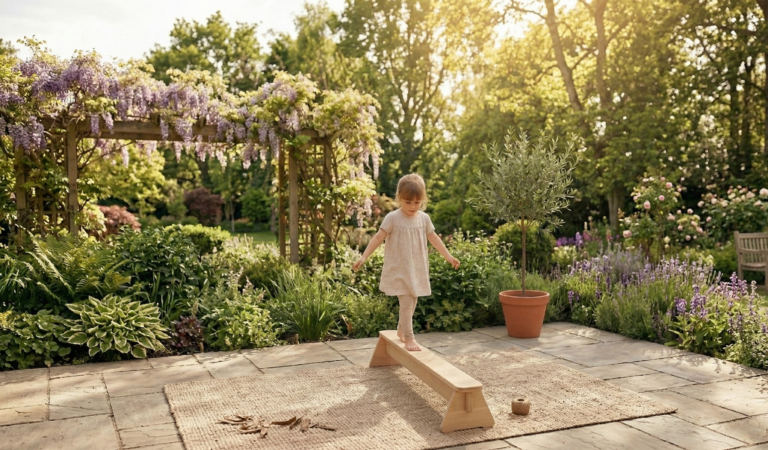
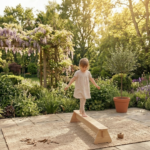
4. Balance Board or Stepping Stones
What it does:
Builds balance, core strength, body awareness, and physical confidence through manageable challenge.
Why it works at 18 months:
Balance is developing rapidly at this age. Materials that isolate balance practice (without overwhelming danger) allow focused skill-building.
But here’s what matters more than the equipment: your presence during challenge.
When your child uses balance equipment:
- Sit nearby (not spotting every moment, just present)
- Stay calm when they wobble (your calm = their confidence)
- If they fall, pause before rushing in (allow them to assess whether they’re actually hurt)
- When they succeed: “You balanced on the wobbly board” (description, not praise)
- When they struggle: “That’s challenging. You’re working on it.”
Your calm during their challenge teaches them: “I can handle this. Struggle is normal. I’m capable.”
Product recommendation:
Wooden Balance Board – Gentle Curve
Natural wood curved board for rocking and balancing. Gentle curve appropriate for beginners. Can also be flipped over and used as bridge, tunnel, or in imaginative play.
What’s developing: Balance, core strength, vestibular system (inner ear/balance regulation), body awareness, confidence, creative thinking (when used in non-standard ways).
Your role: Secure base. Calm presence. Resisting the urge to prevent every wobble. Allowing them to discover their own limits.
Price: $60-80
Wooden Balance Board – Toddler Curve
Alternative:
Stepping Stones Set ($25-35) – Plastic or foam stones of varying heights for walking balance practice
5. Ride-On Toy (No Pedals)
What it does:
Builds leg strength, coordination, spatial awareness, and confidence through self-propelled movement.
Why it works at 18 months:
Most 18-month-olds can’t pedal yet, but they can push with their feet to move a ride-on toy. This builds the leg strength and coordination needed for future pedaling.
But here’s what matters more than the toy: going places together.
When your child uses ride-on toys:
- Create “destinations” together (ride to the kitchen, to the door, to daddy)
- Ride alongside them sometimes (if you have a second ride-on, or walk while they ride)
- Narrate the journey: “You’re riding to the window. Now you’re turning around.”
- Allow them to set the pace and destination
- Don’t rush them—the meandering is part of the exploration
The toy provides movement. You provide companionship and meaning.
Product recommendation:
Radio Flyer Scoot-About
Sturdy wooden ride-on with four wheels for stability. Low seat appropriate for 18-month-old leg length. Classic simple design without unnecessary features.
What’s developing: Leg strength, bilateral coordination, spatial navigation, steering/directional control, independence in movement.
Your role: Sometimes riding companion, sometimes observer from nearby. Providing unhurried time for exploration. Creating meaning through destinations and narration.
Price: $50-70
Radio Flyer Scoot-About Ride-On
Gross Motor Summary: What Matters Most
The materials above support development. But here’s what actually creates confident, capable toddlers:
✓ Your calm presence during physical challenge
✓ Resisting the urge to prevent every fall
✓ Allowing them to assess their own limits
✓ Staying nearby without hovering
✓ Matching their pace rather than rushing
✓ Genuine interest in their physical discoveries
✓ Parallel play and companionship during movement
Children become confident in their bodies when we trust their bodies.
The climbing structure matters. Your calm while they climb matters more.
FINE MOTOR DEVELOPMENT: Building Precision, Focus, and Hand Strength
Eighteen-month-olds are developing remarkable hand control. The pincer grasp (thumb and finger) is refined. They can place objects deliberately, not just randomly. They’re beginning to use tools with intention.
But they’re also doing psychological work through fine motor activity: developing focus, persistence, pride in mastery.
Your role: Provide materials that isolate hand skills. Observe with genuine interest. Protect their focus from interruption. Resist the urge to fix or correct. Allow repetition.
Here’s what supports this work:
1. Shape Sorter (Simple Wooden Design)
What it does:
Teaches shape matching, spatial reasoning, problem-solving, and hand-eye coordination through concrete manipulation.
Why it works at 18 months:
The cognitive leap of matching shape to hole is happening now. Early 18-month-olds might use trial-and-error. Late 18-month-olds often can match shapes without testing every hole.
But here’s what matters more than the shape sorter: how you respond to struggle.
When your child works with a shape sorter:
- Sit nearby (companionship, not instruction)
- Watch with genuine curiosity about their process
- Resist demonstrating or correcting
- If they try to force the wrong shape, stay silent (the material provides feedback—it won’t fit)
- When they succeed: “The circle went through” (description, not judgment)
- When they struggle: Calm presence. Maybe: “You’re trying different holes.”
Your non-interference communicates: “You can figure this out. I trust your process.”
Product recommendation:
TOWO Wooden Shape Sorter House
Wooden house-shaped sorter with 15 colorful geometric shapes. Shapes drop into the house and can be retrieved through the little door. Natural wood construction with bright, engaging shapes in various colors and forms (circles, squares, triangles, rectangles, pentagons, hexagons, and more).
What makes this one special:
The variety of shapes (15 vs. the typical 6-8) means this toy grows with your child. At 18 months, they’ll work with the basic circles, squares, and triangles. At two, they’re tackling the more complex hexagons and pentagons. At three, they’re still using it, now sorting by color or shape type rather than just matching to holes.
The house design adds imaginative play potential: The shapes become “people” going into the house. The door becomes part of the story. What starts as pure shape-matching becomes integrated into pretend play scenarios.
What’s developing: Shape recognition, spatial reasoning, problem-solving, hand-eye coordination, pincer grasp refinement, persistence, cause-and-effect, color recognition, categorization skills (as they get older and sort shapes in different ways).
Developmental progression: At first, lots of trial and error. Later, visual matching before attempting. Eventually, sorting games (all the red shapes, all the triangles). This progression happens through repetition—allow them to do this puzzle dozens of times over months and years.
Your role: Observer. Companion. Protector of focus (don’t interrupt when they’re concentrating). Calm presence during struggle. Later, conversation partner when they start creating stories with the shapes and house.
Price: $20-25
TOWO Wooden Shape Sorter House
2. Simple Wooden Puzzles (3-5 Large Pieces with Knobs)
What it does:
Develops visual discrimination, spatial reasoning, problem-solving, pincer grasp (grasping the knobs), and sustained focus.
Why it works at 18 months:
This is the entry point for puzzle work. Large pieces with knobs are manageable. 3-5 pieces provides success without overwhelming frustration.
But here’s what matters more than the puzzle: witnessing their thinking.
When your child works on puzzles:
- Sit with them (not over them)
- Watch their process with genuine interest
- Notice out loud what they’re doing: “You’re trying that piece. Now you’re trying a different spot.”
- Resist putting pieces in for them (even when they’re struggling)
- If truly stuck, you might: “That piece might fit here” (pointing, not placing)
- When complete: “You put all the pieces in” (accomplishment acknowledged, not judged)
Your interested observation communicates: “Your thinking matters. Your process is valuable.”
Product recommendation:
Melissa & Doug Jumbo Knob Puzzles (Farm, Pets, or Safari)
4-5 large wooden pieces, each with a chunky knob for grasping. Realistic images. Pieces are large enough to handle easily at this age.
What’s developing: Visual matching, spatial reasoning (orientation matters—piece must be right way), problem-solving, pincer grasp, hand-eye coordination, focus.
Why knobs matter at this age: The large knob gives something substantial to grasp. This makes the puzzle accessible before fine motor control is fully refined.
Your role: Nearby companion. Interested observer. Patient witness to struggle and success. Protector of concentration—if they’re focused, don’t interrupt to praise or teach.
Price: $8-12 each
Melissa & Doug Jumbo Knob Puzzle – Farm
How many puzzles: Start with 1-2. Rotate as mastered. Having 3-4 total to rotate keeps interest high.
3. Stacking and Nesting Toys
What it does:
Teaches size relationships, seriation (ordering by size), spatial reasoning, and hand control through manipulation of graduated pieces.
Why it works at 18 months:
The concept of bigger/smaller is forming. Stacking and nesting toys make this concrete—you can see and feel the size differences. The self-correcting nature (bigger won’t fit inside smaller) teaches without adult correction.
But here’s what matters more than the toy: allowing discovery.
When your child works with stacking/nesting toys:
- Provide the materials, then step back
- Watch what they discover (they might stack, nest, line up, use in pretend play)
- Allow “mistakes” (stacking out of order, trying to nest incorrectly)—these are experiments, not failures
- Notice their discoveries: “You found that the small one fits inside the big one”
- Don’t correct the order unless they ask for help
- Allow repetition (stacking, knocking down, restacking is the work)
Your allowing them to discover rather than being shown communicates: “You’re a capable learner. You can figure things out.”
Product recommendation:
Grimm’s Rainbow Stacking Bowls (or quality alternative)
Set of wooden bowls in graduated sizes. Can be stacked (nested concave) or bowls-up. Natural wood or rainbow stained. Open-ended use (stacking, nesting, sorting, pretend play).
What’s developing: Size discrimination, seriation (ordering), spatial reasoning, fine motor control, problem-solving, creative thinking.
Why wooden: The weight and substance provide better feedback than lightweight plastic. The child feels the size difference, not just sees it.
Price: $18-25 (alternatives) / $65-75 (Grimm’s original)
Alternative:
Stacking Rings on Post – Classic toy, same developmental benefits, different form ($12-18)
4. Large Bead Threading or Lacing
What it does:
Develops hand-eye coordination, bilateral coordination (one hand holds, other threads), pincer grasp, and sustained focus.
Why it works at 18 months:
This is the early introduction to threading. Large beads with thick, stiff laces are appropriate for this age. The movement of threading builds the precise hand control needed for future fine motor tasks (eventually including writing).
But here’s what matters more than successful threading: sitting together.
When your child practices threading:
- Sit with them (parallel activity, not instruction)
- You might thread your own beads alongside them (modeling, not teaching)
- Notice their efforts: “You’re trying to get the string through the hole”
- Success or not-yet-success both get calm acknowledgment
- Allow repetition (on, off, on, off, on, off—this is mastery-building)
- Don’t rush to the “completed necklace”—the process is the point
Your calm companionship during fine motor work builds connection while skill develops.
Product recommendation:
Melissa & Doug Primary Lacing Beads
Large wooden beads (about 1 inch) in primary colors. Two thick, stiff laces. Beads large enough to grasp easily, holes big enough to thread with moderate effort (not frustrating).
What’s developing: Hand-eye coordination, bilateral coordination, pincer grasp refinement, focus, persistence, pattern-making (if they choose to create color patterns).
Safety note: Beads this size present choking hazard. Always supervised. Store out of reach when not in use.
Your role: Companion during the activity. Patient witness to effort. Protector of focus. Allow the work to happen at their pace.
Price: $14-18
Melissa & Doug Primary Lacing Beads
5. Pegboard with Large Pegs
What it does:
Isolates the precise hand movement of placing pegs in holes—building pincer grasp strength, hand-eye coordination, and focus.
Why it works at 18 months:
The movement is simple enough to be achievable, challenging enough to require concentration. The repetitive nature (place peg, remove peg, place peg) is exactly what 18-month-olds seek.
But here’s what matters more than completing the board: the concentration.
When your child works with pegboards:
- Observe the concentration on their face (this is deep work)
- Protect this focus—don’t interrupt with praise or questions
- Stay nearby but quiet
- When they finish (or stop): “You filled the whole board” or “You put in five pegs”
- Allow them to dump out and start again (repetition is mastery-building)
Your protection of their concentration communicates: “Your focused work is valuable. I won’t disrupt it.”
Product recommendation:
Large Peg Board for Toddlers
Wooden board with 25-30 large holes. Chunky wooden pegs (about 1 inch tall). Simple, no patterns to follow—just placement practice.
What’s developing: Pincer grasp strength, hand-eye coordination, focus and concentration, one-to-one correspondence (one peg per hole), fine motor precision.
Why large pegs: Appropriately sized for 18-month-old hands. Smaller pegs come later (age 2-3) as fine motor control refines.
Your role: Quiet observer. Protector of concentration. Allowing repetition without rushing to “what’s next.”
Price: $15-25
6. Simple Busy Board or Latches Board
What it does:
Provides practice with real-world mechanisms—latches, switches, locks, doors—building hand strength, problem-solving, and understanding of how things work.
Why it works at 18 months:
Toddlers at this age are fascinated by how things open and close. A busy board channels this interest into focused practice with real mechanisms.
But here’s what matters more than the board: discovering together.
When your child explores a busy board:
- Sit with them initially (companionship during discovery)
- You might demonstrate one latch slowly: “Watch—I’m sliding this open”
- Then step back and let them explore
- Notice their discoveries: “You figured out how to open that door”
- Don’t correct their approach (there are many ways to work a latch)
- Allow sustained exploration (they might work one latch for ten minutes—that’s appropriate)
Your interested presence during their investigation communicates: “Figuring things out is valuable work.”
Product recommendation:
Melissa & Doug Latches Board
Wooden board featuring 6 different latches and locks, each securing a numbered door. Behind each door is a colorful picture of an animal. Real metal hardware including hook-and-eye latch, barrel bolt, hinged hasp, sliding bolt, combination lock, and latch lock.
What makes this board effective:
Real metal mechanisms, not flimsy plastic. Each latch requires actual problem-solving and different hand movements. The numbered doors add visual interest (though at 18 months, the numbers are just decorative—the latches are the real work). The animal pictures behind the doors provide the reward of discovery.
The progressive difficulty matters: Some latches (like the sliding bolt) are relatively straightforward. Others (like the combination lock and latch lock) require more complex hand movements and problem-solving. This built-in progression means the board remains challenging as fine motor skills develop.
What’s developing: Fine motor strength (some latches require force), problem-solving (how does this mechanism work?), cause-and-effect understanding (when I move this, that opens), bilateral coordination (one hand stabilizes while the other manipulates), persistence (working at a tricky latch), hand-eye coordination.
Developmental progression:
- 18 months: Working on the simpler latches (sliding bolt, simple hook)
- 2 years: Mastering more complex mechanisms
- 2.5-3 years: All latches manageable, may lose interest or continue using for fine motor practice
Your role: Initial companion during discovery. Then observer from nearby. Allowing sustained exploration without rushing them to “finish” and move to something else. If they’re working one latch for ten minutes, that’s deep concentration—protect it.
Price: $18-22
7. Blocks (Large Wooden Unit Blocks)
What it does:
Supports spatial reasoning, balance, cause-and-effect, creativity, and hand control through building and knocking down.
Why it works at 18 months:
Block play at this age is mostly stacking, lining up, and knocking down. More complex building comes later (ages 2-3+). But the foundation work—how blocks balance, how height works, what happens when towers fall—is happening now.
But here’s what matters more than the blocks: building together sometimes.
When your child plays with blocks:
- Sometimes sit with them and build your own tower (parallel play)
- Sometimes watch from nearby (independent play)
- Notice what they’re working on: “You’re making yours very tall” or “You lined them all up”
- Laugh together when towers fall (shared joy in destruction and rebuilding)
- Allow knocking down without scolding (this is cause-and-effect learning, not misbehavior)
- Provide unhurried time (20 minutes of block play teaches more than five rushed minutes)
Your companionship during block play turns construction into connection.
Product recommendation:
Melissa & Doug Wooden Building Blocks (60-piece set)
Natural wood blocks in basic shapes. No paint or decoration—just simple wood providing honest feedback about balance and gravity.
Why unit blocks: The proportional relationships (two small blocks equal one large block) provide mathematical foundation, even though the child doesn’t know that consciously.
What’s developing: Spatial reasoning, balance, cause-and-effect, hand-eye coordination, creativity, problem-solving, understanding of gravity and physics.
Your role: Sometimes building companion, sometimes observer. Provider of unhurried time. Protector of the building/knocking down/rebuilding cycle.
Price: $25-35
Melissa & Doug Wooden Building Blocks
Fine Motor Summary: What Matters Most
The materials above support development. But here’s what actually creates focused, capable toddlers:
✓ Your calm presence during concentrated work
✓ Protecting their focus from interruption
✓ Witnessing their thinking process
✓ Resisting the urge to fix or correct
✓ Allowing repetition without rushing to “what’s next”
✓ Sitting with them during fine motor work
✓ Genuine interest in their discoveries
Children develop fine motor skills through practice. They develop focus and persistence through our protection of their concentration.
The shape sorter matters. Your patient presence while they figure it out matters more.
What You Don’t Need at 18 Months
Knowing what to skip saves money and reduces overwhelm.
❌ Electronic Learning Toys
Why skip: 18-month-olds learn through hands-on manipulation of physical objects, not through pushing buttons that respond automatically. Electronic feedback is arbitrary—it doesn’t teach cause-and-effect the way physical materials do.
Better: Simple toys that respond to the child’s actions in physically logical ways (blocks fall or stand, puzzles fit or don’t).
❌ Character-Branded Anything
Why skip: At 18 months, character toys don’t add value. The child doesn’t need Elmo on their shape sorter or Mickey Mouse on their blocks.
Better: Simple, quality materials without branding. The shape sorter teaches shape matching. The character adds nothing developmental.
❌ Toys That Require Constant Adult Setup
Why skip: If you have to reset the toy every three minutes, it’s preventing independence, not supporting it.
Better: Materials the child can use independently—puzzles they can complete and dump themselves, blocks they can build and knock down alone, shape sorters they can work without help.
❌ Toys With Too Many Features
Why skip: Busy boards trying to teach colors, numbers, letters, and animal sounds while also providing latches create confusion, not learning.
Better: Materials that isolate one skill or concept clearly. A simple latches board teaches problem-solving. Adding seventeen other features dilutes the learning.
The Setup That Supports Development
Having good materials is half the equation. How you present them matters too.
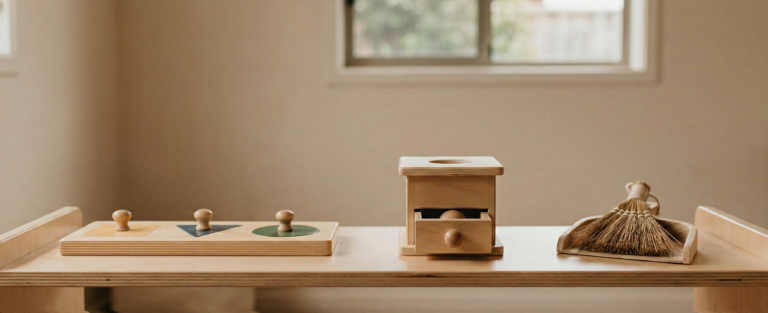
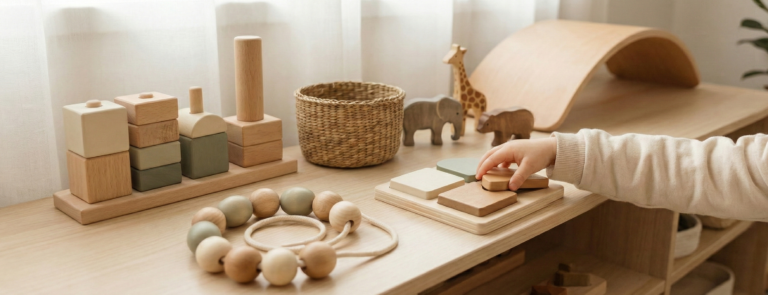
The Low Shelf
Why it works:
Materials on a low shelf communicate: “You can choose. You can access this independently. You are capable.”
How to set up:
- Low shelf at child height (IKEA Kallax works perfectly)
- 6-8 activities accessible (not more—see our guide: How Many Toys Does a Child Actually Need?)
- Each activity on its own tray or in its own basket
- Space between materials (not crowded)
Example 18-month-old shelf:
- Shape sorter
- Simple 4-piece knobbed puzzle
- Stacking bowls
- Basket with 4-5 balls (various sizes)
- Pegboard with pegs
- Basket with blocks
- Small basket with 2-3 board books
That’s enough. Everything else rotates from storage.
Rotation Prevents Overwhelm
Why rotation matters:
When materials are always available, they become invisible. When rotated, they feel new again.
How to rotate at 18 months:
- Keep 40-50% of toys in storage
- Swap 2-3 items every 1-2 weeks
- Observe what gets used—keep those accessible longer
- Rotate out mastered items or consistently ignored materials
See our complete guide: The Montessori Toy Rotation System
Realistic Expectations for 18 Months
Independent Play Duration
Realistic: 5-15 minutes of sustained focus on a single activity
What this looks like:
- 10 minutes working on a shape sorter
- 15 minutes stacking and knocking down blocks
- 8 minutes focused on a puzzle
- 12 minutes threading beads on and off
This assumes: Child is rested, fed, emotionally regulated, and you’re nearby (secure base).
Not realistic: 30+ minute independent play sessions. That comes later (ages 2-3+).
The Rhythm of Gross and Fine Motor
Expect alternation:
- 15 minutes of active climbing/running
- Then 10 minutes of focused fine motor work
- Then more active play
- Then quiet focus again
This back-and-forth is healthy. They’re integrating different systems, not being “difficult” or “unable to focus.”
Your Presence Required
18-month-olds play best when you’re nearby.
Not hovering. Not entertaining constantly. Just… present.
Your proximity allows:
- Their nervous system to relax
- Focus to develop
- Confidence to explore
- Security to take risks
This need for your presence is developmental, not a problem to fix.
The most independent 18-month-old still checks frequently: “Are you there?” When you are, they return to their work.
What Actually Matters
I’ve recommended specific toys. They’re good toys. They support development.
But here’s what I really want you to hear:
The materials facilitate development. Your presence creates the foundation.
Your 18-month-old becomes confident in their body because you stay calm when they climb.
They develop focus because you protect their concentration.
They persist through puzzles because you trust their process.
They explore creatively because you don’t direct every moment.
The climbing structure matters. Your calm while they climb matters more.
The shape sorter matters. Your patience during their struggle matters more.
The blocks matter. Your companionship during building matters more.
You are not just providing materials. You are providing secure attachment—the foundation everything else builds on.
The very best “toy” for an 18-month-old is a calm, present, trustworthy adult who:
- Stays nearby without hovering
- Watches with genuine interest
- Allows struggle without rescuing
- Protects focus without interrupting
- Provides companionship without directing
Be that person. Then provide good materials. In that order.
Everything I’ve recommended works better when paired with your warm, attentive presence.
That’s what actually supports development at 18 months.
Related Posts:
What Makes a Toy “Montessori”? (And What Doesn’t) – Understanding the principles behind these recommendations
Complete Montessori Toy Guide for 2-Year-Olds – What comes next developmentally
How Many Toys Does a Child Actually Need? – The case for simplicity
The Montessori Toy Rotation System – How to organize these materials
Disclaimer: This post contains Amazon affiliate links. When you purchase through these links, I may earn a small commission at no additional cost to you. I recommend these specific products because they genuinely support 18-month-old development and align with Montessori principles—but I want to be clear that your presence and attunement matter far more than any product.