You’re trying to choose toys for your toddler, and suddenly you’re drowning in philosophy.
Half the parenting internet is telling you to buy Montessori materials. The other half is rhapsodizing about Waldorf toys. And you’re standing there thinking: “Aren’t these basically the same thing? Natural materials, wooden toys, screen-free childhood?”
They’re not the same. But they’re also not as different as the internet makes them seem.
Here’s what actually distinguishes these two approaches—not in academic theory, but in what it means for the toys you choose, the environment you create, and how your child spends their time.
And here’s the relief: you don’t have to pick one and reject the other.
Let me show you what actually matters.
The 30-Second Version
If you’re just here for the quick answer:
Montessori emphasizes independence, real-world skills, and self-directed learning through carefully designed materials. Think: child-sized kitchen tools, realistic animal figures, puzzles that isolate specific skills.
Waldorf protects imagination, values rhythm and beauty, and delays academic focus in favor of creative play. Think: simple wooden blocks, silk play cloths, open-ended toys without predetermined purposes.
Where they overlap: Both value natural materials, reject plastic and electronics, emphasize hands-on learning, and trust children’s developmental unfolding.
Where they differ: Montessori leans practical and reality-based. Waldorf leans imaginative and fantasy-embracing. Montessori structures freedom. Waldorf protects childhood.
Can you mix them? Absolutely. Most families do.
Now let’s go deeper.
Where These Approaches Come From
Before we compare them, quick context on their origins—because their histories explain their different emphases.
Montessori: Observation-Based Method
Founded by: Dr. Maria Montessori, Italian physician and educator
When: Early 1900s
Core insight: Children learn best through direct sensory experience with purposefully designed materials
Maria Montessori observed children intensely in clinical and educational settings. She noticed patterns: they chose real work over pretend play. They concentrated deeply when materials matched their developmental needs. They became independent when the environment supported it.
She designed materials based on what she observed actually working—not on theory about what should work.
The result: A system focused on independence, practical life skills, and carefully structured freedom.
Waldorf: Philosophy-Based Method
Founded by: Rudolf Steiner, Austrian philosopher
When: 1919
Core insight: Childhood has distinct developmental stages that should be honored, not rushed
Rudolf Steiner developed Waldorf education based on his philosophical system (anthroposophy). He believed childhood, especially early childhood, should be protected from premature intellectualization. Young children learn through imitation, imagination, and rhythm—not academics.
He designed an approach that values artistic expression, natural rhythms, and developmental stages that unfold on their own timeline.
The result: A system focused on imagination, rhythm, and protecting the magic of childhood.
Different origins, different emphases—but surprisingly compatible in practice.
The Philosophical Differences That Actually Matter
Let’s break down what distinguishes these approaches in ways you’ll actually notice at home.
1. Reality vs. Imagination (Ages 0-6)
This is the biggest practical difference.
Montessori Approach:
Young children (under 6) need to understand reality before they can meaningfully engage with fantasy. Give them realistic representations of the world—accurate animal figures, real tools, books with photographs—so they build a solid foundation of what’s real.
Once they understand reality (around age 6+), imagination built on that foundation is rich and meaningful.
What this looks like:
- Realistic wooden animal figures (accurate colors, proportions)
- Books with real photographs, not illustrations
- Play kitchen with real pots (child-sized but functional)
- Tools that actually work (not pretend versions)
The reasoning: A child who doesn’t know what a real horse looks like can’t understand what makes a unicorn fantastical. Reality first, fantasy later.
Waldorf Approach:
Young children live in a world of imagination and wonder. Don’t rush them into cold rationality. Simple, open-ended toys that don’t dictate what they “are” allow children to project their own imagination freely.
Protect the dreamlike quality of early childhood. There’s time for reality later.
What this looks like:
- Simple wooden figures without defined features (a peg doll can be anyone)
- Play silks (can become anything—a river, a cape, a mountain)
- Gnomes, fairies, seasonal nature tables
- Toys without predetermined identities
The reasoning: Childhood is inherently magical. Imposing hard realism too early robs children of the imaginative richness that’s natural to this stage.
In practice:
This difference is less extreme than it sounds. Both approaches value simple, open-ended materials. The distinction is more about:
- Montessori: This wooden animal is a zebra (realistic representation)
- Waldorf: This wooden figure can be whatever the child imagines it to be today
Most families find a middle ground: Realistic figures for learning about actual animals, plus open-ended materials for imaginative play.
2. Structure vs. Rhythm
Montessori Approach:
Create a prepared environment where everything has a designated place. Children choose their work freely within this ordered space. The structure provides freedom—when materials are organized, accessible, and purposeful, children can act independently.
What this looks like:
- Low shelves with materials clearly visible
- Each activity on its own tray or in its own basket
- Everything has a specific spot (helps children manage their environment)
- Work cycle: child chooses activity, completes it, returns it, chooses next
The principle: Order in the environment creates freedom for the child.
Waldorf Approach:
Create a rhythmic daily flow where activities follow natural patterns. Children feel secure when they know what comes next. Rhythm (not rigid schedule) creates safety and trust.
What this looks like:
- Predictable daily rhythm: morning activities, outdoor time, rest, creative play
- Seasonal rhythms: activities that change with the seasons
- Weekly rhythms: bread-baking Tuesday, nature walk Friday, etc.
- Consistency in transitions (same song, same routine)
The principle: Rhythm in time creates security and allows the child to relax into the present moment.
In practice:
These aren’t contradictory. Most families need both:
- Montessori-style organized space (so children can find and use materials independently)
- Waldorf-style daily rhythm (so children feel secure and know what to expect)
You can have low, organized shelves (Montessori) AND a predictable daily flow (Waldorf). They complement each other.
3. Isolation of Skills vs. Holistic Experience
Montessori Approach:
Materials isolate one skill or concept at a time. A puzzle teaches shape matching. Threading beads teaches hand-eye coordination. Pouring practice teaches control.
By focusing on one thing, the child can master that specific skill without confusion.
What this looks like:
- Puzzles with one clear learning objective
- Pink tower (teaches size discrimination only)
- Sandpaper letters (isolates letter shape recognition)
- Practical life activities that break down complex tasks into components
The principle: Master one skill at a time. Build complexity gradually.
Waldorf Approach:
Activities engage the whole child—head, heart, and hands working together. Baking bread involves math (measuring), science (yeast rising), art (shaping), sensory experience (kneading), and practical skill.
Learning isn’t fragmented into isolated skills. It’s integrated and meaningful.
What this looks like:
- Seasonal activities that weave together multiple experiences
- Art projects that engage imagination, fine motor, and emotional expression simultaneously
- Story-telling that incorporates movement, rhythm, and moral themes
- Play that’s not directed toward specific skill acquisition
The principle: Children learn holistically. Don’t fragment experience into isolated components.
In practice:
Both have value. Some skills (like fine motor control) benefit from isolated practice. Other experiences (like baking together) are valuable precisely because they’re holistic.
Most families use both approaches: Specific skill-building materials when appropriate, and rich integrated experiences at other times.
4. Early Academics vs. Late Academics
Montessori Approach:
If a child shows readiness and interest, academic materials (letters, numbers) can be introduced as early as age 3-4. But always concrete and hands-on, never abstract or pressured.
Follow the child. If they’re interested, support it. If they’re not, wait.
What this looks like:
- Sandpaper letters (tactile, concrete letter learning)
- Number rods (physical representation of quantity)
- Moveable alphabet (composing words with physical letters)
The principle: Academic learning is fine when it’s concrete, self-directed, and child-initiated. Don’t force it, but don’t withhold it if the child is ready.
Waldorf Approach:
Delay formal academics until around age 6-7. Young children learn through play, imitation, and imagination—not through letters and numbers. Pushing academics too early can harm natural development.
Protect play. There’s time for academics later.
What this looks like:
- No letters or numbers in early childhood classrooms
- Focus on storytelling, art, music, movement
- Academic instruction begins in first grade (around age 6-7)
- Even then, introduced artistically (drawing letters, rhythmic counting)
The principle: Childhood isn’t preparation for life. It’s life. Don’t rush it.
In practice:
This is where families often diverge based on their own values. Some agree with Waldorf’s approach (no academics until 6+). Others appreciate Montessori’s “follow the child” philosophy (if they’re interested at 4, support it).
Both approaches agree: Don’t pressure, don’t force, don’t make learning abstract and disconnected. Where they differ is whether to offer academic materials at all in early childhood.
What This Means for Toy Selection
Theory is interesting. But you’re probably here because you’re trying to figure out what to actually buy.
Here’s how these philosophical differences translate to your playroom.
Toys Both Approaches Love
These materials align with both Montessori and Waldorf principles:
Simple Wooden Blocks
- Montessori perspective: Teaches spatial reasoning, balance, cause-and-effect
- Waldorf perspective: Open-ended, allows imagination, can become anything
- Both agree: Natural material, simple, timeless
Recommendation: Plain wooden unit blocks in natural wood finish
Natural Materials for Sensory Play
- Montessori perspective: Direct sensory experience teaches about textures, weights, properties
- Waldorf perspective: Natural materials connect children to the earth, provide rich sensory input
- Both agree: Pinecones, shells, smooth stones, wool, silk, wood
Recommendation: Baskets of natural loose parts for open exploration
Art Supplies
- Montessori perspective: Practical life skill (using tools), self-expression, fine motor development
- Waldorf perspective: Artistic expression is central to childhood, honors creativity
- Both agree: High-quality materials (beeswax crayons, watercolors, natural clay)
Recommendation: Quality art materials accessible on low shelf, rotated to prevent overwhelm
Musical Instruments
- Montessori perspective: Sensorial exploration of sound, cause-and-effect, cultural materials
- Waldorf perspective: Music and rhythm are foundational to development, singing and movement are essential
- Both agree: Real instruments (not electronic toys that play tinny songs)
Recommendation: Simple percussion instruments, pentatonic scale instruments (like xylophones)
Where Toy Choices Diverge
Realistic vs. Simple Figures
Montessori would choose:
Detailed, realistic animal figures—accurate colors, proportions, species identification
Why: Children learn what animals actually look like. Builds vocabulary and classification skills.
Example: Schleich or Safari Ltd realistic animal figures
Waldorf would choose:
Simple wooden animal figures without detailed features, or peg dolls that can become any character
Why: Open-ended forms allow imagination. The child projects meaning onto the toy rather than the toy dictating what it “is.”
Example: Ostheimer wooden animals (simplified but beautiful), Grapat peg dolls
Can you have both? Yes. Realistic figures for learning about actual animals. Simple figures for imaginative play.
Functional vs. Symbolic Play Kitchens
Montessori would choose:
Real kitchen tools at child size—actual metal pots, wooden spoons, real step stool for counter access
Why: Children want to do real work. Pretend kitchen misses the opportunity for actual contribution and skill-building.
Example: Child helps cook real food with real tools in the real kitchen (using a learning tower)
Waldorf would choose:
Simple wooden play kitchen with open-ended props that become whatever food the child imagines
Why: Pretend cooking develops imagination. The play is valuable in itself, not just as preparation for real tasks.
Example: Simple wooden play kitchen with fabric vegetables, wooden bowls and utensils
Can you have both? Yes. Real participation in actual cooking (Montessori) plus imaginative play kitchen (Waldorf) serve different purposes.
Puzzle Approach
Montessori would choose:
Puzzles that isolate shape matching, gradual difficulty progression, realistic images
Why: Clear learning objective, self-correcting, builds specific spatial reasoning skills
Example: Wooden knobbed puzzles with 3-6 pieces, realistic images (animals, vehicles, objects)
Waldorf would choose:
Simple wooden puzzles, but less emphasis overall. More focus on open-ended building and creative play.
Why: Puzzles are fine but not central. Imagination and creative play matter more than specific skill isolation.
Example: Simple chunky puzzles, but not as prominent in toy rotation
Can you have both? This isn’t really about mixing—just emphasis. Most homes have puzzles (Montessori approach) alongside open-ended play materials (Waldorf approach).
The Aesthetic Difference
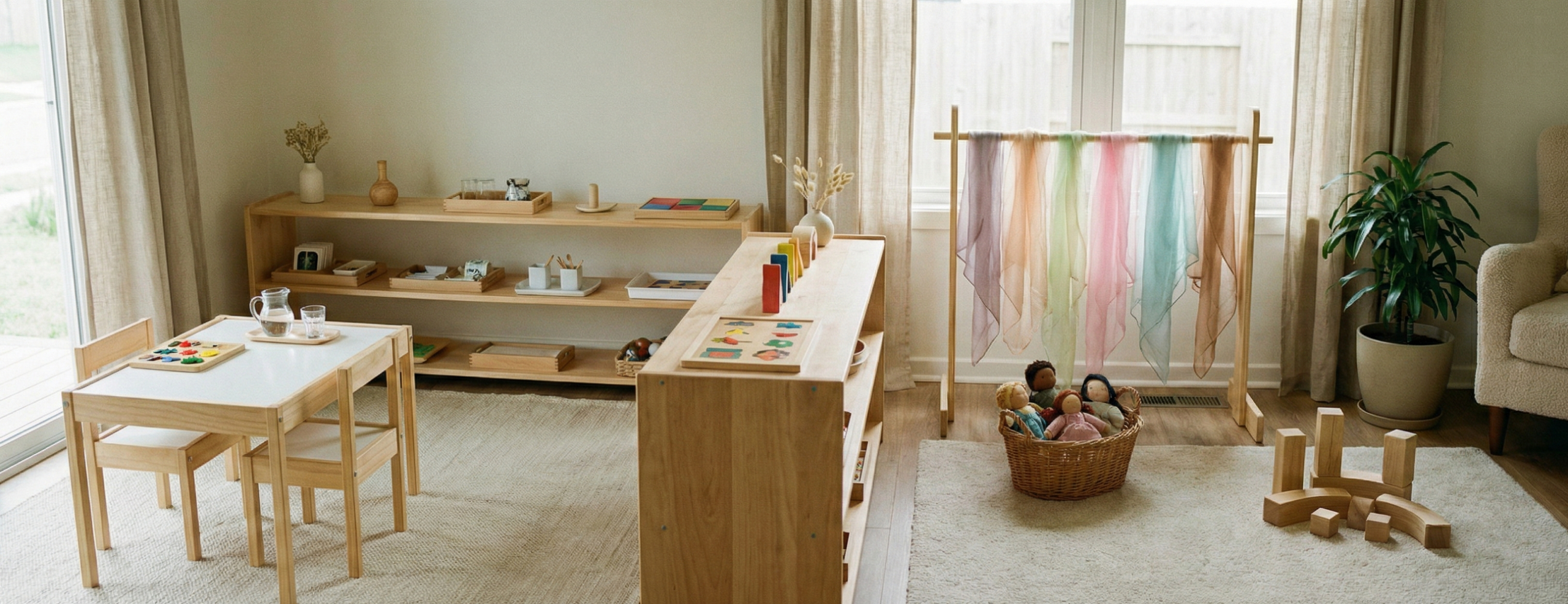
You can often guess whether a space is Montessori or Waldorf-influenced just by looking at it.
Montessori Aesthetic
Visual characteristics:
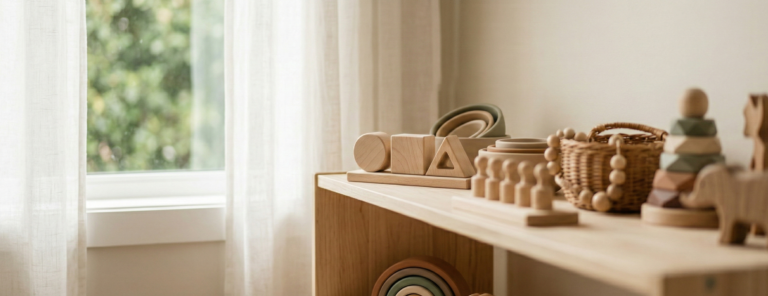
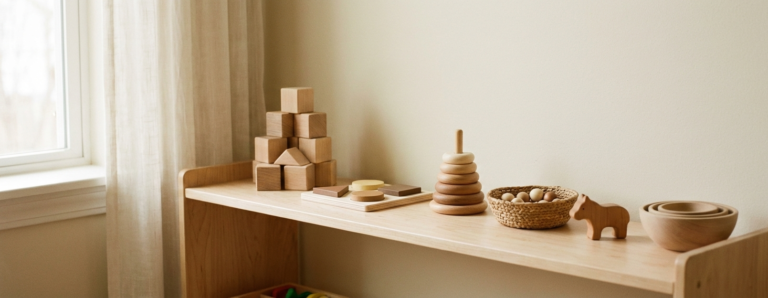
- Clean lines, organized shelves
- Materials clearly visible and accessible
- Natural wood, but also white, neutral tones
- Each material in its designated spot
- Minimal decoration (focus on materials, not ambiance)
- Practical focus (what’s displayed is meant to be used)
The feel: Ordered, calm, purposeful. Everything has a function and a place.
Color palette: Natural wood, white, neutrals, sometimes single clear colors (red, blue, yellow)
Waldorf Aesthetic
Visual characteristics:
- Soft, cozy, seasonal
- Play silks draped artistically
- Nature table with seasonal items
- Warmer lighting (no fluorescent)
- More fabric, softer textures
- Decorative elements (gnomes, seasonal crafts)
The feel: Warm, magical, home-like. Beauty and coziness are valued.
Color palette: Soft natural dyes, muted rainbow colors, earth tones, seasonal shifts
In practice:
Many families blend these aesthetics:
- Montessori-style organization (low shelves, materials accessible)
- Waldorf-style warmth (soft textiles, seasonal touches, cozy lighting)
There’s no rule saying you can’t have organized shelves (Montessori) with play silks and a nature table (Waldorf) in the same space.
Common Misconceptions
Let’s clear up some confusion you’ve probably encountered online.
Misconception 1: “Montessori doesn’t allow imagination”
Reality: Montessori doesn’t reject imagination. It suggests building imagination on a foundation of reality—especially for young children (under 6).
By age 6+, Montessori classrooms have rich imaginative work: storytelling, creative writing, theatrical presentations, art projects.
The distinction: Montessori prioritizes reality-based learning for young children, then transitions to imagination built on that understanding.
Misconception 2: “Waldorf rejects all modern life”
Reality: Waldorf education delays screen time and limits plastic toys, but this doesn’t mean rejecting modernity entirely.
Waldorf families use cars, live in cities, have jobs. The approach emphasizes protecting childhood rhythms and natural materials—not living in the past.
The distinction: Waldorf is selective about what aspects of modern life enter early childhood, not anti-modern across the board.
Misconception 3: “You have to choose one”
Reality: Most families blend principles from both. Very few people strictly adhere to one approach exclusively at home.
You can have:
- Organized Montessori shelves with Waldorf play silks
- Realistic animal figures alongside simple wooden blocks
- Real kitchen participation (Montessori) and a simple play kitchen (Waldorf)
Unless you’re running a licensed school with specific requirements, you can take what works and leave what doesn’t.
Misconception 4: “All wooden toys are Montessori and Waldorf”
Reality: Both approaches value natural materials, but not all wooden toys align with either philosophy.
A wooden electronic learning toy that plays alphabet songs isn’t Montessori or Waldorf just because it’s wooden.
What matters: The principles behind the material choices, not just the material itself.
Can You Actually Mix These Approaches?
Short answer: Yes. Most families do.
Long answer:
The principles aren’t contradictory—they emphasize different aspects of development. You can honor both:
From Montessori, take:
- Organized, accessible environment
- Real tools and practical life participation
- Respect for child’s independence
- Observation-based material selection
- Reality-based learning for young children
From Waldorf, take:
- Rhythmic daily flow
- Protection of imaginative play
- Warmth and beauty in the environment
- Natural seasonal rhythms
- No rush toward academics
What this looks like in practice:
Morning: Child helps prepare real breakfast (Montessori practical life), following a predictable morning rhythm (Waldorf).
Play time: Child chooses independently from low organized shelf (Montessori) that includes both realistic animals and open-ended play silks (Waldorf).
Afternoon: Outdoor play following seasonal rhythms (Waldorf), then focused work on a self-chosen puzzle (Montessori).
Evening: Shared meal, storytelling, predictable bedtime routine (Waldorf).
See how they weave together?
Which Approach Is “Better”?
Neither. They’re different lenses on childhood development.
Montessori might resonate more if you:
- Value early independence
- Appreciate clear structure and organization
- Want your child participating in real household work
- Like the idea of self-correcting materials
- Are comfortable with early academics if child-initiated
Waldorf might resonate more if you:
- Want to protect imaginative play
- Value rhythm and ritual in daily life
- Prefer delaying academics
- Are drawn to artistic and seasonal focus
- Want a warmer, cozier aesthetic
Most families find themselves somewhere in the middle:
- Structure AND rhythm
- Independence AND imagination
- Practical skills AND artistic expression
- Reality-based learning AND magical play
That’s not confusion. That’s wisdom.
What Actually Matters More Than Method
Here’s what I’ve observed after years in Montessori classrooms and consulting with families:
The specific philosophy matters less than:
1. Consistency in your approach
Pick principles that resonate, then apply them consistently. Children thrive on predictability.
2. Quality materials over quantity
A few good wooden toys (whether Montessori-style or Waldorf-style) beat forty cheap plastic toys.
3. Your presence and observation
Watching your child, noticing what engages them, adjusting based on what you see—this matters more than perfect adherence to any method.
4. Respect for your child’s development
Both approaches emphasize this. Trust your child’s unfolding. Don’t rush.
5. Natural materials and screen-free time
Both approaches agree on this. It’s foundational.
If you’re doing these things, you’re honoring the core wisdom of both approaches—regardless of which label you use.
Getting Started: What to Actually Do
If you’re trying to implement these ideas at home, start here:
This Week:
Choose 3-5 principles that resonate most:
- Do you care more about independence (Montessori) or rhythm (Waldorf)?
- Do you want realistic toys (Montessori) or open-ended (Waldorf)?
- Do you value organized shelves (Montessori) or cozy warmth (Waldorf)?
There’s no wrong answer. Pick what feels right for your family.
This Month:
Set up one aspect thoughtfully:
If leaning Montessori:
Create one low shelf with 6-8 materials clearly visible and accessible. Each material on its own tray or in its own basket.
If leaning Waldorf:
Establish one predictable daily rhythm (morning routine, bedtime routine, or weekly tradition like Friday nature walks).
If blending both:
Do both. Organized shelf (Montessori) with predictable rhythm (Waldorf).
This Quarter:
Observe what’s working:
- Is your child more engaged with realistic or open-ended toys?
- Does structure or rhythm create more security?
- What materials get used repeatedly?
Adjust based on what you’re seeing—not based on what any method “should” look like.
The Bottom Line
Montessori and Waldorf aren’t competing teams. They’re different emphases on childhood development.
Montessori asks: How can we help children become independent and capable?
Waldorf asks: How can we protect the magic and rhythm of childhood?
Both answer: Through natural materials, hands-on learning, respect for development, and trust in the child’s unfolding.
You don’t have to choose.
Take organized independence from Montessori. Take rhythmic warmth from Waldorf. Your child benefits from both.
The best approach is the one you can implement consistently with materials you can access and principles that resonate with your actual family.
Everything else is just internet philosophy debate.
Trust yourself. Observe your child. Adjust as needed.
That’s more Montessori and more Waldorf than perfect adherence to either method could ever be.
Related Posts:
What Makes a Toy “Montessori”? (And What Doesn’t) – Understanding Montessori principles for toy selection
Complete Montessori Toy Guide for 2-Year-Olds – Specific Montessori-aligned recommendations
How to Rotate Toys the Montessori Way (Less Overwhelm, More Engagement) – Organizing materials for maximum engagement
Do Montessori Toys Actually Work? What the Do Montessori Toys Actually Work? What to Look for Instead of Labels – Evidence behind these approaches
Disclaimer: This post contains Amazon affiliate links. When you purchase through these links, I may earn a small commission at no additional cost to you. I recommend materials that align with Montessori and/or Waldorf principles based on what genuinely supports child development—not based on which philosophy “owns” certain products.