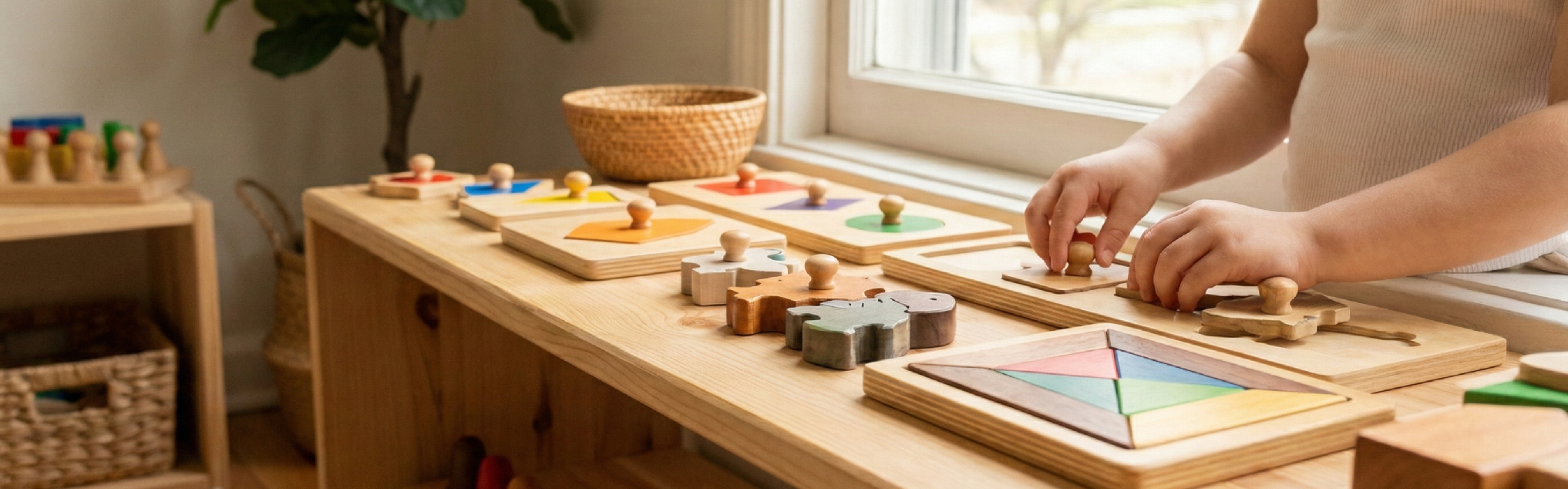
You watch your child complete the same puzzle for the fifteenth time this week.
It takes them thirty seconds now. No hesitation. No trial and error. Just a quick, confident placement.
You’re thinking: Is it time for something harder? Or will that frustrate them? How do you even know?
Here’s what most parents don’t realize: puzzles aren’t just about entertainment. They’re tracking cognitive development in real time.
When your child masters a puzzle completely—when it becomes automatic—that’s not the end. That’s the signal they’re ready for the next developmental step. Fine motor development plays a big role in determining that readiness.
Let me show you what that progression actually looks like.
Why Wooden Puzzles (And Why Progression Matters)
Before we get into stages, it helps to understand why wooden puzzles specifically and why progression can’t be rushed.
Why wooden over cardboard:
Weight provides feedback.
Wooden pieces have heft. They don’t slide around when placed. This physical feedback helps children understand when a piece is correctly positioned versus when it’s just sitting on top of the puzzle.
Durability withstands the learning process.
Learning involves dropping, testing, sometimes frustration. Wooden puzzles hold up to this without corners bending or pieces tearing. The material respects that learning is physical.
Sensory difference matters.
Wood feels substantial in small hands. It has texture, weight, temperature. These sensory inputs support the cognitive work happening – it’s one of the reasons natural materials are central to the Montessori approach. Cardboard doesn’t provide the same tactile information.
Self-correcting through quality fit.
Well-made wooden puzzles have precise cuts. Pieces fit or they don’t. This clarity helps children self-correct without adult intervention. Poor quality puzzles (where pieces sort of fit in multiple spots) undermine this learning.
Why progression matters:
Too easy = boredom and disengagement.
When a puzzle no longer requires thinking, it stops serving developmental purpose. Your child may still do it out of habit, but the cognitive work has ended.
Too hard = frustration and avoidance.
Puzzles beyond current capacity don’t “stretch” children—they overwhelm them. The child learns that puzzles feel bad, and they stop trying.
Just right = sustained focus and confidence building.
The sweet spot: achievable with effort. Requires concentration. Involves some trial and error. Results in satisfaction. This is where development happens.
Each level builds specific skills for the next.
Puzzle progression isn’t arbitrary. Each stage develops the spatial reasoning, fine motor control, and problem-solving strategies required for the next level. Skipping stages skips skill-building.
Summary Progression
| Stage | Age | Puzzle Type | Piece Count |
|---|---|---|---|
| 1 | 6-12 months | Single shape knob puzzles | 4 pieces |
| 2 | 12-18 months | Simple shape recognition | 5-6 pieces |
| 3 | 18-24 months | Multi-piece scenes | 9-12 pieces |
| 4 | 2-3 years | First complex puzzles | 8-12 pieces |
| 5 | 3-4 years | Interlocking puzzles | 24-36 pieces |
| 6 | 4-5+ years | Complex jigsaws | 60 pieces |
Stage 1: First Puzzles (6-12 Months)
Developmental Readiness:
Your child is ready for first puzzles when you observe:
- Can grasp objects with pincer grip (thumb and finger)
- Beginning to understand that objects fit in spaces
- Interested in putting things into containers
- Can focus on a task for 3-5 minutes
- Experimenting with cause and effect
This isn’t about age—it’s about observed capacity.
What First Puzzles Look Like:
Piece count: 4 large pieces
Key feature: Jumbo knobs for grasping
Visual design: High contrast shapes (circle, square, triangle, semi-circle)
Structure: Each piece fits one specific spot only
Learning mechanism: Self-correcting through shape
Product Example:
Adena Montessori Colorful Multiple-Shape Puzzles

What it includes:
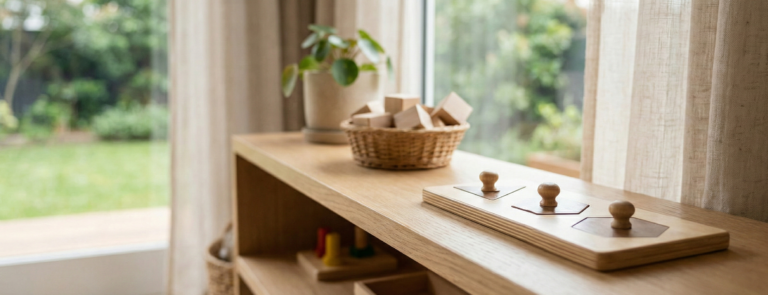
Four large wooden puzzle boards, each featuring one geometric shape (circle, square, triangle, semi-circle) with an oversized knob for grasping. Bright, contrasting colors make visual discrimination easy.
Why this works as a first puzzle:
The jumbo knobs support developing pincer grasp perfectly. Each shape is dramatically different—no subtle discrimination required. The child can see immediately whether the piece fits. The four separate boards mean you can introduce one at a time, preventing overwhelm.
What you’re supporting:
Hand-eye coordination, shape recognition, cause-and-effect understanding (this shape goes here, that one doesn’t), color awareness, completion satisfaction.
What makes this developmentally appropriate:
The isolation of one shape per board is classic Montessori. The child isn’t choosing between multiple options—they’re mastering one relationship at a time. This builds confidence through success.
Price: $18
Adena Montessori Shape Puzzles for 6-12 Months
What to Observe:
Can they grasp the knob?
If they’re struggling to pick up pieces, they may need more time developing pincer grasp with other activities (large beads to string, pegs to place in boards).
Do they try rotating the piece to fit?
This shows problem-solving. They understand the piece should fit but recognize their first attempt didn’t work. This trial-and-error is exactly what you want to see.
Do they return to it voluntarily?
If they complete it once and show no interest again, they may not be quite ready. If they return to it repeatedly, that’s developmental engagement.
Are they mouthing pieces?
Completely normal at this age. This is why material quality matters—these puzzles use non-toxic finishes safe for babies.
When to Move On:
You’ll know your child has mastered this stage when:
- They complete each puzzle quickly without trial and error
- They show no hesitation or thinking time
- They rarely return to them anymore
- They’re seeking more complex challenges elsewhere
Typical timeline: 2-4 weeks of daily interest, then readiness for the next step.
Don’t rush this. Those weeks of repetition are building neural pathways. Mastery matters.
Stage 2: Simple Shape Recognition (12-18 Months)
Developmental Leap:
Between first puzzles and this stage, your child has developed:
- More refined visual discrimination (can notice size differences)
- Better rotation skills (can turn pieces with more precision)
- Understanding that pieces can relate to each other
- Increased patience and sustained focus
- Beginning size relationship understanding
What These Puzzles Look Like:
Piece count: 5-6 pieces
Key feature: Still with knobs (fine motor support continues)
Visual design: Graduated sizes creating patterns
Structure: Pieces may relate to each other (size progression)
New challenge: Understanding relative size relationships
Product Examples:
Option 1: Boby Montessori Multiple Circle Puzzle Board

What it includes:
Five graduated circles in different sizes, each with a knob. The circles nest within each other, teaching size relationships through direct physical experience.
Why this is the right next step:
This introduces relative size understanding—bigger and smaller aren’t abstract concepts but physical realities the child discovers through manipulation. The self-correcting nature (larger circles won’t fit inside smaller ones) teaches without adult correction.
Additional learning:
Size discrimination, spatial relationships, order and sequence, and visual perception. The graduated sizing is classic Montessori sensorial material.
What’s developing:
Visual discrimination (noticing size differences), logical thinking (understanding that things have an order), fine-motor refinement, and problem-solving through trial and error.
Price: $16
Boby Montessori Circle Puzzle Board
Option 2: LOVEVERY Friends of All Shapes Puzzle

What it includes:
Six pieces featuring different shapes (circle, square, triangle, rectangle, semi-circle, oval) that fit into corresponding spaces on a wooden board. Each piece has a small knob.
Why this works at this stage:
More shape variety than first puzzles, but still one clear spot for each piece. The shapes are more complex than basic geometric forms—children must pay closer attention to angles and curves.
Design note:
LOVEVERY is known for developmentally appropriate design. This puzzle bridges the gap between first knobbed puzzles and more complex scene puzzles beautifully.
What’s developing:
Shape discrimination beyond basics, spatial reasoning, visual memory (remembering which shape goes where), fine motor control.
Price: $22
LOVEVERY Friends of All Shapes Puzzle
What You’ll Observe:
They’re starting to problem-solve systematically.
Instead of randomly trying every piece, they’re beginning to look at the shape first, then search for where it belongs.
They may not need the knobs anymore.
Some children at this stage start picking up pieces from the edges rather than using the knobs. This is fine—it shows increased fine motor control.
They’re getting faster.
What took 5 minutes initially now takes 2. That’s not just memorization—that’s increased cognitive processing speed and developing spatial memory.
When to Move On:
Signs of mastery:
- Completes puzzles confidently and independently
- No longer needs to test each piece in multiple spots
- Shows interest in more complex images beyond shapes
- Fine motor control is refined enough to manipulate pieces without knobs
Typical timeline: 4-8 weeks at this stage, sometimes longer. Some children stay here happily for months. That’s not a problem—it means they’re working at their level.
Stage 3: Multi-Piece Scenes (18-24 Months)
Developmental Capacity:
By this stage, your child has developed:
- Ability to manipulate puzzle pieces without knobs (improved fine motor)
- Understanding of scenes and context (these pieces relate to each other)
- Problem-solving through systematic trial and error
- Sustained focus for 10-15 minutes
- Understanding of completion (the picture is finished, no gaps)
What These Puzzles Look Like:
Piece count: 9-12 pieces
Key feature: May or may not have knobs (pegs becoming less necessary)
Visual design: Realistic animals or objects, detailed images
Structure: Individual pieces that don’t interlock yet
New challenge: Visual matching of detailed, realistic images
Product Example:
QUOKKA Wooden Animal Puzzles (3-Set)

What it includes:
Three separate puzzle boards featuring realistic animal illustrations. Each puzzle has 9-12 pieces showing various animals (farm animals, safari animals, ocean animals depending on set). Pieces have small pegs for handling.
Why this is the right progression:
The shift to realistic animal images (rather than simplified shapes) requires more sophisticated visual discrimination. Children must pay attention to details—the giraffe’s spots, the elephant’s trunk, the specific colors and patterns that distinguish each animal.
The learning shift:
This is where puzzles become about representation—these images stand for real things in the world. Language often explodes during this stage as children connect puzzle images to animals they’ve seen in books, at zoos, or in their environment.
What’s developing:
Visual discrimination of complex images, vocabulary expansion (animal names, body parts, habitats), categorization thinking (these are all animals, but different kinds), fine motor precision, sustained problem-solving.
Why three puzzles matter:
Variety prevents boredom. Children can choose based on interest, and having multiple puzzles at the same difficulty level allows for consolidation of skills before moving to the next stage.
Price: $22
QUOKKA Wooden Animal Puzzles 3-Set
If you’re looking for more options at this age, our complete guide to Montessori toys for 2-year-olds covers the full range of developmental toys for this stage.
What You’ll Notice:
Language integration:
“Where does the elephant go?” becomes a question they ask themselves. Puzzle time and language development are deeply connected at this stage.
Strategic thinking is emerging:
Your child might start with animals they recognize most easily, or work from one side of the puzzle to the other. They’re not just randomly trying pieces anymore—they’re developing approaches.
They’re checking the image:
Looking back and forth between the piece and the board, trying to figure out where it belongs before testing it. This is visualization—a huge cognitive leap.
Frustration might increase briefly:
More pieces and more visual complexity = more challenge. Some trial and error is productive. If frustration leads to giving up repeatedly, the puzzle might be slightly too advanced. Revisit knobbed puzzles temporarily.
When to Move On:
Mastery signals:
- Completes 12-piece realistic image puzzles with confidence
- Uses strategies (starting with certain animals, checking details)
- Sustained focus throughout completion
- Vocabulary includes most animals in the puzzles
- Actively seeking more challenge
Important: Don’t rush this stage. These realistic image puzzles build crucial observation skills and visual memory. The child needs strong image recognition before moving to interlocking puzzles.
Typical timeline: 3-6 months at this stage. This is where significant visual discrimination development happens.
Stage 4: First Complex Puzzles (2-3 Years)
Developmental Readiness:
This is a significant leap. Your child now has:
- Refined fine motor control (can manipulate smaller pieces)
- Strong visual discrimination (notices details and differences)
- Understanding of layered relationships (3D thinking emerging)
- Problem-solving strategies (systematic approaches)
- Increased frustration tolerance (can persist through genuine challenge)
What These Puzzles Look Like:
Piece count: 8-12 pieces
Key feature: May include layered or 3D elements
Visual design: Chunky, substantial pieces; realistic detailed images
Structure: Individual pieces, may stand upright, possibly layered
New challenge: Three-dimensional thinking, layering concepts
Product Examples:
Option 1: Wooden Montessori Animal Puzzles – Chunky Safari Set

What it includes:
Realistic, chunky wooden animal figures (lion, zebra, elephant, giraffe) that fit into corresponding spaces on a wooden board. Pieces are thick enough to stand independently for play after puzzle completion.
Why this works at this stage:
The chunky pieces require more sophisticated grasping and placement—they’re weighted and substantial. The realistic detailing (textures, accurate coloring) demands close visual attention. The fact that pieces can stand and be played with extends the activity beyond puzzle-solving into imaginative play.
The cognitive shift:
These aren’t just puzzles—they’re objects that represent real animals. This supports the understanding that representations can be manipulated and used in different ways. Puzzle pieces become play figures, which integrates problem-solving with creativity.
What’s developing:
Spatial reasoning in three dimensions, visual memory (remembering how animals look from different angles), fine motor precision with weighted objects, imaginative thinking, and vocabulary expansion.
Price: $19
Wooden Montessori Chunky Safari Animal Puzzle
Option 2: jojofuny Wooden Animal Puzzle – Elephant 3D

What it includes:
A multi-layered elephant puzzle where pieces stack on top of each other, creating a three-dimensional form. Each layer is a different color, helping children understand the sequence.
Why this is developmentally significant:
This introduces the concept of layering—pieces don’t just fit beside each other, they build on top of each other in a specific order. This is foundational for understanding three-dimensional space and sequential thinking.
The challenge:
Children must understand not just where pieces go, but in what order they must be placed. This requires planning and sequential thinking that earlier puzzles didn’t demand.
What’s developing:
Three-dimensional spatial reasoning, sequential thinking (this must come before that), color recognition and ordering, problem-solving through logical sequence, and fine motor control with stacking.
Why this matters:
Layered puzzles prepare children for more complex construction activities (block building, Magna-Tiles) by teaching that structures have layers and order. This is abstract thinking becoming concrete.
Price: $17
jojofuny Wooden Elephant 3D Layered Puzzle
What You’ll Observe:
Increased manipulation time:
Your child might spend time examining pieces before placement—turning them, looking at details, thinking about where they belong. This isn’t hesitation, it’s cognitive processing.
Testing and revising:
They try a placement, realize it’s not quite right, adjust. This self-correction without adult help is significant developmental progress.
Pride in completion:
There’s often visible satisfaction when these puzzles come together. They’ve mastered something genuinely challenging, and they know it.
Extended play:
With the chunky safari puzzle, children often play with the animals after completing the puzzle. This shows they understand the pieces represent real things, not just puzzle components.
When to Move On:
Mastery indicators:
- Completes both types (chunky and layered) confidently
- Understands three-dimensional concepts
- Can sequence layered pieces without trial and error
- Sustained focus for 15-20 minutes
- Actively seeking more complex challenges
Timeline: This stage often lasts 4-8 months. Three-dimensional thinking is complex. Let skills solidify fully before moving to interlocking puzzles with higher piece counts.
Stage 5: Interlocking Puzzles (3-4 Years)
Developmental Capacity:
Children ready for interlocking puzzles demonstrate:
- Strong fine motor control (can manipulate irregular shapes)
- Understanding of part-to-whole relationships
- Emerging strategy development (edges first, sorting by image)
- Patience with productive struggle
- Ability to sustain focus for 20-30 minutes
The best Montessori toys for 3-year-olds extend well beyond puzzles at this stage – fine motor toys, practical life activities, and open-ended building all complement interlocking puzzle work.
What These Puzzles Look Like:
Piece count: 24-36 pieces
Key feature: Pieces interlock (connect to each other)
Visual design: Detailed scenes or collections of related objects
Structure: Pieces fit together to create complete image
Challenge: Understanding how pieces relate spatially to adjacent pieces
Product Example:
Adena Montessori 3D Creative Wooden Puzzle Set – Turtle
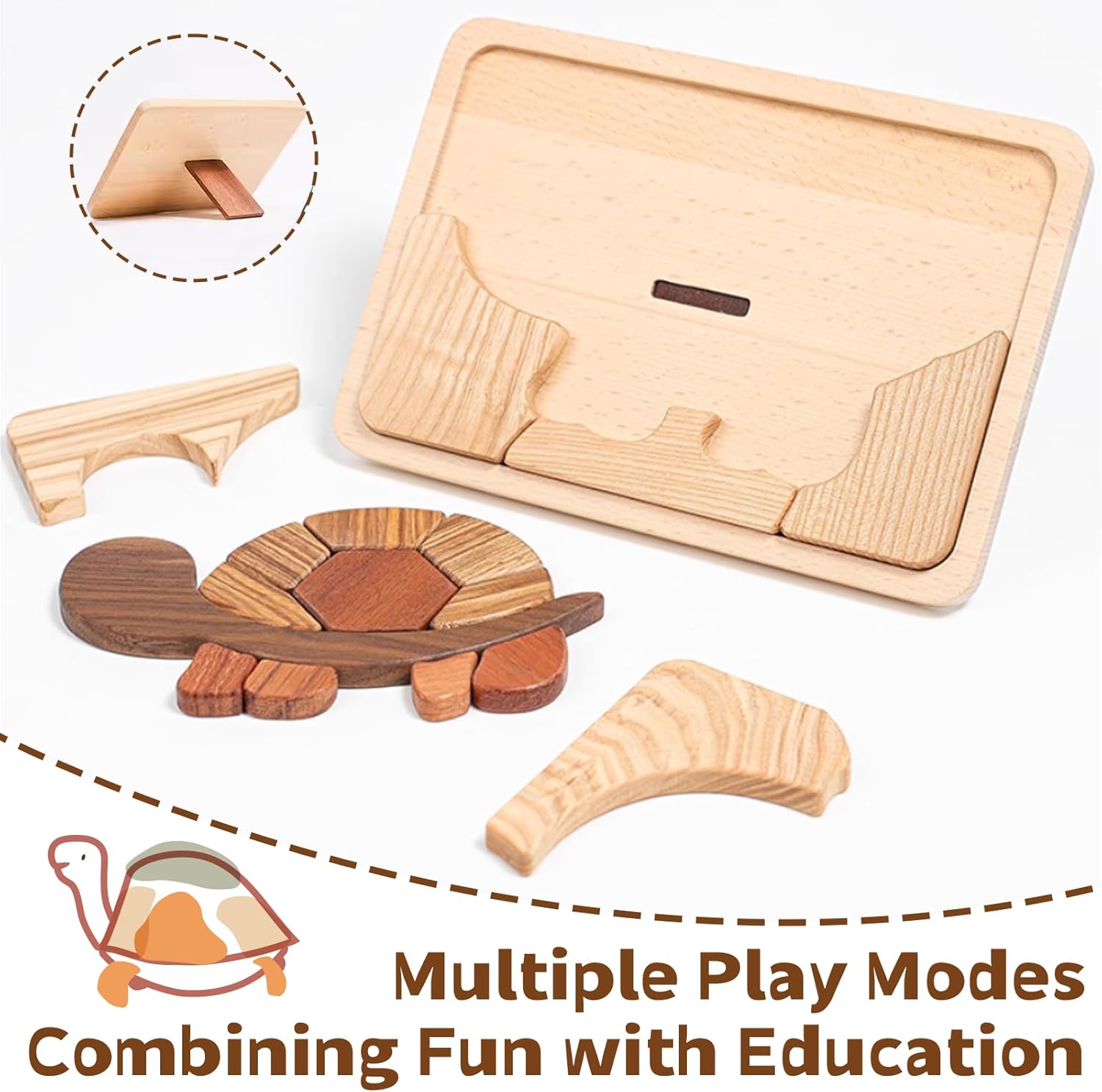
What it includes:
A wooden puzzle featuring a detailed turtle design with interlocking pieces. The three-dimensional aspect means pieces have depth and create a sculptural quality when assembled.
Why this is appropriate for this stage:
This bridges chunky standalone puzzles and traditional flat interlocking puzzles. The pieces connect to each other, but the substantial wooden construction and clear image make it less overwhelming than 50+ piece cardboard puzzles.
The cognitive leap:
Interlocking pieces require understanding that shapes must match on multiple sides—not just fitting into a space, but connecting to adjacent pieces. This demands spatial reasoning at a more abstract level.
What’s developing:
Abstract spatial reasoning, systematic problem-solving (testing piece orientations), visual memory (remembering what part of the image you’re looking for), pattern recognition, persistence through challenge.
Why wooden at this stage:
The weight and precision of wooden construction provides clear feedback. Pieces that fit click satisfyingly into place. Pieces that don’t fit are obviously wrong. This self-correcting quality supports independent problem-solving.
Price: $20
Adena Montessori 3D Wooden Turtle Puzzle
What You’ll Observe:
Strategy development:
Your child might start organizing pieces before beginning—sorting by color, separating edge pieces, grouping similar patterns. These strategies emerge through experience, not instruction.
Increased focus duration:
A puzzle that would have been abandoned in frustration months ago now holds attention for 20+ minutes. This is executive function development in action.
Pride in difficulty:
“This one has 30 pieces!” becomes something to celebrate rather than avoid. The challenge itself becomes rewarding.
Sometimes choosing easier puzzles:
On some days, your child might return to a mastered Stage 3 puzzle instead of tackling the challenging interlocking one. This isn’t regression—it’s self-regulation. They’re matching activity to their current energy and emotional state.
When to Move On:
Mastery signals:
- Completes 24-36 piece wooden interlocking puzzles confidently
- Uses strategies consistently
- Can work on puzzles independently for extended periods
- Actively seeking higher piece counts
- Shows interest in more detailed, complex images
Timeline: 6-12 months at this stage is completely normal. This is where children develop the foundations for genuinely complex puzzle-solving.
Stage 6: Complex Jigsaw Puzzles (4-5+ Years)
Developmental Capacity:
Children ready for 60-piece puzzles demonstrate:
- Strong visual discrimination (notice subtle color and pattern variations)
- Systematic problem-solving approaches that transfer across puzzles
- Sustained focus for 30+ minutes
- Comfort with productive struggle
- Pride in mastering genuine challenges
- Sometimes preference for working independently
What Complex Puzzles Look Like:
Piece count: 60 pieces
Key feature: Traditional jigsaw interlocking, smaller pieces
Visual design: Detailed, colorful scenes with visual complexity
Structure: Standard cardboard jigsaw construction
Challenge: Requires strategy, visual memory, sustained persistence
Product Examples:
Option 1: Ravensburger Puppy Party 60-Piece Puzzle

What it includes:
Sixty interlocking pieces creating a detailed scene of playful puppies. High-quality Ravensburger construction means pieces fit precisely and durably.
Why this is appropriate for this stage:
The image has enough detail and color variation to make piece placement challenging but solvable. Multiple puppies in different positions require careful attention to distinguish between similar-looking pieces.
What makes Ravensburger quality matter:
At higher piece counts, precision in cutting becomes critical. Pieces that almost-but-not-quite fit create false positives that derail problem-solving. Ravensburger’s manufacturing standards mean pieces either fit definitively or they don’t—providing clear feedback.
What’s developing:
Advanced spatial reasoning, sophisticated problem-solving strategies (creating small sections then connecting them), visual memory (remembering what you’re looking for while searching through 60 pieces), sustained attention, persistence through complexity.
Theme appeal:
Puppies are inherently engaging for this age group, which supports sustained interest through the challenge.
Price: $18
Ravensburger Puppy Party 60-Piece Puzzle
Option 2: Ravensburger Rainforest Animals 60-Piece Puzzle

What it includes:
Sixty pieces creating a detailed rainforest scene with various animals hidden throughout the lush environment.
Why this adds challenge:
The rainforest scene has more visual complexity than the puppy puzzle—lots of green foliage with subtle variations, animals partially hidden, intricate details. This requires closer attention and more sophisticated piece discrimination.
The educational element:
Finding hidden animals adds a seek-and-find component beyond puzzle assembly. Children often study the completed puzzle extensively, discovering new details they missed during construction.
What’s developing:
Visual scanning (searching through complex imagery for specific elements), attention to detail, ability to distinguish subtle color variations (different greens in foliage), category thinking (animals vs. plants), sustained engagement with complex visual information.
When to use this:
After the puppy puzzle is mastered, or for children particularly interested in animals and nature themes.
Price: $13
Ravensburger Rainforest Animals 60-Piece Puzzle
Strategy Development:
By this stage, most children have developed personal puzzle approaches. You might observe:
Sorting systems:
- Edge pieces first (creating the frame)
- Sorting by dominant color or pattern
- Grouping pieces by image section (all the puppies, all the grass)
- Organizing by piece shape
Visual strategies:
- Studying the reference image carefully before starting
- Looking for distinctive features (eyes, patterns, unique colors)
- Working section by section rather than randomly
- Connecting smaller completed sections into larger ones
Cognitive strategies:
- Testing logical placements based on image before trying physically
- Remembering where previously tried pieces didn’t fit
- Using process of elimination systematically
These strategies aren’t taught—they emerge through experience. Your child’s brain is learning how to learn.
Working Over Multiple Sessions:
At this stage, 60-piece puzzles might not get completed in one sitting. This is developmentally appropriate and valuable.
This teaches:
- Task resumption (remembering where you left off)
- Long-term goal orientation (working toward completion over days)
- Delayed gratification (satisfaction comes eventually, not immediately)
- Maintaining interest and commitment over time
Supporting this:
- Provide space where partially completed puzzles can stay undisturbed
- Don’t pressure completion (“We need to finish this today”)
- Show interest when your child returns to it
- Celebrate completion whenever it happens, even if it’s days later
What You’ll Notice:
Increased independence:
Your child may prefer working on puzzles alone, especially during initial stages. This isn’t rejection—it’s concentration. The cognitive work requires focus without distraction. Respect that.
Pride in difficulty:
“This one has 60 pieces!” becomes a point of pride. The challenge itself has become intrinsically rewarding, not something to avoid.
Preference development:
Your child might express preferences for certain types of images or puzzle styles. Honor these preferences—they support sustained engagement.
Self-regulation:
Some days they tackle the hard puzzle. Some days they return to a mastered 24-piece one. This shows sophisticated understanding of their own capacity and energy levels. This is emotional intelligence developing.
When to Move Beyond:
Eventually, your child may be ready for 100+ piece puzzles. Signs include:
- Completing 60-piece puzzles with relative ease
- Actively seeking “harder” puzzles
- Sustained focus approaching 45+ minutes
- Strong strategies that transfer to new puzzles immediately
- Interest in more complex, detailed images
At this point, wooden construction becomes less critical than piece count and image complexity. Cardboard puzzles offer more variety at higher piece counts and typically cost less, making experimentation more accessible.
Frequently Asked Questions
What age should a child do a 24-piece puzzle? Most children are ready for 24-piece interlocking puzzles around age 3 to 3.5, once they’ve developed strong fine motor control and can sustain focus for 20+ minutes. That said, readiness varies — if your child is confidently completing 12-piece puzzles and actively seeking more challenge, that’s a better indicator than age alone.
What age should a child do a 50-piece puzzle? Children typically move toward 50-piece puzzles between ages 4 and 5, after spending several months building confidence with 24-36 piece interlocking puzzles. The key readiness signs are consistent use of strategies (sorting edges, grouping by color), sustained focus for 30+ minutes, and a genuine appetite for more complex challenges.
How many puzzle pieces is right for a 2-year-old? At age 2, most children are working through Stage 3 or Stage 4 in the progression above — meaning 9 to 12-piece scene puzzles or chunky 8-12 piece puzzles with realistic images. Simple knobbed puzzles with 4-6 pieces may still be in rotation too, especially for focused independent play. Piece count matters less than whether the puzzle matches what you’re observing in your child.
How many puzzle pieces is right for a 3-year-old? Three-year-olds are often transitioning from chunky standalone puzzles (8-12 pieces) into their first interlocking puzzles (24-36 pieces). Many 3-year-olds are still solidifying Stage 4 skills, and that’s completely appropriate — this stage can last 4-8 months. When they’re completing chunky puzzles confidently and seeking harder challenges, that’s the signal to introduce interlocking pieces.
What if my child seems behind the typical puzzle progression timeline? The timelines in this guide reflect general patterns, not rigid milestones. Children develop at different rates, and puzzle engagement varies a lot based on how much exposure they’ve had. If your child has had limited access to puzzles, starting at an earlier stage and progressing quickly is completely normal. If you have concerns about broader developmental delays, speaking with your pediatrician is always a good idea — but puzzle timing alone is rarely cause for concern.
Is it okay if my child skips puzzle stages? Some children do move through certain stages quickly, especially if they’ve had lots of puzzle exposure or show strong spatial reasoning naturally. What you want to avoid is skipping to a level that creates frustration rather than productive challenge. If a child abandons puzzles repeatedly, that’s usually a sign the current puzzle is too difficult — stepping back a stage and rebuilding confidence tends to work better than pushing forward.
The progression you’ve just read isn’t theoretical—it’s how spatial reasoning develops through direct experience.
Each stage builds the cognitive capacity required for the next. The puzzles are just the tools. The real work—the neural pathway development, the problem-solving strategy formation, the frustration tolerance building—is happening inside your child’s growing mind.
Your role is to observe, select appropriately, and trust the process.
You’re doing that work now.